Akhirome Ehiole, Walton Nephi A, Nogee Julie M, Jay Patrick Y
Department of Pediatrics, Washington University School of Medicine.
Circ J. 2017 Apr 25;81(5):629-634. doi: 10.1253/circj.CJ-16-1343. Epub 2017 Apr 1.
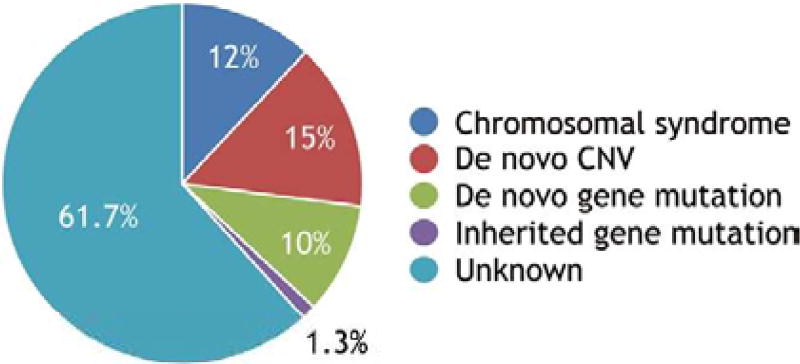
Twenty years ago, chromosomal abnormalities were the only identifiable genetic causes of a small fraction of congenital heart defects (CHD). Today, a de novo or inherited genetic abnormality can be identified as pathogenic in one-third of cases. We refer to them here as monogenic causes, insofar as the genetic abnormality has a readily detectable, large effect. What explains the other two-thirds? This review considers a complex genetic basis. That is, a combination of genetic mutations or variants that individually may have little or no detectable effect contribute to the pathogenesis of a heart defect. Genes in the embryo that act directly in cardiac developmental pathways have received the most attention, but genes in the mother that establish the gestational milieu via pathways related to metabolism and aging also have an effect. A growing body of evidence highlights the pathogenic significance of genetic interactions in the embryo and maternal effects that have a genetic basis. The investigation of CHD as guided by a complex genetic model could help estimate risk more precisely and logically lead to a means of prevention.
二十年前,染色体异常是一小部分先天性心脏病(CHD)仅有的可识别遗传病因。如今,在三分之一的病例中可确定新发或遗传的基因异常具有致病性。我们在此将其称为单基因病因,因为这种基因异常具有易于检测的显著效应。那么另外三分之二的病因该如何解释呢?本综述探讨了复杂的遗传基础。也就是说,单个可能几乎没有或完全没有可检测效应的基因突变或变异组合会导致心脏缺陷的发病机制。胚胎中直接作用于心脏发育途径的基因受到了最多关注,但通过与代谢和衰老相关途径建立妊娠环境的母体基因也有影响。越来越多的证据凸显了胚胎中遗传相互作用以及具有遗传基础的母体效应的致病意义。以复杂遗传模型为指导对先天性心脏病进行研究,有助于更精确地估计风险,并合理地找到预防方法。