Tu Min-Chien, Lo Chung-Ping, Huang Ching-Feng, Hsu Yen-Hsuan, Huang Wen-Hui, Deng Jie Fu, Lee Yung-Chuan
Department of Neurology, Taichung Tzu Chi Hospital, Buddhist Tzu Chi Medical Foundation, Taichung, Taiwan.
Department of Radiology, Taichung Tzu Chi Hospital, Buddhist Tzu Chi Medical Foundation, Taichung, Taiwan.
PLoS One. 2017 Apr 7;12(4):e0175143. doi: 10.1371/journal.pone.0175143. eCollection 2017.
To describe and compare diffusion tensor imaging (DTI) parameters between patients with subcortical ischemic vascular disease (SIVD) and Alzheimer's disease (AD) diagnosed using structuralized neuropsychiatric assessments, and investigate potential neuronal substrates related to cognitive performance.
Thirty-five patients with SIVD, 40 patients with AD, and 33 cognitively normal control (NC) subjects matched by age and education level were consecutively recruited and underwent cognitive function assessments and DTI examinations. Comparisons among these three subgroups with regards to cognitive performance and DTI parameters including fractional anisotropy (FA) and mean diffusivity (MD) values were performed. Partial correlation analysis after controlling for age and education was used to evaluate associations between cognitive performance and DTI parameters.
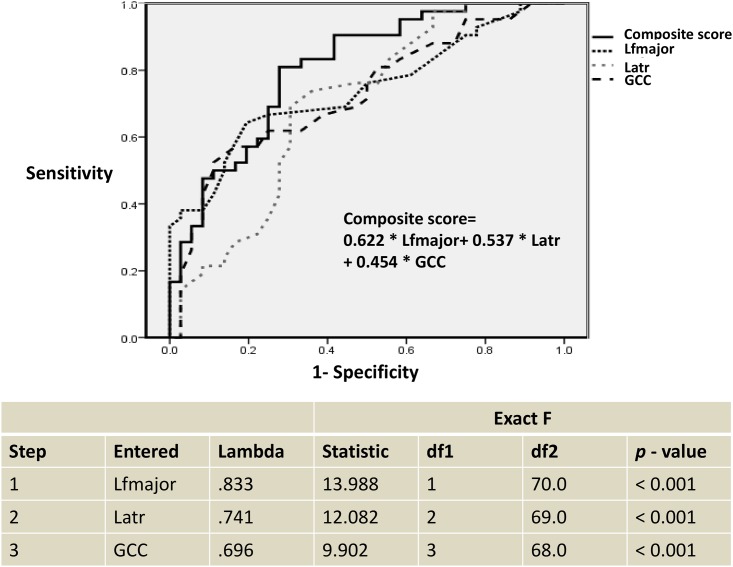
With regards to cognitive performance, the patients with SIVD had lower total scores in frontal assessment battery (FAB) compared to those with AD (p < 0.05) in the context of comparable Mini-Mental Status Examination and Cognitive Abilities Screening Instrument scores. With regards to DTI parameters, there were more regions of significant differences in FA among these three subgroups compared with MD. Compared with NC group, the patients with SIVD had significant global reductions in FA (p < 0.001 ~ 0.05), while significant reductions in FA among the patients with AD were regionally confined within the left superior longitudinal fasciculus, genu and splenium of the corpus callosum, and bilateral forceps major, and the anterior thalamic radiation, uncinate fasciculus, and cingulum of the left side (p < 0.01 ~ 0.05). Analysis of FA values within the left forceps major, left anterior thalamic radiation, and genu of the corpus callosum revealed a 71.8% overall correct classification (p < 0.001) with sensitivity of 69.4%, specificity of 73.8%, positive predictive value of 69.4%, and negative predictive value of 73.8% in discriminating patients with SIVD from those with AD. In combined analysis of the patients with SIVD and AD (n = 75), the total FAB score was positively correlated with FA within the bilateral forceps minor, genu of the corpus callosum, left forceps major, left uncinate fasciculus, and right inferior longitudinal fasciculus (p = 0.001 ~ 0.038), and inversely correlated with MD within the right superior longitudinal fasciculus, genu and body of the corpus callosum, bilateral forceps minor, right uncinate fasciculus, and right inferior longitudinal fasciculus (p = 0.003 ~ 0.040).
Our findings suggest the effectiveness of DTI measurements in distinguishing patients with early-stage AD from those with SIVD, with discernible changes in spatial distribution and magnitude of significance of the DTI parameters. Strategic FA assessments provided the most robust discriminative power to differentiate SIVD from AD, and FAB may serve as an additional cognitive marker. We also identified the neuronal substrates responsible for FAB performance.
使用结构化神经精神评估方法描述并比较皮质下缺血性血管病(SIVD)患者与阿尔茨海默病(AD)患者之间的扩散张量成像(DTI)参数,并研究与认知表现相关的潜在神经基质。
连续招募35例SIVD患者、40例AD患者以及33例年龄和教育水平相匹配的认知正常对照(NC)受试者,进行认知功能评估和DTI检查。对这三个亚组在认知表现和DTI参数(包括分数各向异性(FA)和平均扩散率(MD)值)方面进行比较。在控制年龄和教育因素后进行偏相关分析,以评估认知表现与DTI参数之间的关联。
在认知表现方面,在简易精神状态检查表和认知能力筛查工具得分相当的情况下,SIVD患者的额叶评估量表(FAB)总分低于AD患者(p<0.05)。在DTI参数方面,与MD相比,这三个亚组之间FA存在更多显著差异的区域。与NC组相比,SIVD患者的FA整体显著降低(p<0.0010.05),而AD患者的FA显著降低主要局限于左侧上纵束、胼胝体膝部和压部以及双侧主要钳状体,以及左侧丘脑前辐射、钩束和扣带(p<0.010.05)。对左侧主要钳状体、左侧丘脑前辐射和胼胝体膝部内的FA值进行分析显示,在区分SIVD患者与AD患者时,总体正确分类率为71.8%(p<0.001),敏感性为69.4%,特异性为73.8%,阳性预测值为69.4%,阴性预测值为73.8%。在SIVD和AD患者(n=75)的联合分析中,FAB总分与双侧小钳状体、胼胝体膝部、左侧主要钳状体、左侧钩束和右侧下纵束内的FA呈正相关(p=0.0010.038),与右侧上纵束、胼胝体膝部和体部、双侧小钳状体、右侧钩束和右侧下纵束内的MD呈负相关(p=0.0030.040)。
我们的研究结果表明DTI测量在区分早期AD患者与SIVD患者方面是有效的,DTI参数在空间分布和显著程度上有明显变化。策略性的FA评估在区分SIVD与AD方面具有最强的鉴别力,FAB可作为一个额外的认知标志物。我们还确定了与FAB表现相关的神经基质。