Naz Arshi, Jamal Muhammad Younus, Amanat Samina, Din Ujjan Ikram, Najmuddin Akber, Patel Humayun, Raziq Fazle, Ahmed Nisar, Imran Ayisha, Shamsi Tahir Sultan
Department of Thrombosis and Hemostasis, National Institute of Blood Diseases and Bone Marrow Transplantation, ST 2/A, Block 17, Gulshan-e-Iqbal, KDA Scheme 24, Karachi, Pakistan.
Department of Hematology, Pakistan Atomic Energy Commission Hospital, Islamabad, Pakistan.
Orphanet J Rare Dis. 2017 Apr 7;12(1):66. doi: 10.1186/s13023-017-0620-6.
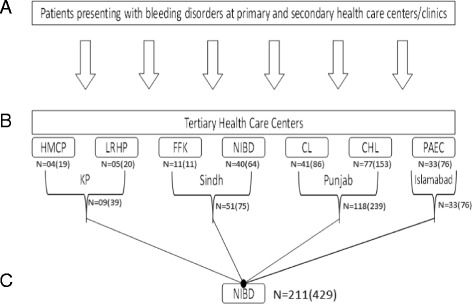
Autosomal recessive bleeding disorders (ARBDs) include deficiencies of clotting factors I, II, V, VII, X, XI, XIII, vitamin K dependent clotting factors, combined factor V & VIII, Von Willebrand Disease (vWD) type 3, Glanzmann's thrombasthenia (GT) and Bernard-Soulier syndrome. Patients with primary bleeding disorders from all the major provincial capitals of Pakistan were screened for ARBDs. Prothrombin (PT), activated partial thromboplastin time (APTT), bleeding time (BT) and fibrinogen levels were measured. Cases with isolated prolonged APTT were tested for factors VIII and IX using factor assays This was followed by FXI:C level assessment in cases with normal FVIII and FIX levels. vWD was screened in patients with low FVIII levels. Factors II, V and X were tested in patients with simultaneous prolongation of PT and APTT. Peripheral blood film examination and platelet aggregation studies were performed to assess platelet disorders. Urea clot solubility testing was done to detect Factor XIII levels where platelet function tests were normal. Descriptive analysis was done using SPSS version 16.
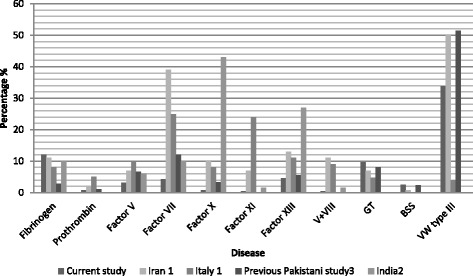
Of the 429 suspected bleeding disorder patients, 148 (35%) were diagnosed with hemophilia A and 211 (49.1%) patients had ARBDs. 70 patients (16.3%) remained undiagnosed. Out of 211 patients with ARBD; 95 (33.8%) had vWD type 3. Fibrinogen deficiency was found in 34 patients (12%), GT in 27 (9.6%), factor XIII deficiency in 13 (4.6%), factor VII deficiency in 12 (4.3%), factor V deficiency in 9 (3.2%). Eight patients (2.8%) had vitamin K-dependent clotting factor deficiency, Bernard-Soulier syndrome was diagnosed in seven patients (2.5%), factor X deficiency in 2 (0.7%), factor II deficiency in 2 (0.7%), factor XI deficiency and combined factor V and VIII deficiency in 1 (0.4%) patient each.
vWD type 3 was the most common ARBD found in our sample of patients in Pakistan, followed by fibrinogen deficiency and GT in respective order.
常染色体隐性遗传性出血性疾病(ARBDs)包括凝血因子I、II、V、VII、X、XI、XIII、维生素K依赖凝血因子、V和VIII联合缺乏、3型血管性血友病(vWD)、血小板无力症(GT)以及巨大血小板综合征。对来自巴基斯坦所有主要省会城市的原发性出血性疾病患者进行了ARBDs筛查。检测了凝血酶原(PT)、活化部分凝血活酶时间(APTT)、出血时间(BT)和纤维蛋白原水平。对孤立性APTT延长的病例使用因子检测法检测因子VIII和IX。随后,对FVIII和FIX水平正常的病例进行FXI:C水平评估。对FVIII水平低的患者进行vWD筛查。对PT和APTT同时延长的患者检测因子II、V和X。进行外周血涂片检查和血小板聚集研究以评估血小板疾病。在血小板功能试验正常的情况下进行尿素凝块溶解度试验以检测因子XIII水平。使用SPSS 16版进行描述性分析。
在429例疑似出血性疾病患者中,148例(35%)被诊断为血友病A,211例(49.1%)患者患有ARBDs。70例患者(16.3%)仍未确诊。在211例ARBD患者中;95例(33.8%)患有3型vWD。34例患者(12%)发现纤维蛋白原缺乏,27例(9.6%)患有GT,13例(4.6%)患有因子XIII缺乏,12例(4.3%)患有因子VII缺乏,9例(3.2%)患有因子V缺乏。8例患者(2.8%)患有维生素K依赖凝血因子缺乏,7例患者(2.5%)被诊断为巨大血小板综合征,2例(0.7%)患有因子X缺乏,2例(0.7%)患有因子II缺乏,各有1例(0.4%)患者患有因子XI缺乏和V与VIII联合缺乏。
在我们的巴基斯坦患者样本中,3型vWD是最常见的ARBD,其次依次是纤维蛋白原缺乏和GT。