Ohki Takamasa, Kondo Mayuko, Karasawa Yuki, Kawamura Satoshi, Maeshima Shuuya, Kojima Kentaro, Seki Michiharu, Toda Nobuo, Shioda Yoshinobu, Tagawa Kazumi
Department of Gastroenterology, Mitsui Memorial Hospital, Tokyo, Japan.
Department of Surgery, Shioda Hospital, Katsuura City, Japan.
Adv Ther. 2017 May;34(5):1097-1108. doi: 10.1007/s12325-017-0524-9. Epub 2017 Apr 7.
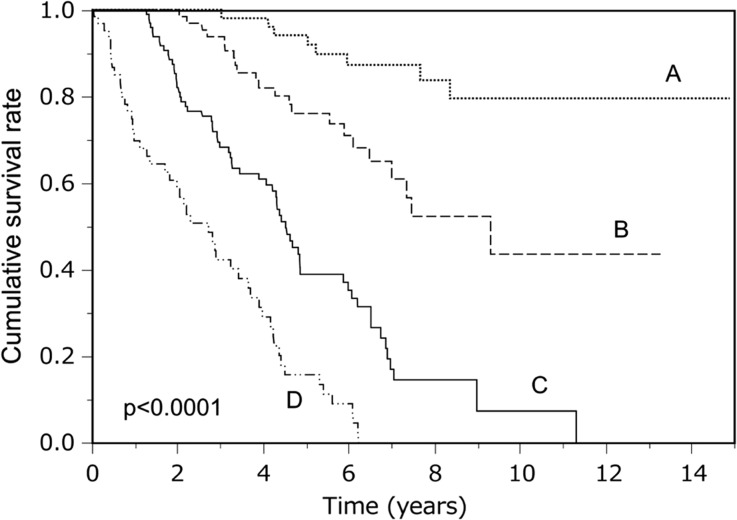
Transcatheter arterial chemoembolization (TACE) is the first-line treatment for intermediate stage hepatocellular carcinoma (HCC) and prolongs survival in HCC patients. However, repeated TACE results in diminished therapeutic response. In addition, the superiority of sorafenib to TACE monotherapy or combined therapy in patients with HCC is still controversial. The prognosis of HCC has many variables and, thus, the effect of a specific treatment is difficult to evaluate. The frequency of treatments per year (FT rate) used in this study was obtained by dividing the total number of radiofrequency ablations and TACE or transcatheter arterial infusion treatments by the years of survival. The aim of this study was to evaluate the overall survival (OS) of TACE versus sorafenib using the FT rate.
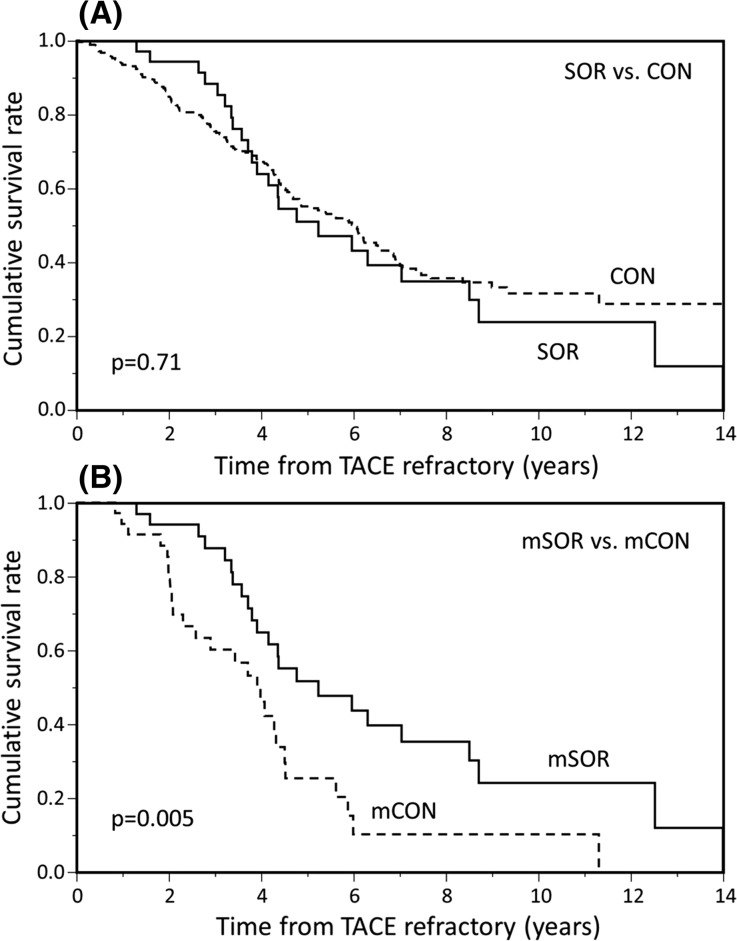
We compared the OS of patients with recurrence of HCC receiving repeated TACE monotherapy (CON) with those receiving therapy switched from TACE to sorafenib (SOR). In addition, a one-to-one FT rate matching cohort consisting of matched SOR (mSOR) and matched CON (mCON) was determined using the propensity score matching method, and OS in the cohort was evaluated. Factors influencing survival were evaluated using Cox proportional hazard regression analysis in all patients and the FT rate matched cohort.
In the FT rate matched cohort, the cumulative survival rate was significantly higher in the mSOR group compared with the mCON group. Multivariate regression analysis of the FT rate matched cohort showed the FT rate and sorafenib to be significant variables for survival with a hazard ratio (HR) of 2.86 (p < 0.001) and 0.42 (p = 0.008), respectively.
Early switching from TACE to sorafenib therapy may prolong OS in HCC patients unresponsive to TACE. The present study indicates that the FT rate is potentially a useful index in evaluating the outcome for patients at various stages and treatment regimens.
Bayer Yakuhin, Ltd.
经动脉化疗栓塞术(TACE)是中期肝细胞癌(HCC)的一线治疗方法,可延长HCC患者的生存期。然而,重复进行TACE会导致治疗反应减弱。此外,索拉非尼在HCC患者中相对于TACE单药治疗或联合治疗的优势仍存在争议。HCC的预后有许多变量,因此,特定治疗的效果难以评估。本研究中使用的每年治疗频率(FT率)是通过将射频消融和TACE或经动脉灌注治疗的总数除以生存年数获得的。本研究的目的是使用FT率评估TACE与索拉非尼的总生存期(OS)。
我们比较了接受重复TACE单药治疗(CON)的HCC复发患者与接受从TACE转换为索拉非尼(SOR)治疗的患者的OS。此外,使用倾向评分匹配方法确定了由匹配的SOR(mSOR)和匹配的CON(mCON)组成的一对一FT率匹配队列,并评估了队列中的OS。在所有患者和FT率匹配队列中,使用Cox比例风险回归分析评估影响生存的因素。
在FT率匹配队列中, mSOR组的累积生存率显著高于mCON组。FT率匹配队列的多变量回归分析显示,FT率和索拉非尼是生存的显著变量,风险比(HR)分别为2.86(p <0.001)和0.42(p = 0.008)。
对于对TACE无反应的HCC患者,早期从TACE转换为索拉非尼治疗可能会延长OS。本研究表明,FT率可能是评估不同阶段和治疗方案患者预后的有用指标。
拜耳药业株式会社