Bhardwaj Vandana, Malhotra Poonam, Hasija Suruchi, Chowdury Ujjwal Kumar, Pangasa Neha
Department of Cardiac Anaesthesia, Cardio Thoracic Centre, All India Institute of Medical Sciences, New Delhi, India.
Department of Cardio Thoracic Vascular Surgery, All India Institute of Medical Sciences, New Delhi, India.
Ann Card Anaesth. 2017 Apr-Jun;20(2):212-218. doi: 10.4103/aca.ACA_4_17.
In the last few years, viscoelastic point-of-care (POC) coagulation devices such as thromboelastography (TEG), rotational thromboelastometry (ROTEM), and Sonoclot (SON) analyzer have been increasingly used in major surgeries for timely assessment and management of coagulopathies. The aim of the present study was to evaluate coagulation profile of cyanotic cardiac patients with TEG, ROTEM, and SON analyzer. In addition, we assessed the correlation of standard laboratory coagulation tests and postoperative chest drain output (CDO) with the parameters of POC testing devices.
Thirty-five patients of either gender, belonging to the American Society of Anesthesiologists Grade I-III, and undergoing elective cardiac surgery on cardiopulmonary bypass for cyanotic congenital heart disease were included in this study. To identify possible coagulation abnormalities, blood samples for TEG, ROTEM, SON, and standard laboratory coagulation were collected after induction of anesthesia. The correlations between variables were assessed using Pearson's correlation coefficient. P < 0.05 was considered statistically significant.
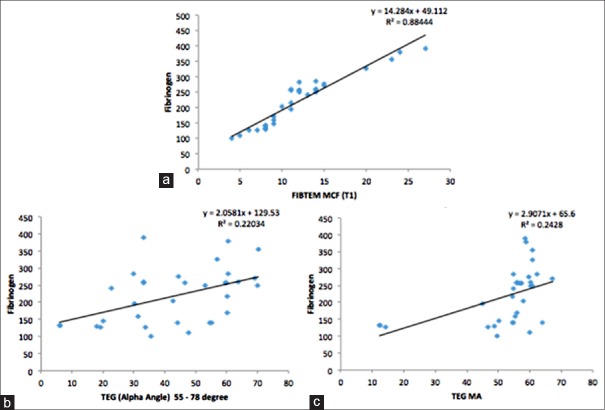
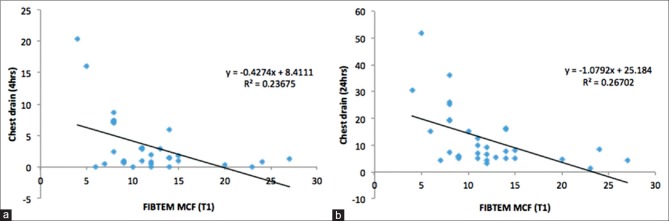
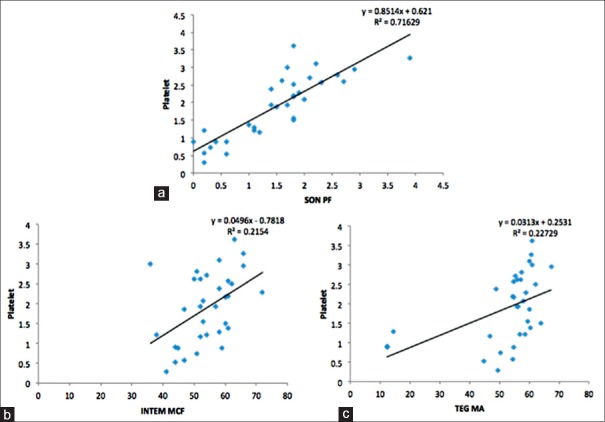
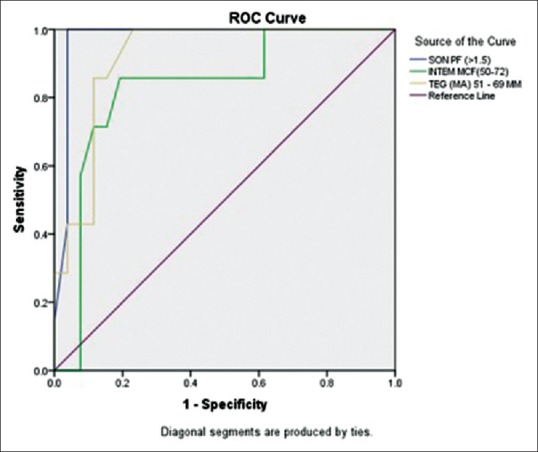
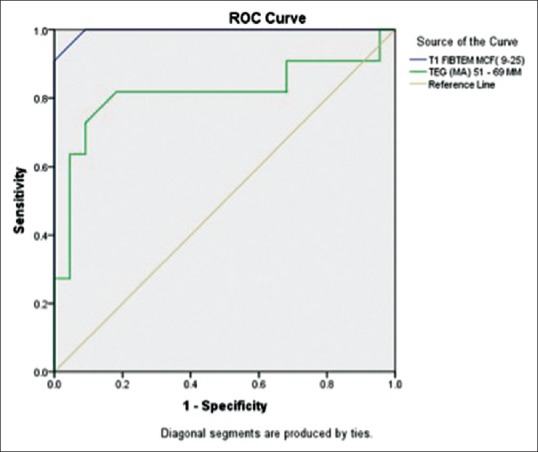
EXTEM clot time (CT) and clot formation time (CFT) were prolonged in 87% and 45% patients whereas INTEM CT and CFT were prolonged in 36% and 73% patients, respectively. FIBTEM maximum clot firmness (MCF) was decreased in 30% patients. We observed significant correlation between fibrinogen concentration and ROTEM FIBTEM MCF (r = 0.94, P < 0.001). The SON platelet function (SON PF) showed good correlation with platelet count (r = 0.85, P < 0.001). We also found significant correlation between preoperative FIBTEM MCF and CDO in first 4 postoperative hours (r = 0.49, P = 0.004) and 24 postoperative hours (r = 0.52, P = 0.005). Receiver operating characteristic analysis demonstrated that SON PF and TEG maximum amplitude are highly predictive of thrombocytopenia below 100 × 109/L (area under the curve [AUC] - 0.97 and 0.92, respectively), while FIBTEM-MCF is highly predictive of hypofibrinogenemia (fibrinogen <150 mg/dL (AUC, 0.99).
Cyanotic cardiac patients have preoperative coagulation abnormalities in ROTEM, TEG, and SON parameters. ROTEM FIBTEM is highly predictive of hypofibrinogenemia while SON PF is highly predictive of thrombocytopenia. ROTEM FIBTEM can be studied as a marker of increased postoperative CDO.
在过去几年中,黏弹性即时检测(POC)凝血设备,如血栓弹力图(TEG)、旋转血栓弹力测定法(ROTEM)和Sonoclot(SON)分析仪,已越来越多地用于大手术中,以便及时评估和处理凝血功能障碍。本研究的目的是使用TEG、ROTEM和SON分析仪评估紫绀型心脏病患者的凝血情况。此外,我们还评估了标准实验室凝血试验及术后胸腔引流量(CDO)与POC检测设备参数之间的相关性。
本研究纳入了35例美国麻醉医师协会分级为I-III级、因紫绀型先天性心脏病接受体外循环择期心脏手术的患者,性别不限。为确定可能存在的凝血异常,在麻醉诱导后采集用于TEG、ROTEM、SON检测及标准实验室凝血检测的血样。使用Pearson相关系数评估变量之间的相关性。P < 0.05被认为具有统计学意义。
EXTEM凝血时间(CT)和凝血形成时间(CFT)在87%和45%的患者中延长,而INTEM CT和CFT分别在36%和73%的患者中延长。30%的患者FIBTEM最大凝血硬度(MCF)降低。我们观察到纤维蛋白原浓度与ROTEM FIBTEM MCF之间存在显著相关性(r = 0.94,P < 0.001)。SON血小板功能(SON PF)与血小板计数显示出良好的相关性(r = 0.85,P < 0.001)。我们还发现术前FIBTEM MCF与术后前4小时(r = 0.49, P = 0.004)及术后24小时(r = 0.52, P = 0.005)的CDO之间存在显著相关性。受试者工作特征分析表明,SON PF和TEG最大振幅对血小板计数低于100×10⁹/L的血小板减少症具有高度预测性(曲线下面积[AUC]分别为0.97和0.92),而FIBTEM-MCF对低纤维蛋白原血症(纤维蛋白原<为150mg/dL,AUC为0.99)具有高度预测性。
紫绀型心脏病患者在ROTEM、TEG和SON参数方面存在术前凝血异常。ROTEM FIBTEM对低纤维蛋白原血症具有高度预测性,而SON PF对血小板减少症具有高度预测性。ROTEM FIBTEM可作为术后CDO增加的一个标志物进行研究。