García-Estévez Ignacio, Quijada-Morín Natalia, Rivas-Gonzalo Julián C, Martínez-Fernández José, Sánchez Nilda, Herrero-Jiménez Carlos M, Escribano-Bailón M Teresa
Grupo de Investigación en Polifenoles, Unidad de Nutrición y Bromatología, Facultad de Farmacia, University of Salamanca, Campus Miguel de Unamuno, Salamanca, Spain.
Instituto Hispano Luso de Investigaciones Agrarias, CIALE. University of Salamanca, Villamayor, Spain.
J Sci Food Agric. 2017 Sep;97(12):4066-4074. doi: 10.1002/jsfa.8366. Epub 2017 Jun 2.
The phenolic composition of grapes is key when making decisions about harvest date and ensuring the quality of grapes. The present study aimed to investigate the relationship between the detailed phenolic composition of grapes and the agronomic parameters and hyperspectral indices, with the latter being measured via field radiometry techniques.
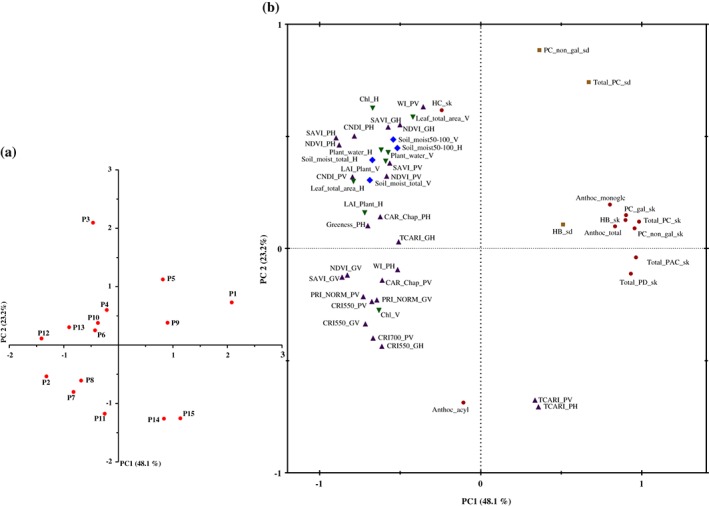
Good correlations were found between phenolic composition (both anthocyanin and flavanol composition) and some hyperspectral indices related to vigor, such as the NDVI (normalized difference vegetation index) and the SAVI (soil adjusted vegetation index). The strongest correlations were observed between the phenolic composition of grape skin at harvest time and variables measured from grapes at veraison time, as well as variables determined from grapevines at harvest time. The potential usefulness of these hyperspectral indices calculated from measurements performed directly on grapes or grapevines for estimating the anthocyanin and flavanol composition of grape skins was indicated by the high coefficients of determination (R 0.7955 and R 0.8594, respectively) as obtained by means of principal component regression.
According to the results of the present study, hyperspectral indices calculated from measurements performed directly on grapes at veraison time or on grapevines at harvest time may be useful for estimating the anthocyanin and flavanol composition of grape skins. This suggests that field radiometry might provide valuable information for estimating the phenolic composition of grapes, which may prove to be very useful when establishing strategies for harvest planning. © 2017 The Authors. Journal of The Science of Food and Agriculture published by John Wiley & Sons Ltd on behalf of Society of Chemical Industry.
在决定葡萄采收日期及确保葡萄品质时,葡萄的酚类成分至关重要。本研究旨在探究葡萄详细的酚类成分与农艺参数及高光谱指数之间的关系,后者通过田间辐射测量技术进行测定。
发现酚类成分(花青素和黄烷醇成分)与一些与活力相关的高光谱指数之间存在良好的相关性,如归一化植被指数(NDVI)和土壤调节植被指数(SAVI)。在采收时葡萄皮的酚类成分与转色期时葡萄测量的变量以及采收时葡萄藤测定的变量之间观察到最强的相关性。通过主成分回归获得的高决定系数(分别为R 0.7955和R 0.8594)表明,直接在葡萄或葡萄藤上进行测量计算得到的这些高光谱指数在估计葡萄皮的花青素和黄烷醇成分方面具有潜在用途。
根据本研究结果,在转色期直接对葡萄或在采收期对葡萄藤进行测量计算得到的高光谱指数可能有助于估计葡萄皮的花青素和黄烷醇成分。这表明田间辐射测量可能为估计葡萄的酚类成分提供有价值的信息,这在制定采收计划策略时可能非常有用。© 2017作者。《食品与农业科学杂志》由John Wiley & Sons Ltd代表化学工业协会出版。