Gould T D, Georgiou P, Brenner L A, Brundin L, Can A, Courtet P, Donaldson Z R, Dwivedi Y, Guillaume S, Gottesman I I, Kanekar S, Lowry C A, Renshaw P F, Rujescu D, Smith E G, Turecki G, Zanos P, Zarate C A, Zunszain P A, Postolache T T
Department of Psychiatry, University of Maryland School of Medicine, Baltimore, MD, USA.
Department of Pharmacology, University of Maryland School of Medicine, Baltimore, MD, USA.
Transl Psychiatry. 2017 Apr 11;7(4):e1092. doi: 10.1038/tp.2017.50.
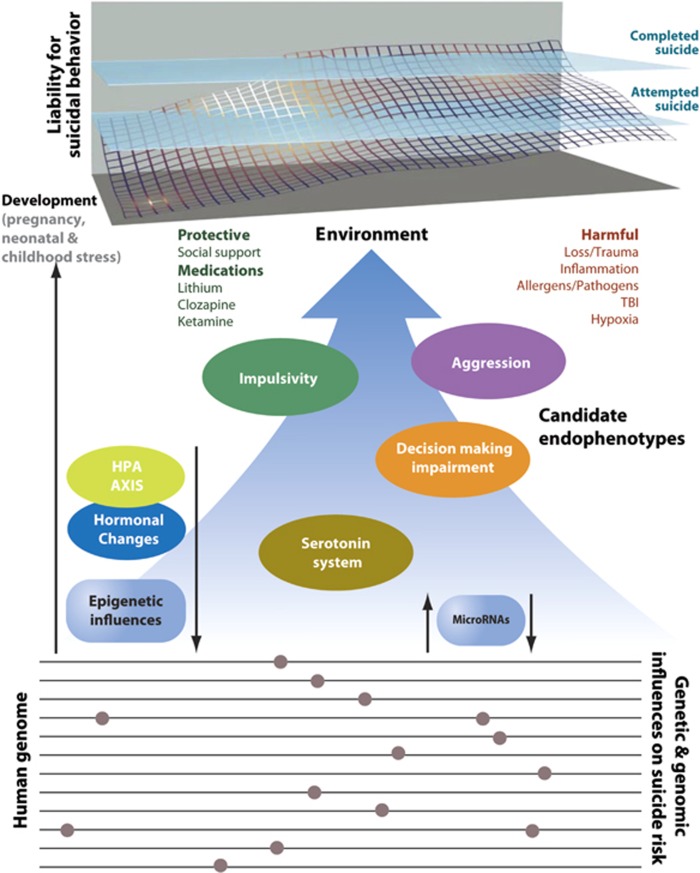
Worldwide, suicide is a leading cause of death. Although a sizable proportion of deaths by suicide may be preventable, it is well documented that despite major governmental and international investments in research, education and clinical practice suicide rates have not diminished and are even increasing among several at-risk populations. Although nonhuman animals do not engage in suicidal behavior amenable to translational studies, we argue that animal model systems are necessary to investigate candidate endophenotypes of suicidal behavior and the neurobiology underlying these endophenotypes. Animal models are similarly a critical resource to help delineate treatment targets and pharmacological means to improve our ability to manage the risk of suicide. In particular, certain pathophysiological pathways to suicidal behavior, including stress and hypothalamic-pituitary-adrenal axis dysfunction, neurotransmitter system abnormalities, endocrine and neuroimmune changes, aggression, impulsivity and decision-making deficits, as well as the role of critical interactions between genetic and epigenetic factors, development and environmental risk factors can be modeled in laboratory animals. We broadly describe human biological findings, as well as protective effects of medications such as lithium, clozapine, and ketamine associated with modifying risk of engaging in suicidal behavior that are readily translatable to animal models. Endophenotypes of suicidal behavior, studied in animal models, are further useful for moving observed associations with harmful environmental factors (for example, childhood adversity, mechanical trauma aeroallergens, pathogens, inflammation triggers) from association to causation, and developing preventative strategies. Further study in animals will contribute to a more informed, comprehensive, accelerated and ultimately impactful suicide research portfolio.
在全球范围内,自杀是主要的死亡原因之一。尽管相当一部分自杀死亡可能是可以预防的,但有充分的文献记载,尽管政府和国际社会在研究、教育和临床实践方面投入了大量资金,自杀率并未下降,在一些高危人群中甚至还在上升。虽然非人类动物不会表现出适合转化研究的自杀行为,但我们认为动物模型系统对于研究自杀行为的候选内表型以及这些内表型背后的神经生物学机制是必要的。动物模型同样是一种关键资源,有助于确定治疗靶点和药理手段,以提高我们管理自杀风险的能力。特别是,某些导致自杀行为的病理生理途径,包括应激和下丘脑 - 垂体 - 肾上腺轴功能障碍、神经递质系统异常、内分泌和神经免疫变化、攻击行为、冲动性和决策缺陷,以及遗传和表观遗传因素、发育和环境风险因素之间关键相互作用的作用,都可以在实验动物中进行模拟。我们广泛描述了人类生物学研究结果,以及锂盐、氯氮平和氯胺酮等药物与改变自杀行为风险相关的保护作用,这些作用很容易转化到动物模型中。在动物模型中研究的自杀行为内表型,对于将观察到的与有害环境因素(例如童年逆境、机械创伤、气传变应原、病原体、炎症触发因素)的关联从相关性转化为因果关系,并制定预防策略也很有用。在动物身上的进一步研究将有助于形成一个更明智、全面、加速且最终有影响力的自杀研究项目组合。