Cui Ran, Yuan Fang, Wang Yue, Li Xia, Zhang Zhenyu, Bai Huimin
Department of Obstetrics and Gynecology, Beijing Chao-Yang Hospital, Capital Medical University Department of Obstetrics and Gynecology, the affiliated hospital Qingdao University Department of Pathology, Beijing Chao-Yang Hospital, Capital Medical University Department of Pathology, the affiliated hospital Qingdao University, Beijing, China.
Medicine (Baltimore). 2017 Apr;96(15):e6584. doi: 10.1097/MD.0000000000006584.
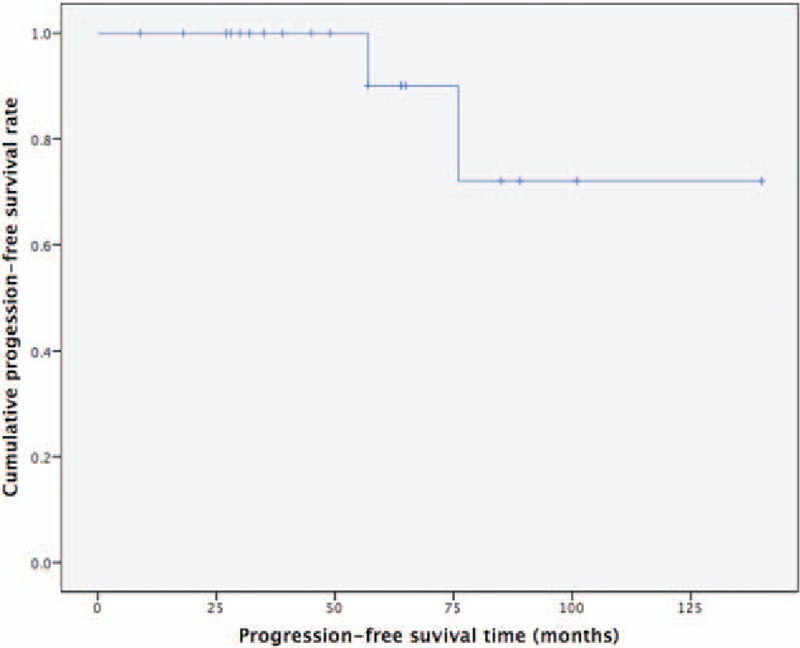
To investigate and evaluate the clinicopathological characteristics and treatment strategies for patients with low-grade endometrial stromal sarcoma (LG-ESS).The medical records of LG-ESS patients who were treated at 2 cancer referral centers from January 2005 to December 2015 were retrospectively reviewed.Twenty patients with LG-ESS met the inclusion criteria and were included in this analysis. Hysterectomy with bilateral salpingo-oophorectomy was the mainstay of surgery. Lymphadenectomy was performed in 12 (60%) cases, and no positive nodes were identified. CD10 was the most commonly used immunohistochemistry marker, followed by smooth muscle actin (SMA), estrogen receptor (ER), desmin, progesterone receptor (PR), and S-100; the positivity rates of these markers were 88.2%, 66.7%, 75.0%, 16.7%, 88.9%, and 0, respectively. Postoperative chemotherapy, radiotherapy, and hormonal treatment were provided alone or in combination in 10 (50%) patients, 4 (20%) patients, and 1 (5%) patient, respectively. One patient developed lung metastasis at initial diagnosis, and 2 (10%) patients had recurrence with distant metastasis. They all underwent complete or incomplete resection followed by hormonal treatment. The overall survival time of these patients was 66, 89, and 109 months at last contact, respectively. The 5-year and 10-year disease-free survival rates for the entire cohort were 90% and 72%, respectively. No patients died of the disease.CD10/SMA/ER/PR in combination with desmin/S-100 might improve the diagnostic accuracy. Surgical resection is the foremost treatment for LG-ESS patients with recurrence or distant metastasis. Hormonal treatment may be beneficial for unresectable or residual tumors.
探讨和评估低级别子宫内膜间质肉瘤(LG-ESS)患者的临床病理特征及治疗策略。回顾性分析2005年1月至2015年12月在2家癌症转诊中心接受治疗的LG-ESS患者的病历。20例LG-ESS患者符合纳入标准并纳入本分析。子宫切除加双侧输卵管卵巢切除术是主要的手术方式。12例(60%)患者进行了淋巴结清扫,未发现阳性淋巴结。CD10是最常用的免疫组化标志物,其次是平滑肌肌动蛋白(SMA)、雌激素受体(ER)、结蛋白、孕激素受体(PR)和S-100;这些标志物的阳性率分别为88.2%、66.7%、75.0%、16.7%、88.9%和0。分别有10例(50%)患者、4例(20%)患者和1例(5%)患者术后接受了单纯或联合化疗、放疗及激素治疗。1例患者初诊时发生肺转移,2例(10%)患者复发并伴有远处转移。他们均接受了完整或不完整切除,随后进行激素治疗。这些患者最后一次随访时的总生存时间分别为66个月、89个月和109个月。整个队列的5年和10年无病生存率分别为90%和72%。无患者死于该疾病。CD10/SMA/ER/PR联合结蛋白/S-100可能提高诊断准确性。手术切除是LG-ESS复发或远处转移患者的首要治疗方法。激素治疗可能对不可切除或残留肿瘤有益。