Karakuş Mehmet, Nasereddin Abed, Onay Hüseyin, Karaca Emin, Özkeklikçi Ahmet, Jaffe Charles L, Kuhls Katrin, Özbilgin Ahmet, Ertabaklar Hatice, Demir Samiye, Özbel Yusuf, Töz Seray
Ege University, Faculty of Medicine, Department of Parasitology, Izmir, Turkey.
Department of Microbiology and Molecular Genetics, IMRIC, Hebrew University - Hadassah Medical Center, Jerusalem, Israel.
PLoS Negl Trop Dis. 2017 Apr 12;11(4):e0005538. doi: 10.1371/journal.pntd.0005538. eCollection 2017 Apr.
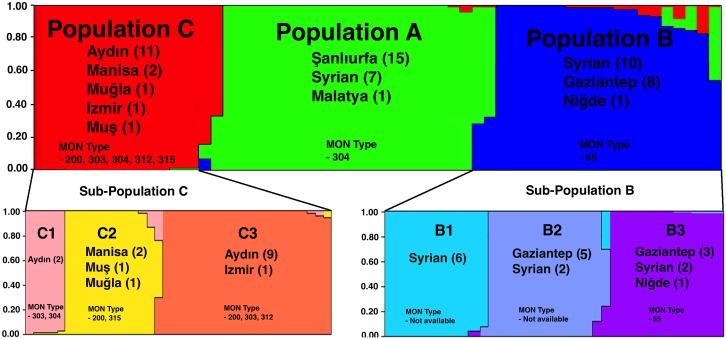
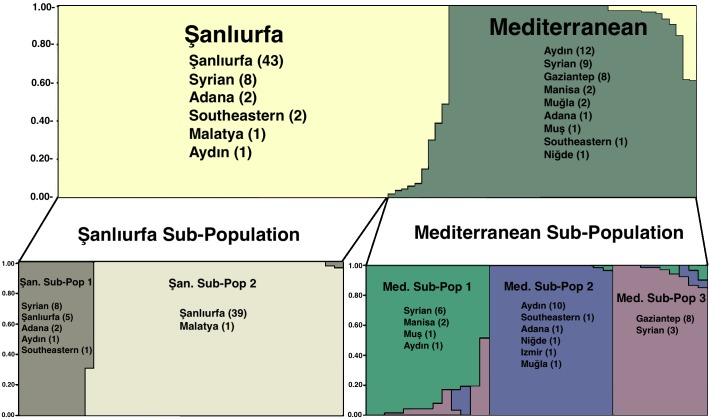
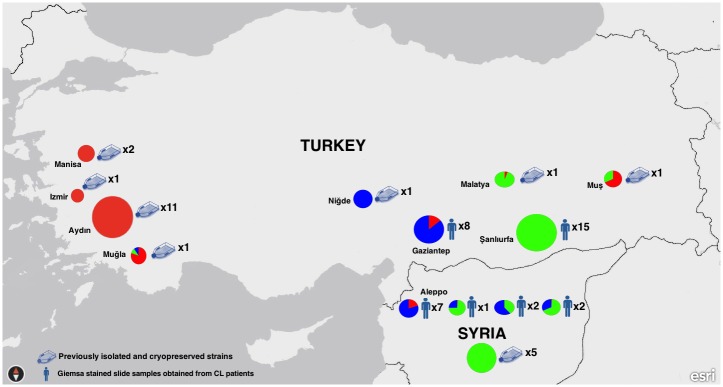
Turkey is located in an important geographical location, in terms of the epidemiology of vector-borne diseases, linking Asia and Europe. Cutaneous leishmaniasis (CL) is one of the endemic diseases in a Turkey and according to the Ministry Health of Turkey, 45% of CL patients originate from Şanlıurfa province located in southeastern Turkey. Herein, the epidemiological status of CL, caused by L. tropica, in Turkey was examined using multilocus microsatellite typing (MLMT) of strains obtained from Turkish and Syrian patients. A total of 38 cryopreserved strains and 20 Giemsa-stained smears were included in the present study. MLMT was performed using 12 highly specific microsatellite markers. Delta K (ΔK) calculation and Bayesian statistics were used to determine the population structure. Three main populations (POP A, B and C) were identified and further examination revealed the presence of three subpopulations for POP B and C. Combined analysis was performed using the data of previously typed L. tropica strains and Mediterranean and Şanlıurfa populations were identified. This finding suggests that the epidemiological status of L. tropica is more complicated than expected when compared to previous studies. A new population, comprised of Syrian L. tropica samples, was reported for the first time in Turkey, and the data presented here will provide new epidemiological information for further studies.
土耳其地理位置重要,在媒介传播疾病流行病学方面连接着亚洲和欧洲。皮肤利什曼病(CL)是土耳其的地方病之一,据土耳其卫生部称,45%的CL患者来自土耳其东南部的尚勒乌尔法省。在此,利用从土耳其和叙利亚患者身上获取的菌株进行多位点微卫星分型(MLMT),研究了土耳其由热带利什曼原虫引起的CL的流行病学状况。本研究共纳入38株冷冻保存菌株和20份吉姆萨染色涂片。使用12个高度特异性微卫星标记进行MLMT。通过Delta K(ΔK)计算和贝叶斯统计来确定种群结构。鉴定出三个主要种群(种群A、B和C),进一步检查发现种群B和C存在三个亚种群。利用先前分型的热带利什曼原虫菌株的数据进行综合分析,确定了地中海种群和尚勒乌尔法种群。这一发现表明,与先前的研究相比,热带利什曼原虫的流行病学状况更为复杂。首次在土耳其报道了一个由叙利亚热带利什曼原虫样本组成的新种群,此处提供的数据将为进一步研究提供新的流行病学信息。