Department of Anaesthesia and Critical Care, John Radcliffe Hospital, Oxford, UK.
Northern Ireland Clinical Trials Unit, Queen's University of Belfast, UK.
Br J Anaesth. 2017 Apr 1;118(4):570-575. doi: 10.1093/bja/aew465.
BACKGROUND.: The acute respiratory distress syndrome (ARDS) is a condition with a high mortality and morbidity. Mechanical ventilation prevents immediate mortality but may further damage patients' lungs. Low tidal volume lung-protective strategies have been shown to increase survival by reducing this iatrogenic damage. Current guidelines recommend tidal volumes of 6-8 ml kg -1 of predicted body weight. We used data from three large randomized controlled trials of treatments for ARDS to determine compliance with these recommendations.
METHODS.: We used the tidal volume recorded at randomization for all patients in the OSCAR, HARP-2, and BALTI-2 studies. In addition, we used the ventilation data for control arm patients in OSCAR and all patients in HARP-2 at days 1 and 7 after randomization.
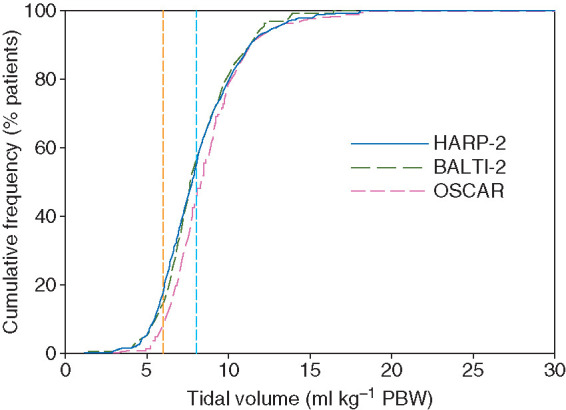
RESULTS.: The three trials enrolled 1660 patients, with tidal volume data available at least at one time point in 1412 patients. Compliance with the 6-8 ml kg -1 recommendation for tidal volume ranged from 20 to 39% of patients across all time points in all three trials.
CONCLUSION.: Poor compliance with the guidelines for tidal volume in patients with ARDS has been demonstrated before in case series, but not in clinical trials where the patient population is specifically selected against standard ARDS diagnostic criteria and the investigators were encouraged to use low tidal volumes. This study may indicate a need to improve implementation and compliance with protective lung ventilation.
急性呼吸窘迫综合征(ARDS)是一种死亡率和发病率都很高的疾病。机械通气可以防止立即死亡,但可能会进一步损害患者的肺部。低潮气量肺保护策略已被证明可以通过减少这种医源性损伤来提高生存率。目前的指南建议潮气量为预测体重的 6-8ml/kg。我们使用了来自三个大型 ARDS 治疗随机对照试验的数据,以确定这些建议的依从性。
我们使用了 OSCAR、HARP-2 和 BALTI-2 研究中所有随机分组患者的记录潮气量。此外,我们还使用了 OSCAR 对照组患者和 HARP-2 所有患者在随机分组后第 1 天和第 7 天的通气数据。
这三项试验共纳入了 1660 名患者,其中至少有 1412 名患者在一个或多个时间点有潮气量数据。在所有三项试验中,所有时间点的患者中,符合潮气量 6-8ml/kg 建议的比例为 20-39%。
在病例系列中已经证明 ARDS 患者对潮气量指南的依从性很差,但在专门选择排除标准 ARDS 诊断标准的患者人群的临床试验中并未如此。本研究可能表明需要改进保护性肺通气的实施和依从性。