Wuensch Alexander, Goelz Tanja, Ihorst Gabriele, Terris Darcey D, Bertz Hartmut, Bengel Juergen, Wirsching Michael, Fritzsche Kurt
Center for Mental Health, Department of Psychosomatic Medicine and Psychotherapy, Medical Center - University of Freiburg, Faculty of Medicine, Hauptstr. 8, D-79104, Freiburg, Germany.
Psychosomatic Medicine and Psychotherapy, Klinikum rechts der Isar, Technical University of Munich, Langerstrasse 3, D-81675, Munich, Germany.
BMC Cancer. 2017 Apr 13;17(1):264. doi: 10.1186/s12885-017-3238-0.
Discussing randomized clinical trials (RCTs) with cancer patients is one of the most challenging communication tasks a physician faces. Only two prior Communication Skills Trainings (CSTs) focused on RCTs in oncology have been reported. Their results demonstrated the need for further improvement. We developed and evaluated an enhanced, individually-tailored CST focused on improving physicians' communication during discussions of RCTs.
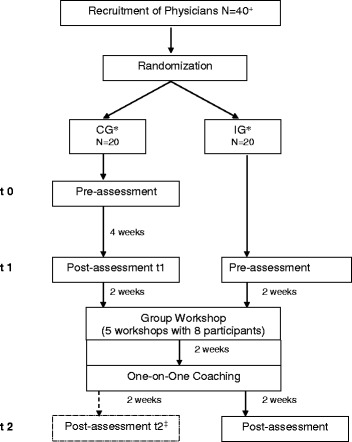
The CST focused on personal learning goals derived from video pre-assessment that were addressed in a 1.5-day group workshop and one-on-one coaching sessions. Forty physicians were recruited and randomly assigned to intervention and control groups. Video-recorded standardized consultations with actor-patients were utilized. As a primary outcome (1), training success was evaluated by blinded raters using a previously developed checklist. Change in checklist items was evaluated between pre- and post-training assessment and compared against control group results. As a secondary outcome (2), the physicians' feeling of confidence was assessed by a questionnaire.
(1) Significant improvements in the intervention group were observed for the score on all items (p = 0.03), for the subgroup of content-specific items (p = 0.02), and for the global rating of communication competence (p = 0.04). The improvement observed for the subgroup of general communication skill items did not achieve significance (p = 0.20). (2) The feeling of confidence improved in nine out of ten domains.
While the individually-tailored CST program significantly improved the physicians' discussions of RCTs, specifically related to discussion content, what remains unknown is the influence of such programs in practice on participant recruitment rates. The study was registered retrospectively in 2010/07/22 under DRKS-ID: DRKS00000492 .
与癌症患者讨论随机临床试验(RCT)是医生面临的最具挑战性的沟通任务之一。此前仅有两项针对肿瘤学RCT的沟通技能培训(CST)被报道。其结果表明仍需进一步改进。我们开发并评估了一种强化的、个性化的CST,旨在改善医生在讨论RCT时的沟通。
CST聚焦于从视频预评估中得出的个人学习目标,这些目标在为期1.5天的小组研讨会和一对一辅导课程中得到解决。招募了40名医生并随机分配到干预组和对照组。使用与演员患者进行的视频录制标准化咨询。作为主要结果(1),由盲法评分者使用先前制定的检查表评估培训成功率。在培训前和培训后评估之间评估检查表项目的变化,并与对照组结果进行比较。作为次要结果(2),通过问卷调查评估医生的自信心。
(1)干预组在所有项目的得分(p = 0.03)、特定内容项目子组(p = 0.02)以及沟通能力总体评分(p = 0.04)方面均有显著改善。一般沟通技能项目子组的改善未达到显著水平(p = 0.20)。(2)十个领域中有九个领域的自信心有所提高。
虽然个性化的CST计划显著改善了医生对RCT的讨论,特别是与讨论内容相关的方面,但此类计划在实践中对参与者招募率的影响尚不清楚。该研究于2010年7月22日进行回顾性注册,注册号为DRKS-ID:DRKS00000492。