Ferrari Maud C O, McCormick Mark I, Allan Bridie J M, Chivers Douglas P
Department of Biomedical Sciences, WCVM, University of Saskatchewan, 52 Campus Drive, Saskatoon, SK, Canada
ARC Centre of Excellence for Coral Reef Studies, and Discipline of Marine Biology and Aquaculture, James Cook University, Townsville, Queensland, Australia.
Proc Biol Sci. 2017 Apr 12;284(1852). doi: 10.1098/rspb.2016.2758.
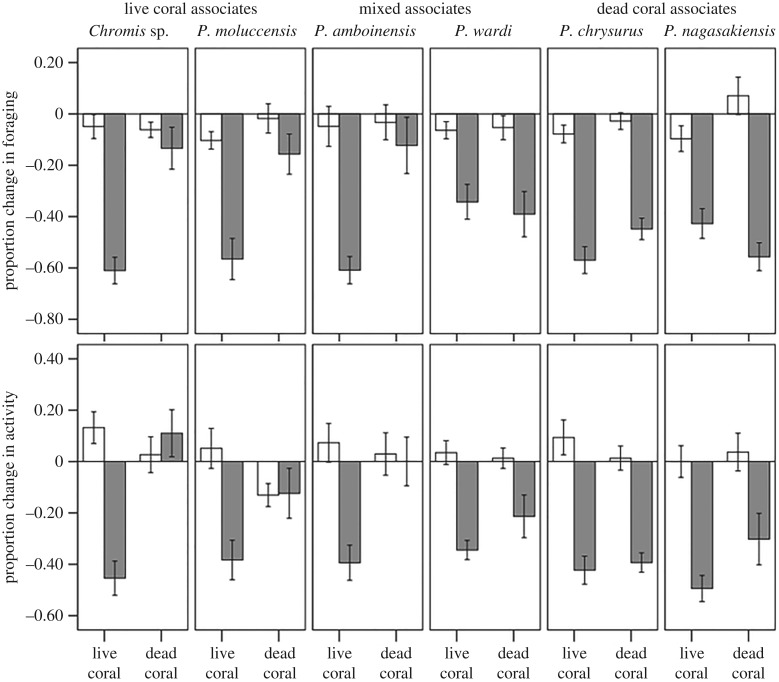
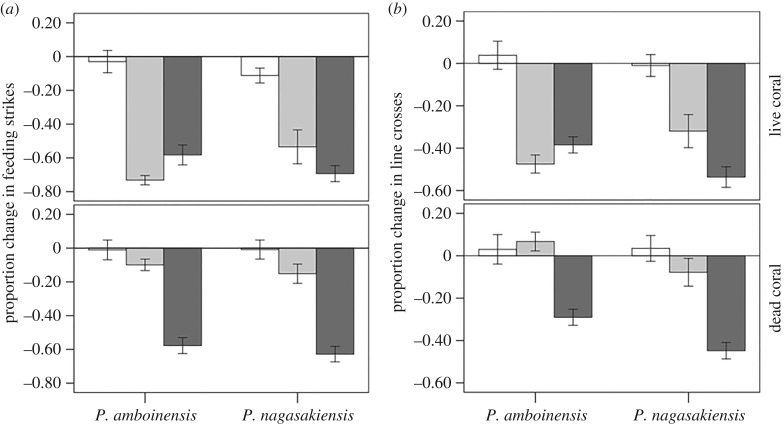
Coral reefs are biodiversity hotpots that are under significant threat due to the degradation and death of hard corals. When obligate coral-dwelling species die, the remaining species must either move or adjust to the altered conditions. Our goal was to investigate the effect of coral degradation on the ability of coral reef fishes to assess their risk of predation using alarm cues from injured conspecifics. Here, we tested the ability of six closely related species of juvenile damselfish (Pomacentridae) to respond to risk cues in both live coral or dead-degraded coral environments. Of those six species, two are exclusively associated with live coral habitats, two are found mostly on dead-degraded coral rubble, while the last two are found in both habitat types. We found that the two live coral associates failed to respond appropriately to the cues in water from degraded habitats. In contrast, the cue response of the two rubble associates was unaffected in the same degraded habitat. Interestingly, we observed a mixed response from the species found in both habitat types, with one species displaying an appropriate cue response while the other did not. Our second experiment suggested that the lack of responses stemmed from deactivation of the alarm cues, rather than the inability of the species to smell. Habitat preference (live coral versus dead coral associates) and phylogeny are good candidates for future work aimed at predicting which species are affected by coral degradation. Our results point towards a surprising level of variation in the ability of congeneric species to fare in altered habitats and hence underscores the difficulty of predicting community change in degraded habitats.
珊瑚礁是生物多样性热点地区,但由于硬珊瑚的退化和死亡,正面临着重大威胁。当专性栖息于珊瑚的物种死亡时,其余物种必须要么迁移,要么适应变化了的环境。我们的目标是研究珊瑚退化对珊瑚礁鱼类利用受伤同种个体发出的警报信号来评估自身被捕食风险能力的影响。在此,我们测试了六种亲缘关系密切的雀鲷幼鱼(雀鲷科)在活珊瑚或死亡退化珊瑚环境中对风险信号的反应能力。在这六个物种中,有两个完全与活珊瑚栖息地相关联,两个主要分布在死亡退化的珊瑚碎块上,而最后两个在两种栖息地类型中都能找到。我们发现,与活珊瑚相关联的两个物种对来自退化栖息地水中的信号未能做出适当反应。相比之下,与珊瑚碎块相关联的两个物种在相同的退化栖息地中,其信号反应未受影响。有趣的是,我们观察到在两种栖息地类型中都能找到的物种有不同的反应,其中一个物种表现出适当的信号反应,而另一个则没有。我们的第二个实验表明,缺乏反应是由于警报信号失活,而不是该物种无法嗅觉。栖息地偏好(活珊瑚与死亡珊瑚相关联的物种)和系统发育是未来旨在预测哪些物种会受到珊瑚退化影响的研究的良好候选因素。我们的结果表明,同属物种在变化的栖息地中生存能力存在惊人的差异,因此凸显了预测退化栖息地中群落变化的难度。