Raneros Aroa Baragaño, Minguela Alfredo, Rodriguez Ramon M, Colado Enrique, Bernal Teresa, Anguita Eduardo, Mogorron Adela Vasco, Gil Alberto Chaparro, Vidal-Castiñeira Jose Ramon, Márquez-Kisinousky Leonardo, Bulnes Paula Díaz, Marin Amelia Martinez, Garay Maria Carmen García, Suarez-Alvarez Beatriz, Lopez-Larrea Carlos
Department of Immunology, Hospital Universitario Central de Asturias, Oviedo, Spain.
Immunology Service, Instituto Murciano de Investigación Biosanitaria (IMIB), Hospital Clínico Universitario Virgen de la Arrixaca, Murcia, Spain.
Oncotarget. 2017 May 9;8(19):31959-31976. doi: 10.18632/oncotarget.16657.
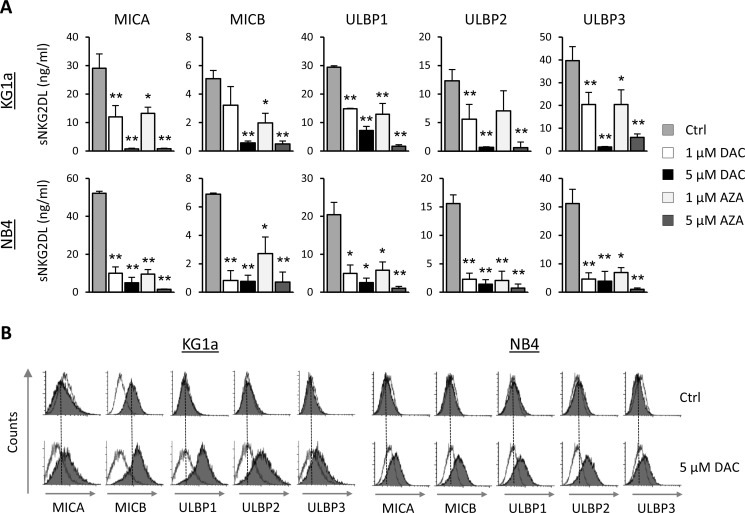
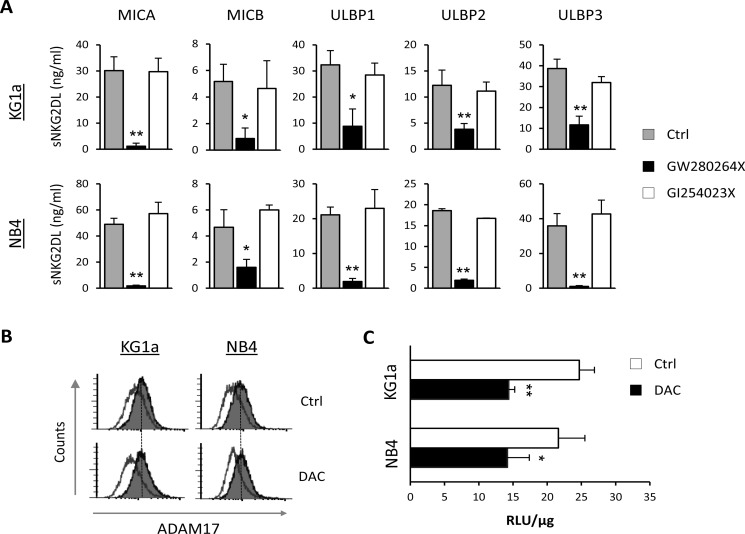
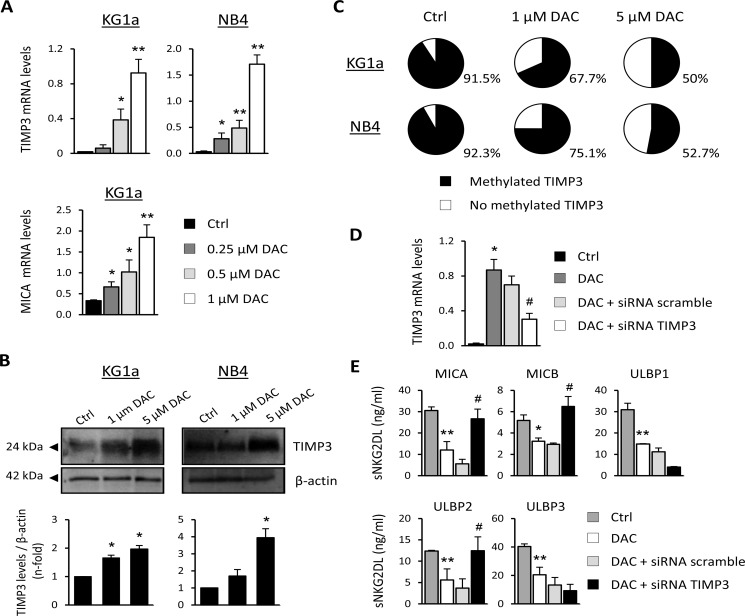
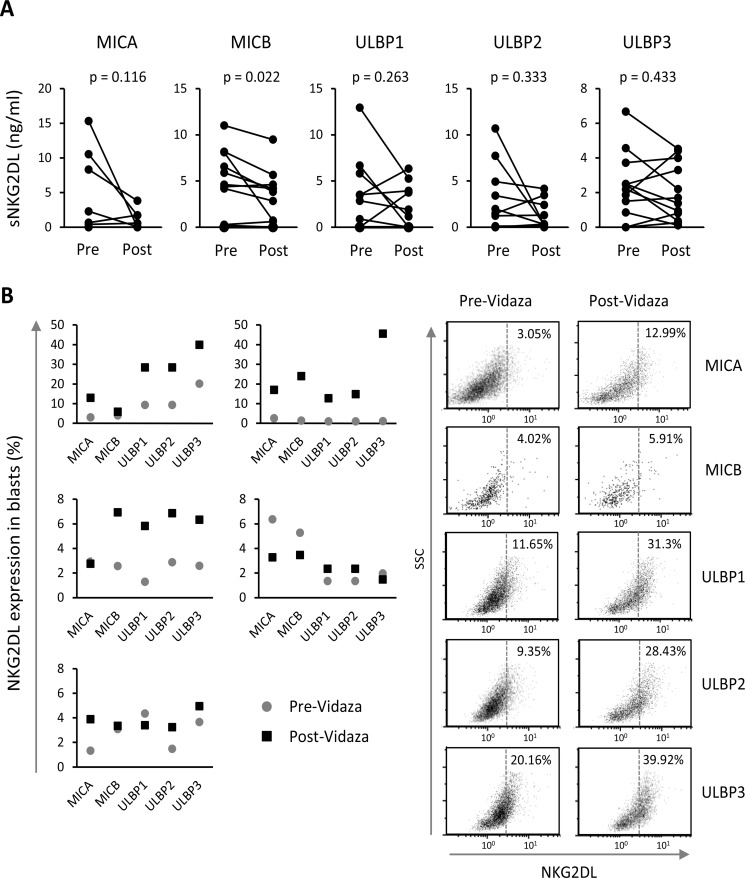
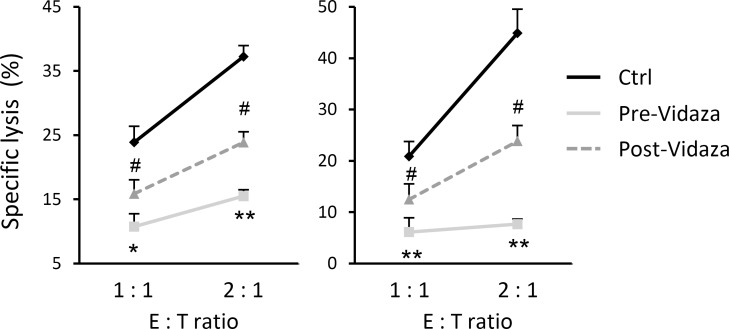
Acute myeloid leukemia (AML) is a disease with great morphological and genetic heterogeneity, which complicates its prognosis and treatment. The hypomethylating agents azacitidine (Vidaza®, AZA) and decitabine (Dacogen®, DAC) have been approved for the treatment of AML patients, but their mechanisms of action are poorly understood. Natural killer (NK) cells play an important role in the recognition of AML blasts through the interaction of the activating NKG2D receptor with its ligands (NKG2DL: MICA/B and ULBPs1-3). However, soluble NKG2DL (sNKG2DL) can be released from the cell surface, impairing immune recognition. Here, we examined whether hypomethylating agents modulate the release of sNKG2DL from AML cells. Results demonstrated that AZA- and DAC-treated AML cells reduce the release of sNKG2DL, preventing downregulation of NKG2D receptor on the cell surface and promoting immune recognition mediated by NKG2D-NKG2DL engagement. We show that the shedding of MICA, MICB and ULBP2 is inhibited by the increased expression of TIMP3, an ADAM17 inhibitor, after DAC treatment. The TIMP3 gene is highly methylated in AML cells lines and in AML patients (25.5%), in which it is significantly associated with an adverse cytogenetic prognosis of the disease. Overall, TIMP3 could be a target of the demethylating treatments in AML patients, leading to a decrease in MICA, MICB and ULBP2 shedding and the enhancement of the lytic activity of NK cells through the immune recognition mediated by the NKG2D receptor.
急性髓系白血病(AML)是一种具有高度形态学和基因异质性的疾病,这使其预后和治疗变得复杂。低甲基化药物阿扎胞苷(Vidaza®,AZA)和地西他滨(Dacogen®,DAC)已被批准用于治疗AML患者,但其作用机制尚不清楚。自然杀伤(NK)细胞通过激活型NKG2D受体与其配体(NKG2DL:MICA/B和ULBPs1 - 3)的相互作用,在识别AML原始细胞中发挥重要作用。然而,可溶性NKG2DL(sNKG2DL)可从细胞表面释放,损害免疫识别。在此,我们研究了低甲基化药物是否调节AML细胞中sNKG2DL的释放。结果表明,经AZA和DAC处理的AML细胞减少了sNKG2DL的释放,防止细胞表面NKG2D受体下调,并促进由NKG2D - NKG2DL结合介导的免疫识别。我们发现,DAC处理后,ADAM17抑制剂TIMP3表达增加,抑制了MICA、MICB和ULBP2的脱落。TIMP3基因在AML细胞系和AML患者中高度甲基化(25.5%),且与该疾病不良的细胞遗传学预后显著相关。总体而言,TIMP3可能是AML患者去甲基化治疗的靶点,导致MICA、MICB和ULBP2脱落减少,并通过NKG2D受体介导的免疫识别增强NK细胞的裂解活性。