Wang Qinchuan, Shu Xiang, Dong Yong, Zhou Jichun, Teng Rongyue, Shen Jianguo, Chen Yongxia, Dong Mingjun, Zhang Wenjun, Huang Yasheng, Xie Shuduo, Wei Qun, Zhao Wenhe, Chen Wenjun, Yuan Xiaoming, Qi Xu, Wang Linbo
Department of Surgical Oncology, Affiliated Sir Runrun Shaw Hospital, Zhejiang University School of Medicine, Hangzhou, China.
Division of Epidemiology, Department of Medicine, Vanderbilt-Ingram Cancer Center, Vanderbilt University School of Medicine, Nashville, TN, USA.
Oncotarget. 2017 May 30;8(22):36171-36184. doi: 10.18632/oncotarget.15609.
Gastric Cancer is one of the most lethal malignancies worldwide. Gamma-glutamyl transpeptidase (GGT) is an enzyme mainly involved in cellular glutathione homeostasis. We aim to explore the clinical value of GGT in gastric cancer.
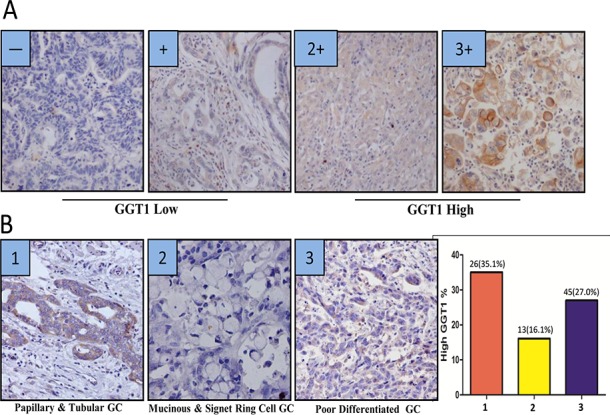
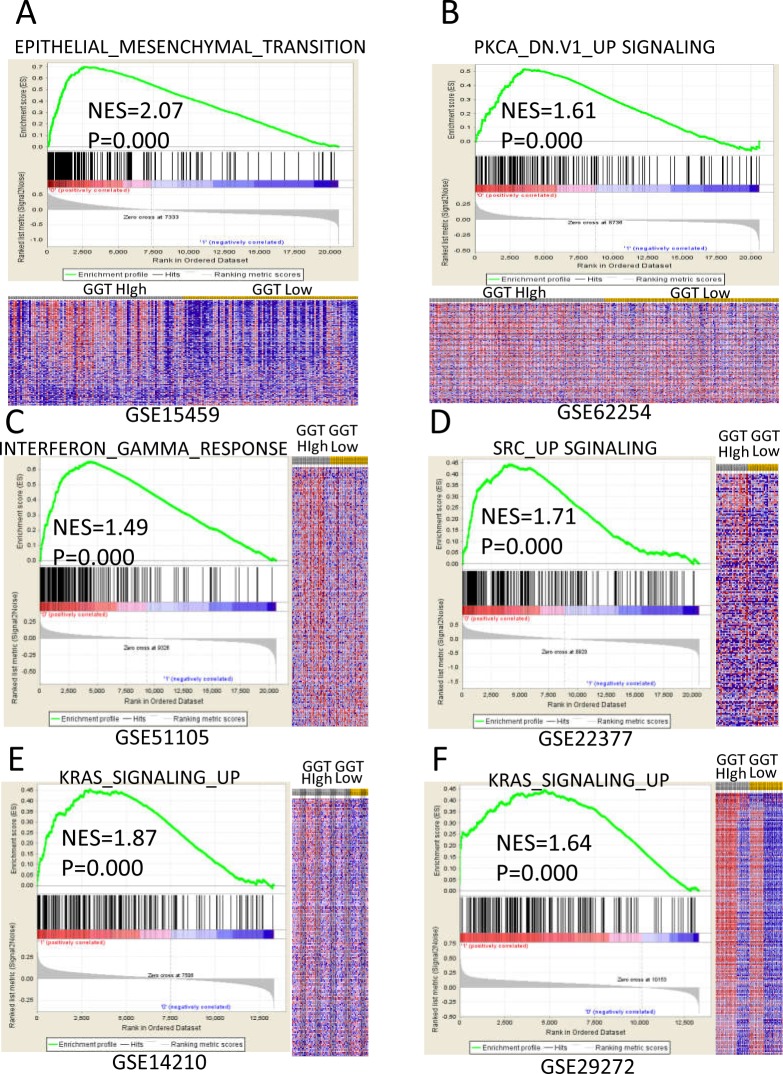
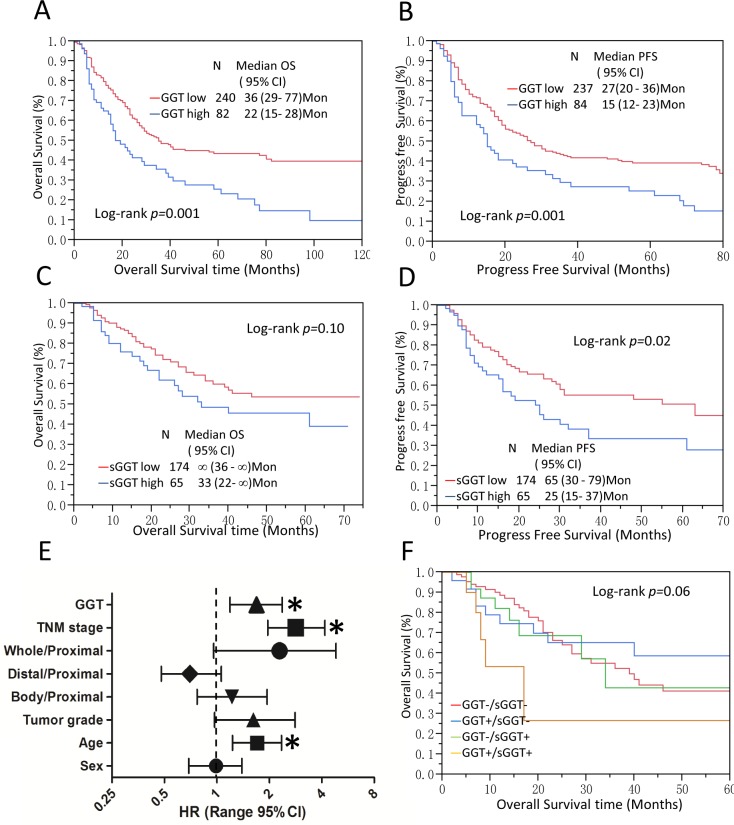
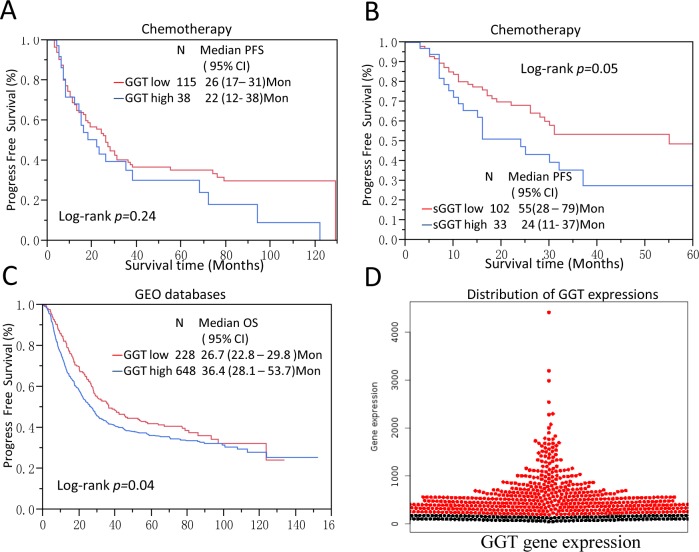
Among 322 patients enrolled, 65/82 patients were determined as GGT positive in serum/tumor, respectively. High tumor GGT expression is significantly associated with lymph node metastasis, histological subtype, and Her2 expression. Kaplan-Meier curve shows that high tumor GGT patients have shorter overall survival (P log-rank=0.001) and progress-free survival (P log-rank =0.001). Patients with both high tumor and serum GGT have the poorest prognosis. The multivariable Cox analysis shows that the hazard ratio of overall survival for high tumor GGT is 1.69 (95% CI 1.19-2.37). High serum GGT is a poor prognostic factor in adjuvant chemotherapy hazard ratio=2.18, 95%CI (1.15-4.47). These findings were further validated in six online datasets. Gene Sets Enrichment Analysis showed that GGT promotes cancer progression through EMT, KRAS, SRC and PKCA pathways.
Tumor GGT and serum GGT levels were evaluated with immuno-histochemistry staining and enzymatic assay, respectively. Kaplan-Meier curve and Cox regression model were used to test the association between GGT and gastric cancer prognosis. Independent datasets from Gene Expression Omnibus and Gene Sets Enrichment Analysis were applied to validate the findings and explore the potential mechanisms.
Both tumor GGT and serum GGT are poor prognostic factors in gastric cancer. Patients with high tumor and serum GGT levels require more intense treatment and follow-up.
胃癌是全球最致命的恶性肿瘤之一。γ-谷氨酰转肽酶(GGT)是一种主要参与细胞内谷胱甘肽稳态的酶。我们旨在探讨GGT在胃癌中的临床价值。
在纳入的322例患者中,分别有65/82例患者血清/肿瘤中的GGT呈阳性。肿瘤GGT高表达与淋巴结转移、组织学亚型及Her2表达显著相关。Kaplan-Meier曲线显示,肿瘤GGT高表达的患者总生存期(P对数秩检验=0.001)和无进展生存期(P对数秩检验=0.001)较短。肿瘤和血清GGT均高的患者预后最差。多变量Cox分析显示,肿瘤GGT高表达患者总生存的风险比为1.69(95%CI 1.19-2.37)。血清GGT高是辅助化疗中不良预后因素(风险比=2.18,95%CI(1.15-4.47))。这些发现在六个在线数据集中得到进一步验证。基因集富集分析表明,GGT通过上皮-间质转化(EMT)、KRAS、SRC和PKCA途径促进癌症进展。
分别采用免疫组织化学染色和酶法检测肿瘤GGT和血清GGT水平。采用Kaplan-Meier曲线和Cox回归模型检验GGT与胃癌预后的相关性。应用来自基因表达综合数据库(Gene Expression Omnibus)的独立数据集和基因集富集分析来验证研究结果并探索潜在机制。
肿瘤GGT和血清GGT均是胃癌的不良预后因素。肿瘤和血清GGT水平高的患者需要更积极的治疗和随访。