Rajan Sunil, Surendran Jayasankar, Paul Jerry, Kumar Lakshmi
Department of Anaesthesiology, Amrita Institute of Medical Sciences, Amrita Vishwa Vidyapeetham, Kochi, Kerala, India.
Indian J Anaesth. 2017 Mar;61(3):230-234. doi: 10.4103/0019-5049.202164.
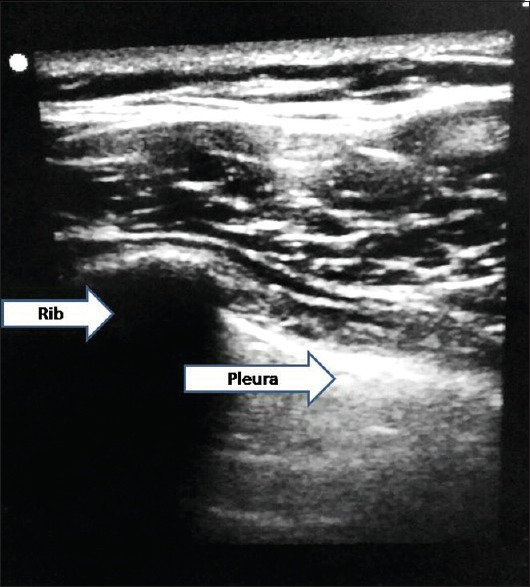
Obese individuals are predisposed to difficult airway and intubation. They usually yield confusing or misleading auscultatory findings. We aimed to assess the rapidity and efficacy of ultrasonographic (USG) sliding lung sign for confirming endotracheal intubation in normal as well as overweight and obese surgical patients.
This prospective, observational study was performed in forty surgical patients. Twenty patients with body mass index (BMI) <25 were recruited to Group A, whereas twenty patients with BMI ≥25 constituted Group B. Following induction and intubation, appearance of end-tidal carbon dioxide waveform was used to confirm endotracheal intubation. Presence of breath sounds bilaterally was sought by auscultation, and time taken for auscultatory confirmation was noted. The USG confirmation of air entry to the lung field as indicated by lung sliding was sought, and the time taken was noted. Chi-square test, independent -test and paired -test were used as applicable.
Auscultatory confirmation was more rapid in Group A as compared to Group B (9.34 ± 2.43 s vs. 14.35 ± 5.53 s, = 0.001). However, there was no significant difference in USG confirmation time in both the groups (8.57 ± 2.05 s vs. 8.61 ± 1.66 s). Four patients in Group B had doubtful breath sounds against none in Group A. There was no doubtful lung slide with USG in both groups. One case of endobronchial intubation in Group B was diagnosed with USG which was doubtful by auscultation.
Ultrasound directed confirmation of endotracheal tube placement in overweight and obese patients is superior in speed and accuracy in comparison to the standard auscultatory method.
肥胖个体易出现气道困难和插管困难。他们的听诊结果通常令人困惑或具有误导性。我们旨在评估超声(USG)滑动肺征在正常以及超重和肥胖手术患者中确认气管插管的速度和效果。
本前瞻性观察性研究纳入了40例手术患者。20例体重指数(BMI)<25的患者被纳入A组,而20例BMI≥25的患者构成B组。诱导和插管后,使用呼气末二氧化碳波形的出现来确认气管插管。通过听诊寻找双侧呼吸音,并记录听诊确认所需的时间。寻找超声确认肺滑动所指示的空气进入肺野情况,并记录所需时间。根据适用情况使用卡方检验、独立样本t检验和配对t检验。
与B组相比,A组听诊确认更快(9.34±2.43秒对14.35±5.53秒,P = 0.001)。然而,两组超声确认时间无显著差异(8.57±2.05秒对8.61±1.66秒)。B组有4例呼吸音可疑,而A组无。两组超声均未出现可疑肺滑动。B组1例支气管内插管通过超声确诊,听诊时可疑。
与标准听诊方法相比,超声引导下确认超重和肥胖患者气管导管位置在速度和准确性方面更具优势。