Tan Sven-Jean, Hewitson Tim D, Hughes Peter D, Holt Stephen G, Toussaint Nigel D
Department of Nephrology, The Royal Melbourne Hospital, Melbourne, Victoria, Australia.; Department of Medicine (RMH), The University of Melbourne, Parkville, Victoria, Australia.
Transplant Direct. 2017 Mar 28;3(4):e150. doi: 10.1097/TXD.0000000000000660. eCollection 2017 Apr.
Living kidney donors (LKDs) experience reduction in kidney function, however serum phosphate (sPi) levels are lower compared to patients with chronic kidney disease matched for reduced kidney function. Mineral metabolism adaptations that occur in LKDs have not been adequately investigated. To evaluate the effect of nephrectomy on markers of mineral metabolism in LKDs compared to healthy volunteers (HV) over 12 months.
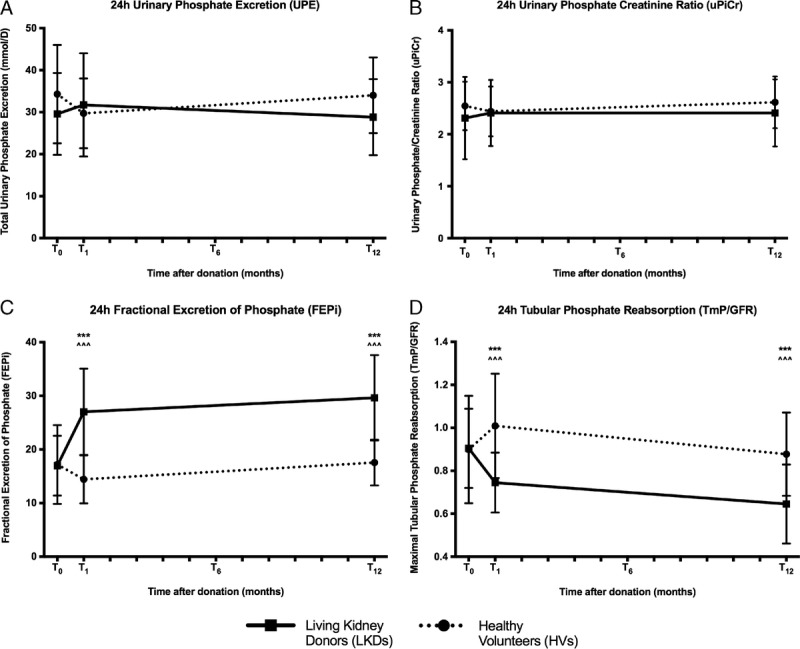
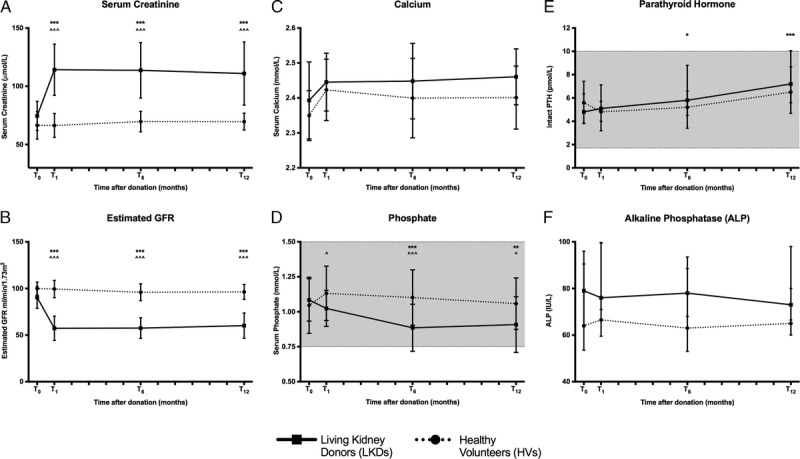
Mineral parameters were evaluated in twenty-one adult LKDs and twenty HVs. Parameters included sPi, intact parathyroid hormone, fibroblast growth factor-23 (FGF23), soluble Klotho (sKl) and urinary phosphate, measured prior to donation (T), 1 month (T), 6 months (T) and 12 months (T) post-kidney donation. Statistical analyses were conducted on normalized variables and changes were assessed using 2-way analysis of variance.
Mean ages of LKDs and HVs were 54.1 ± 14.7 and 52.6 ± 8.0 years, respectively. There were no baseline clinical or biochemical differences between LKDs and HVs. In LKDs at T, serum creatinine increased (from 75 ± 12 to 114 ± 22 μmol/L), FGF23 increased (52 ± 15 to 70 ± 19 pg/mL) and sKl decreased (564 [469-662] to 424 [375-523] pg/mL), all less than 0.001. Changes were sustained at T. After donation, LKDs consistently demonstrated lower sPi compared with T, with the maximal sPi change at T (-0.19 mmol/L difference, < 0.001). Other markers of mineral metabolism were unchanged in LKDs. There were no mineral differences in HVs over 12 months.
Prospective evaluation of mineral metabolism parameters in LKDs provides valuable insight into compensatory mechanisms after reduction in kidney function. Further reduction of sPi at T despite early alterations in FGF23 and sKl suggest adaptation of mineral metabolism continues long-term in LKDs.
活体肾供体(LKDs)的肾功能会下降,然而与肾功能降低程度相匹配的慢性肾脏病患者相比,其血清磷酸盐(sPi)水平更低。LKDs发生的矿物质代谢适应性变化尚未得到充分研究。为了评估与健康志愿者(HV)相比,肾切除术后12个月内对LKDs矿物质代谢标志物的影响。
对21名成年LKDs和20名HV进行矿物质参数评估。参数包括sPi、完整甲状旁腺激素、成纤维细胞生长因子-23(FGF23)、可溶性klotho(sKl)和尿磷酸盐,在捐献前(T0)、捐献后1个月(T1)、6个月(T6)和12个月(T12)进行测量。对标准化变量进行统计分析,并使用双向方差分析评估变化。
LKDs和HVs的平均年龄分别为54.1±14.7岁和52.6±8.0岁。LKDs和HVs之间在基线临床或生化方面无差异。在LKDs中,T0时血清肌酐升高(从75±12升至114±22μmol/L),FGF23升高(52±15至70±19 pg/mL),sKl降低(564[469 - 662]至424[375 - 523]pg/mL),均P<0.001。这些变化在T12时持续存在。捐献后,LKDs的sPi始终低于T0,T6时sPi变化最大(差异为-0.19 mmol/L,P<0.001)。LKDs中其他矿物质代谢标志物未发生变化。HVs在12个月内矿物质无差异。
对LKDs矿物质代谢参数的前瞻性评估为肾功能降低后的代偿机制提供了有价值的见解。尽管FGF23和sKl早期发生改变,但T6时sPi进一步降低表明LKDs中矿物质代谢的适应性变化会长期持续。