School of Biological Sciences, University of Queensland, St. Lucia, 4072 Queensland, Australia.
Department of Geography and Environmental Systems, University of Maryland, Baltimore County, Baltimore, Maryland 21250, USA.
Nat Commun. 2017 Apr 13;8:14895. doi: 10.1038/ncomms14895.
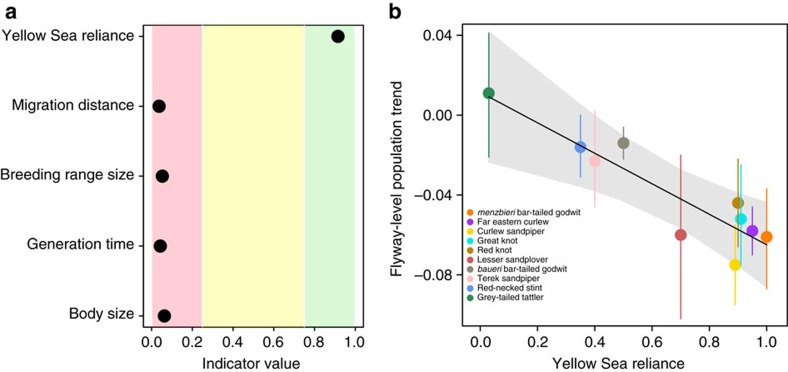
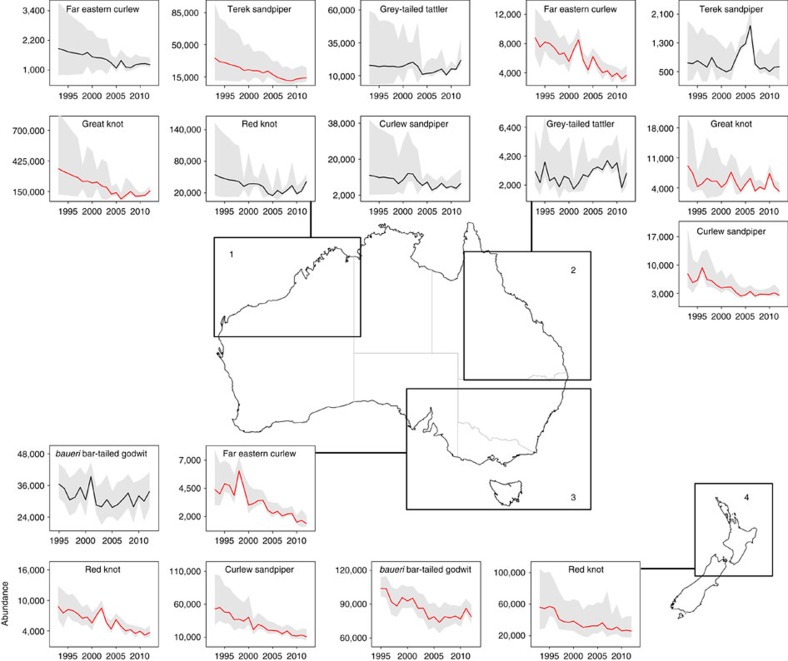
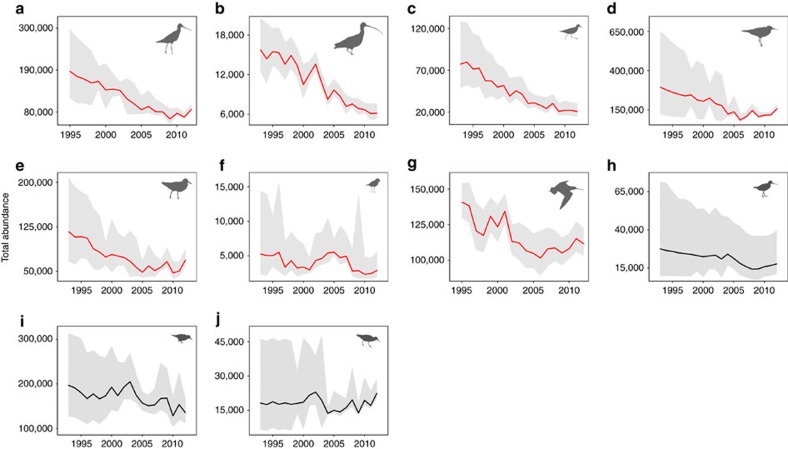
Migratory animals are threatened by human-induced global change. However, little is known about how stopover habitat, essential for refuelling during migration, affects the population dynamics of migratory species. Using 20 years of continent-wide citizen science data, we assess population trends of ten shorebird taxa that refuel on Yellow Sea tidal mudflats, a threatened ecosystem that has shrunk by >65% in recent decades. Seven of the taxa declined at rates of up to 8% per year. Taxa with the greatest reliance on the Yellow Sea as a stopover site showed the greatest declines, whereas those that stop primarily in other regions had slowly declining or stable populations. Decline rate was unaffected by shared evolutionary history among taxa and was not predicted by migration distance, breeding range size, non-breeding location, generation time or body size. These results suggest that changes in stopover habitat can severely limit migratory populations.
迁徙动物受到人类活动引起的全球变化的威胁。然而,人们对于在迁徙过程中补充能量所必需的中途停留栖息地如何影响迁徙物种的种群动态知之甚少。利用 20 年来的全大陆范围的公民科学数据,我们评估了在黄海潮滩上补充能量的 10 种涉禽的种群趋势,黄海潮滩是一个受到威胁的生态系统,在最近几十年里已经缩小了超过 65%。其中 7 个物种的下降速度高达每年 8%。对黄海作为中途停留地依赖程度最大的物种下降幅度最大,而那些主要在其他地区停留的物种的种群则呈缓慢下降或稳定状态。下降率与物种间的共同进化史无关,也不能用迁徙距离、繁殖范围大小、非繁殖地位置、世代时间或体型来预测。这些结果表明,中途停留栖息地的变化可能会严重限制迁徙种群。