Zhang Jibin, Schmidt Carl J, Lamont Susan J
Department of Animal Science, Iowa State University, 806 Stange Rd, 2255 Kildee Hall, Ames, IA, 50011, USA.
Department of Animal and Food Sciences, University of Delaware, 531 South College Ave, Newark, DE, 19716, USA.
BMC Genomics. 2017 Apr 13;18(1):295. doi: 10.1186/s12864-017-3675-9.
Modern fast-growing broilers are susceptible to heart failure under heat stress because their relatively small hearts cannot meet increased need of blood pumping. To improve the cardiac tolerance to heat stress in modern broilers through breeding, we need to find the important genes and pathways that contribute to imbalanced cardiac development and frequent occurrence of heat-related heart dysfunction. Two broiler lines - Ross 708 and Illinois - were included in this study as a fast-growing model and a slow-growing model respectively. Each broiler line was separated to two groups at 21 days posthatch. One group was subjected to heat stress treatment in the range of 35-37 °C for 8 h per day, and the other was kept in thermoneutral condition. Body and heart weights were measured at 42 days posthatch, and gene expression in left ventricles were compared between treatments and broiler lines through RNA-seq analysis.
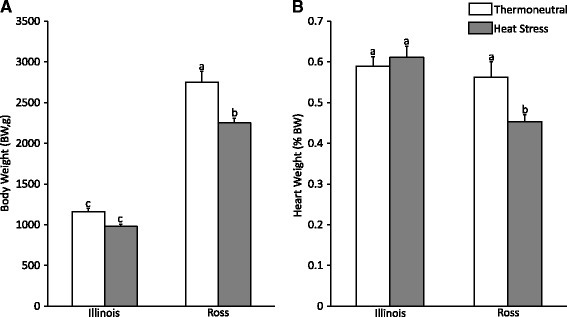
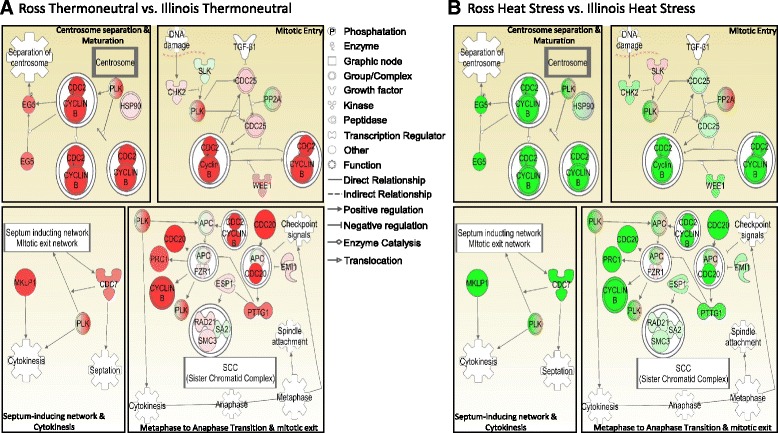
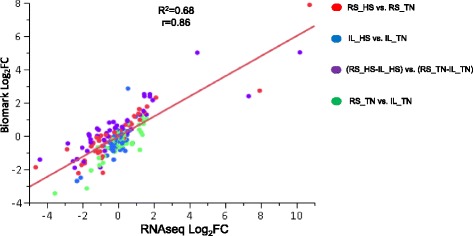
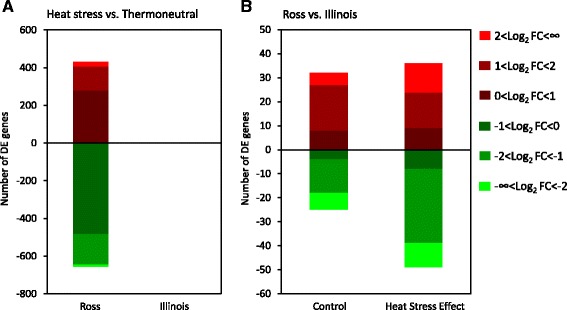
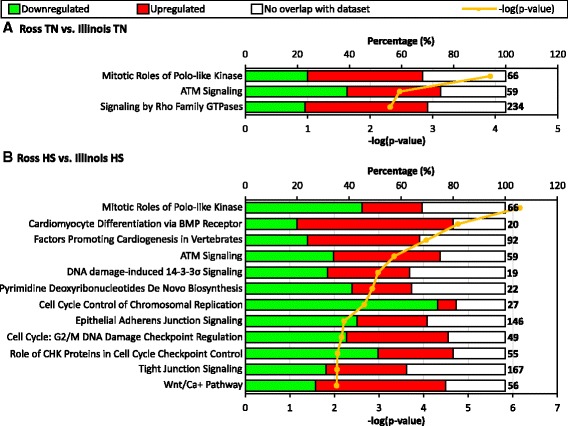
Body weight and normalized heart weight were significantly reduced by heat stress only in Ross broilers. RNA-seq results of 44 genes were validated using Biomark assay. A total of 325 differentially expressed (DE) genes were detected between heat stress and thermoneutral in Ross 708 birds, but only 3 in Illinois broilers. Ingenuity pathway analysis (IPA) predicted dramatic changes in multiple cellular activities especially downregulation of cell cycle. Comparison between two lines showed that cell cycle activity is higher in Ross than Illinois in thermoneutral condition but is decreased under heat stress. Among the significant pathways (P < 0.01) listed for different comparisons, "Mitotic Roles of Polo-like Kinases" is always ranked first.
The increased susceptibility of modern broilers to cardiac dysfunction under heat stress compared to slow-growing broilers could be due to diminished heart capacity related to reduction in relative heart size. The smaller relative heart size in Ross heat stress group than in Ross thermoneutral group is suggested by the transcriptome analysis to be caused by decreased cell cycle activity and increased apoptosis. The DE genes in RNA-seq analysis and significant pathways in IPA provides potential targets for breeding of heat-tolerant broilers with optimized heart function.
现代快速生长的肉鸡在热应激下易患心力衰竭,因为它们相对较小的心脏无法满足增加的血液泵出需求。为了通过育种提高现代肉鸡对热应激的心脏耐受性,我们需要找到导致心脏发育不平衡和与热相关的心脏功能障碍频繁发生的重要基因和途径。本研究纳入了两个肉鸡品系——罗斯708和伊利诺伊,分别作为快速生长模型和慢速生长模型。每个肉鸡品系在孵化后21天分为两组。一组每天在35 - 37°C范围内进行8小时的热应激处理,另一组保持在热中性条件下。在孵化后42天测量体重和心脏重量,并通过RNA测序分析比较处理组和肉鸡品系之间左心室的基因表达。
仅在罗斯肉鸡中,热应激显著降低了体重和标准化心脏重量。使用生物标志物检测法验证了44个基因的RNA测序结果。在罗斯708肉鸡中,共检测到325个热应激和热中性之间的差异表达基因,但在伊利诺伊肉鸡中仅检测到3个。 Ingenuity通路分析(IPA)预测了多种细胞活动的显著变化,特别是细胞周期的下调。两个品系之间的比较表明,在热中性条件下,罗斯的细胞周期活性高于伊利诺伊,但在热应激下降低。在不同比较列出的显著通路(P < 0.01)中,“类Polo样激酶的有丝分裂作用”总是排名第一。
与慢速生长的肉鸡相比,现代肉鸡在热应激下对心脏功能障碍的易感性增加可能是由于相对心脏大小减小导致心脏容量降低。转录组分析表明,罗斯热应激组的相对心脏大小小于罗斯热中性组,这是由细胞周期活性降低和细胞凋亡增加引起的。RNA测序分析中的差异表达基因和IPA中的显著通路为培育具有优化心脏功能的耐热肉鸡提供了潜在靶点。