Zhang Jing, Cong Qian, Fan Xiao-Ling, Wang Rongjiang, Wang Min, Grishin Nick V
Departments of Biophysics and Biochemistry, University of Texas Southwestern Medical Center, Dallas, TX, 75390-8816, USA.
Department of Entomology, South China Agricultural University, Guangzhou, Guangdong, 510640, China.
F1000Res. 2017 Mar 6;6:222. doi: 10.12688/f1000research.10970.1. eCollection 2017.
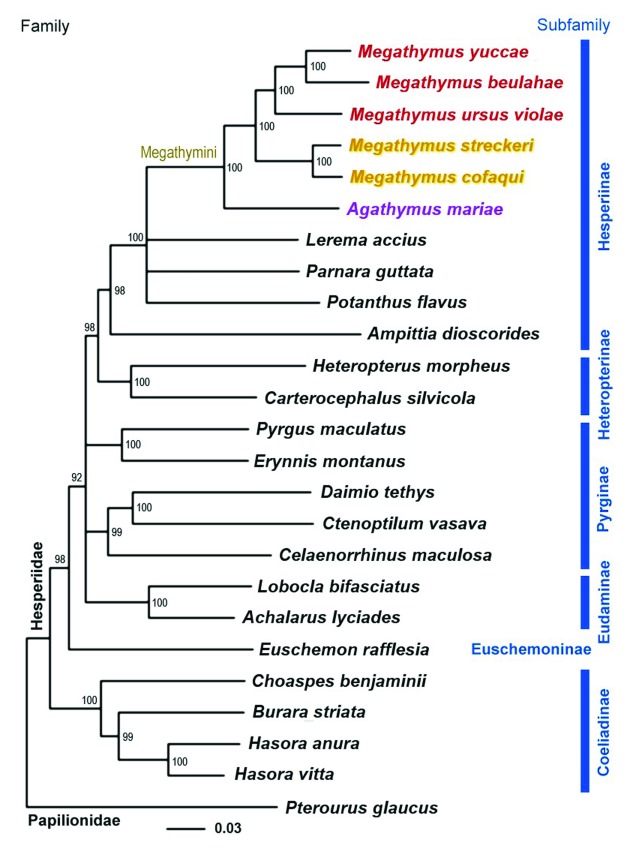
Giant-Skipper butterflies from the genus are North American endemics. These large and thick-bodied Skippers resemble moths and are unique in their life cycles. Grub-like at the later stages of development, caterpillars of these species feed and live inside yucca roots. Adults do not feed and are mostly local, not straying far from the patches of yucca plants. Pieces of muscle were dissected from the thorax of specimens and genomic DNA was extracted (also from the abdomen of a specimen collected nearly 60 years ago). Paired-end libraries were prepared and sequenced for 150bp from both ends. The mitogenomes were assembled from the reads followed by a manual gap-closing procedure and a phylogenetic tree was constructed using a maximum likelihood method from an alignment of the mitogenomes. We determined mitogenome sequences of nominal subspecies of all five known species of and to confidently root the phylogenetic tree. Pairwise sequence identity indicates the high similarity, ranging from 88-96% among coding regions for 13 proteins, 22 tRNAs and 2 rRNA, with a gene order typical for mitogenomes of Lepidoptera. Phylogenetic analysis confirms that Giant-Skippers (Megathymini) originate within the subfamily Hesperiinae and do not warrant a subfamily rank. Genus is monophyletic and splits into two species groups. and caterpillars feed deep in the main root system of yucca plants and deposit frass underground. , and feed in the yucca caudex and roots near the ground, and deposit frass outside through a "tent" (a silk tube projecting from the center of yucca plant). and are sister species consistently with morphological similarities between them. We constructed the first DNA-based phylogeny of the genus from their mitogenomes. The phylogeny agrees with morphological considerations.
属的巨型弄蝶是北美特有物种。这些体型大且身体粗壮的弄蝶类似蛾类,其生命周期独特。在发育后期,这些物种的毛虫形似蛴螬,以丝兰属植物的根部为食并生活在其中。成虫不进食,大多局限于当地,不会远离丝兰属植物丛。从标本的胸部解剖出肌肉组织,并提取基因组DNA(也从近60年前采集的一个标本的腹部提取)。制备了双末端文库,并从两端进行150bp的测序。从读取的序列中组装线粒体基因组,随后进行手动填补缺口程序,并使用最大似然法从线粒体基因组比对构建系统发育树。我们确定了属所有五个已知物种的指名亚种的线粒体基因组序列,以便可靠地确定系统发育树的根。成对序列同一性表明相似度很高,13种蛋白质、22种tRNA和2种rRNA的编码区域之间相似度为88 - 96%,基因顺序是鳞翅目线粒体基因组的典型顺序。系统发育分析证实,巨型弄蝶(Megathymini)起源于弄蝶亚科内部,不具备亚科等级。属是单系的,分为两个物种组。和的毛虫在丝兰属植物的主根系深处取食,并将粪便排放在地下。、和在丝兰属植物的茎基和靠近地面的根部取食,并通过一个“帐篷”(从丝兰属植物中心伸出的丝管)将粪便排到外面。和是姐妹物种,这与它们之间的形态相似性一致。我们根据线粒体基因组构建了属的首个基于DNA的系统发育树。该系统发育树与形态学考虑结果一致。