Naito Masanori, Miura Hirohisa, Nakamura Takatoshi, Sato Takeo, Yamanashi Takahiro, Tsutsui Atsuko, Watanabe Masahiko
Kitasato University, School of Medicine, Department of Surgery, Sagamihara, Kanagawa 252-0374, Japan.
Ann Med Surg (Lond). 2017 Mar 31;17:50-53. doi: 10.1016/j.amsu.2017.03.037. eCollection 2017 May.
Gastrointestinal anastomosis remains associated with a considerable burden of morbidity and, in some cases, mortality. Functional end-to-end anastomosis, whilst extremely efficient, is vulnerable to increased intestinal pressure in the immediate postoperative period, which may predispose to development of anastomotic leakage or bleeding. Therefore, there is a requirement for new techniques that facilitate safe and efficacious anastomotic procedures.
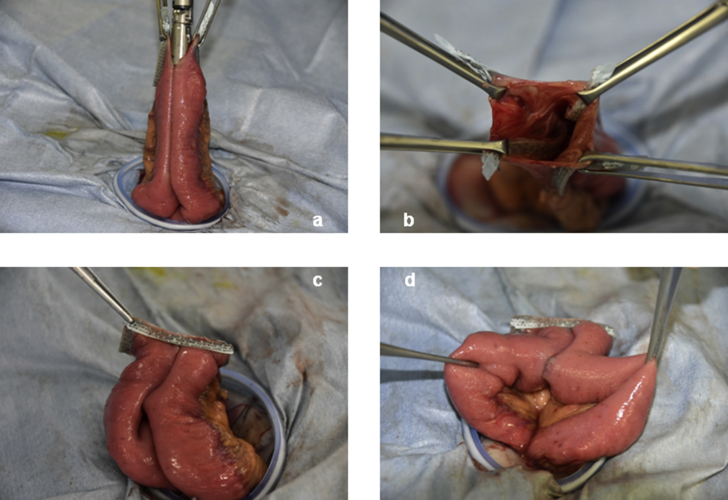
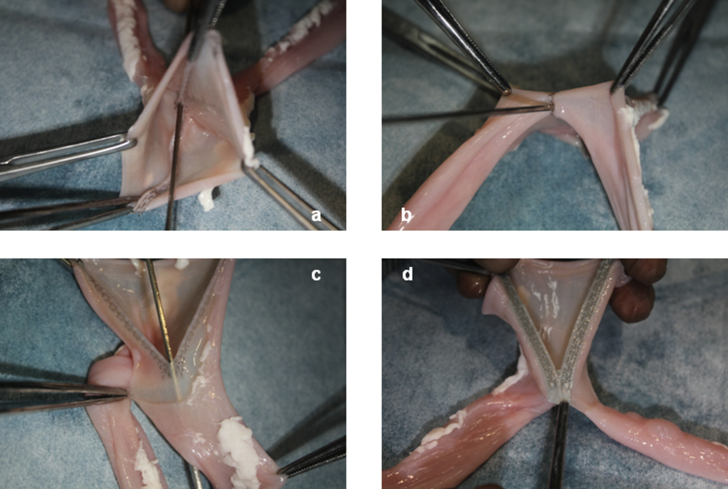
This study examined the clinical application of functional end-to-end anastomosis with a stapler that automatically applies a bioabsorbable polyglycolic acid sheet (Endo GIA™ Reinforced Reload with Tri-Staple™ Technology). A porcine model was used to examine functional end-to-end anastomosis with and without application of a bioabsorbable polyglycolic acid sheet. As the crotch of the anastomosis is considered the weakest point, a probe was used to test the integrity of these anastomoses. Furthermore, we performed functional end-to-end anastomosis using the Endo GIA™ Reinforced stapler in a clinical series of 20 patients undergoing gastrointestinal tract resection. In all cases, functional end-to-end anastomosis was performed without suture reinforcement.
Small intestine anastomoses in the animal study exhibited no weakness at the crotch of the anastomosis, as tested with a probe, suggesting an increased resiliency to conventional complications of functional end-to-end anastomosis. In the clinical population, no postoperative complications were noted. No adhesive intestinal obstruction was noted.
Sutureless functional end-to-end anastomosis using the Endo GIA™ Reinforced appears to be safe, efficacious, and straightforward. Reinforcement of the crotch site with a bioabsorbable polyglycolic acid sheet appears to mitigate conventional problems with crotch-site vulnerability.
胃肠道吻合术仍然伴随着相当高的发病负担,在某些情况下甚至有死亡风险。功能性端端吻合术虽然效率极高,但在术后即刻易受肠内压力升高的影响,这可能会导致吻合口漏或出血。因此,需要新的技术来促进安全有效的吻合手术。
本研究考察了使用自动应用生物可吸收聚乙醇酸片(Endo GIA™ 带三钉™ 技术加强型钉仓)的吻合器进行功能性端端吻合术的临床应用。使用猪模型来考察应用和不应用生物可吸收聚乙醇酸片的功能性端端吻合术。由于吻合口的分叉处被认为是最薄弱的点,因此使用探针来测试这些吻合口的完整性。此外,我们在20例接受胃肠道切除术的临床病例系列中使用Endo GIA™ 加强型吻合器进行功能性端端吻合术。在所有病例中,功能性端端吻合术均未进行缝合加强。
在动物研究中,经探针测试,小肠吻合口在吻合口分叉处未显示出薄弱点,这表明对功能性端端吻合术的传统并发症具有更强的耐受性。在临床病例中,未观察到术后并发症。未发现粘连性肠梗阻。
使用Endo GIA™ 加强型吻合器进行的无缝合功能性端端吻合术似乎是安全、有效且简便的。用生物可吸收聚乙醇酸片加强吻合口分叉处似乎可减轻分叉处易损性的传统问题。