Kang Seok-Jin, Park Young-Il, Hwang So-Ryeon, Yi Hee, Tham Nga, Ku Hyun-Ok, Song Jae-Young, Kang Hwan-Goo
Vet Drugs and Biologics Division, Animal and Plant Quarantine Agency, 177, Hyeoksin 8-ro, Gimcheon-si, Gyeongsangbuk-do, 39660, Republic of Korea.
Stem Cell Res Ther. 2017 Apr 17;8(1):78. doi: 10.1186/s13287-017-0517-2.
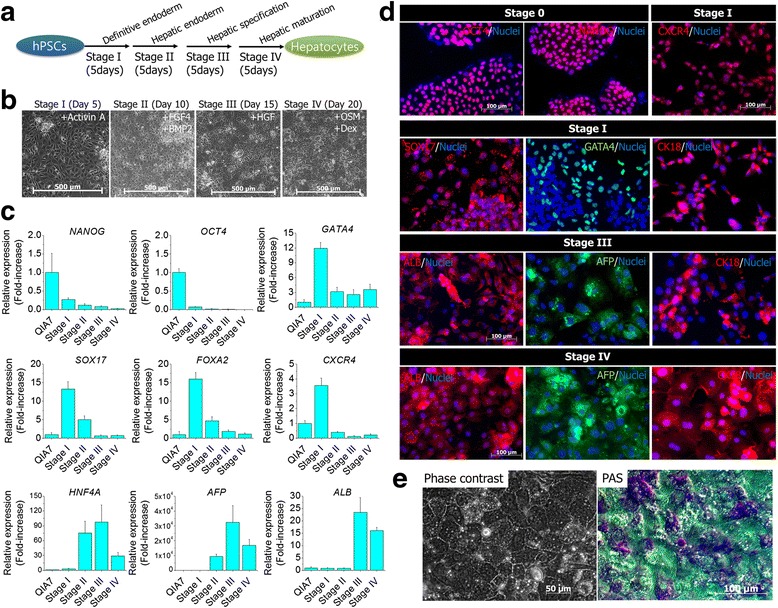
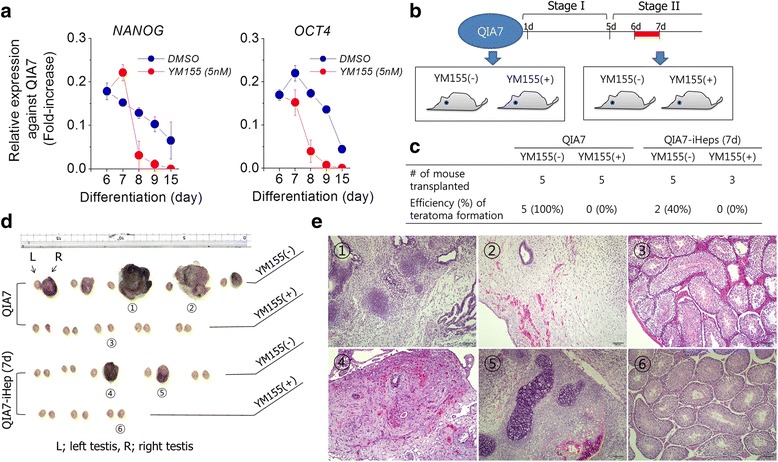
Pluripotent stem cells (PSCs) such as embryonic stem cells and induced pluripotent stem cells are promising target cells for cell regenerative medicine together with recently advanced technology of in-vitro differentiation. However, residual undifferentiated stem cells (USCs) during in-vitro differentiation are considered a potential risk for development of cancer cells and nonspecific lineage cell types. In this study we observed that USCs still exist during hepatic differentiation, consequently resulting in poor quality of the hepatic population and forming teratoma in vivo. Therefore, we hypothesized that effectively removing USCs from in-vitro differentiation could improve the quality of the hepatic population and guarantee safety from risk of teratoma formation.
Human PSCs were differentiated to hepatocytes via four steps. YM155, a known BIRC5 inhibitor, was applied for removing the residual USCs on the hepatic differentiation. After YM155 treatment, hepatocyte development was evaluated by measuring gene expression, immunostaining and hepatic functions at each stage of differentiation, and forming teratomas were confirmed by cell transplantation with or without YM155.
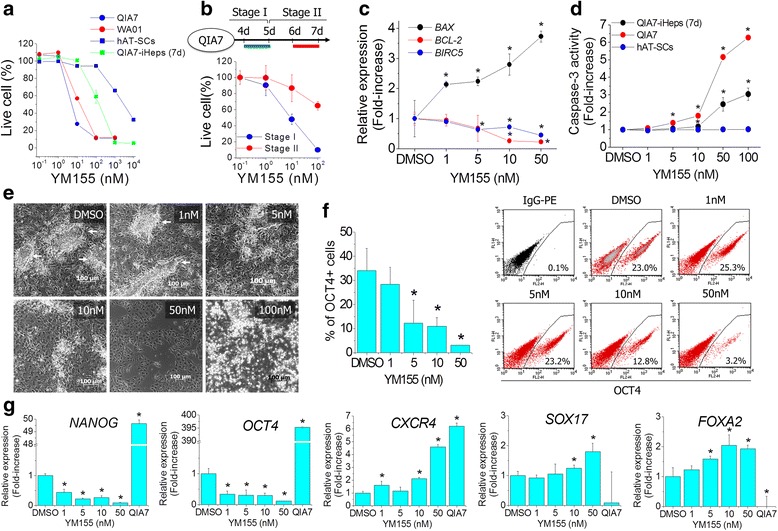
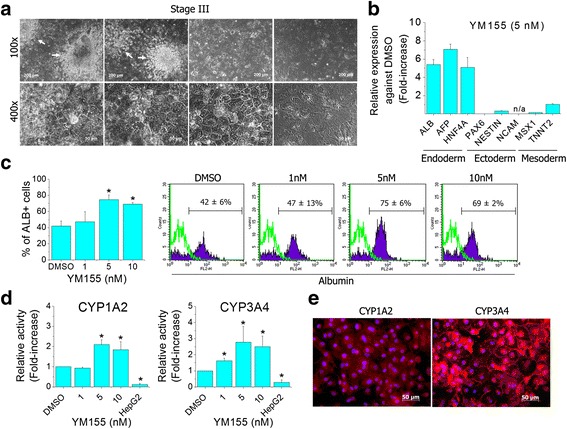
The selected concentrations of YM155 removed USCs (NANOG and OCT4) in a dose-dependent manner. As a result, expression of endodermal markers (SOX17, FOXA2 and CXCR4) at stage II of differentiation and hepatic markers (ALB, AFP and HNF4A) at stage III was up-regulated by YM155 treatment as well as the hepatic population (ALB), and functions (ALB/urea secretion and CYP450 enzyme activity) were enhanced at the final stage of differentiation (stage IV). Furthermore, we demonstrated that NANOG and OCT4 expression remaining until stage III (day 15 of differentiation) completely disappeared when treated with YM155 and teratoma formation was effectively prevented by YM155 pretreatment in the in-vitro study.
We suggest that the removal of USCs using YM155 could improve the quantity and quality of induced hepatocytes and eliminate the potential risk of teratoma formation.
多能干细胞(PSCs),如胚胎干细胞和诱导多能干细胞,连同最近先进的体外分化技术,是细胞再生医学中很有前景的靶细胞。然而,体外分化过程中残留的未分化干细胞(USCs)被认为是癌细胞和非特异性谱系细胞类型发展的潜在风险。在本研究中,我们观察到在肝脏分化过程中仍存在USCs,因此导致肝脏群体质量不佳,并在体内形成畸胎瘤。因此,我们假设从体外分化中有效去除USCs可以提高肝脏群体的质量,并确保避免畸胎瘤形成的风险。
人PSCs通过四个步骤分化为肝细胞。应用已知的BIRC5抑制剂YM155去除肝脏分化过程中残留的USCs。YM155处理后,通过在分化的每个阶段测量基因表达、免疫染色和肝功能来评估肝细胞发育,并通过有或没有YM155的细胞移植来确认畸胎瘤的形成。
所选浓度的YM155以剂量依赖的方式去除USCs(NANOG和OCT4)。结果,YM155处理上调了分化II期的内胚层标志物(SOX17、FOXA2和CXCR4)以及分化III期的肝脏标志物(ALB、AFP和HNF4A)的表达,以及肝脏群体(ALB),并且在分化的最后阶段(IV期)功能(ALB/尿素分泌和CYP450酶活性)得到增强。此外,我们证明在体外研究中,用YM155处理时,直到III期(分化第15天)仍保留的NANOG和OCT4表达完全消失,并且YM155预处理有效地防止了畸胎瘤的形成。
我们建议使用YM155去除USCs可以提高诱导肝细胞的数量和质量,并消除畸胎瘤形成的潜在风险。