Ussher Jane M, Perz Janette
Translational Health Research Institute (THRI), School of Medicine, Western Sydney University, Sydney, New South Wales, Australia.
PLoS One. 2017 Apr 18;12(4):e0175068. doi: 10.1371/journal.pone.0175068. eCollection 2017.
A randomised control trial (RCT) was conducted to examine the efficacy of couple-based cognitive behaviour therapy (CBT) for Premenstrual Disorders (PMDs), in comparison to one-to-one CBT and a wait-list control.
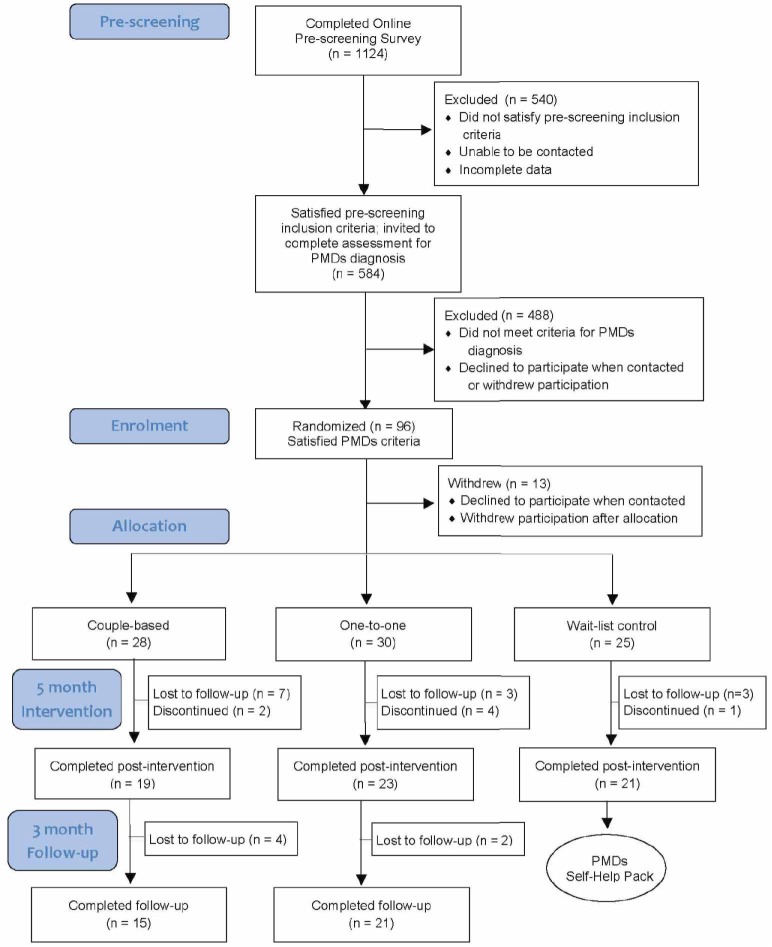
Triangulation of quantitative and qualitative outcome measures evaluated changes pre-post intervention. Eighty three women were randomly allocated across three conditions, with 63 completing post-intervention measures, a retention rate of 76%.
Repeated measures analysis of variance found a significant time by group interaction identifying that women in the two CBT conditions reported lower total premenstrual symptoms, emotional reactivity/mood, and premenstrual distress, in comparison to the wait list control. Significantly higher active behavioural coping post-intervention was found in the couple condition than in the one-to-one and wait list control groups. Qualitative analysis provided insight into the subjective experience of PMDs and participation in the intervention study. Across groups, women reported increased awareness and understanding of premenstrual change post-intervention. A larger proportion of women in the CBT conditions reported reduction in intensity and frequency of negative premenstrual emotional reactivity, increased communication and help-seeking, increased understanding and acceptance of embodied change, and the development of coping skills, post-intervention. Increased partner understanding and improved relationship post-intervention was reported by a greater proportion of participants in the CBT conditions, most markedly in the couple condition.
These findings suggest that one-to-one and couple CBT interventions can significantly reduce women's premenstrual symptomatology and distress, and improve premenstrual coping. Couple based CBT interventions may have a greater positive impact upon behavioural coping and perceptions of relationship context and support. This suggests that CBT should be available for women reporting moderate-severe PMDs, with couple-based CBT offering additional benefits to a one-to-one modality.
开展了一项随机对照试验(RCT),以研究基于夫妻的认知行为疗法(CBT)治疗经前疾病(PMD)的疗效,并与一对一CBT及等待名单对照组进行比较。
采用定量和定性结果测量相结合的方法评估干预前后的变化。83名女性被随机分配到三种情况中,63人完成了干预后的测量,保留率为76%。
重复测量方差分析发现,组间交互作用存在显著的时间效应,表明与等待名单对照组相比,两种CBT情况下的女性报告的经前总症状、情绪反应性/情绪和经前困扰较低。与一对一和等待名单对照组相比,夫妻组干预后积极行为应对显著更高。定性分析深入了解了PMD的主观体验以及参与干预研究的情况。在所有组中,女性报告干预后对经前变化的认识和理解有所增加。在CBT情况下,更大比例的女性报告干预后经前负面情绪反应的强度和频率降低、沟通和求助增加、对身体变化的理解和接受增加以及应对技能的发展。CBT情况下更大比例的参与者报告干预后伴侣的理解增加且关系改善,在夫妻组中最为明显。
这些发现表明,一对一和基于夫妻的CBT干预可显著减轻女性的经前症状和困扰,并改善经前应对。基于夫妻的CBT干预可能对行为应对以及对关系背景和支持的认知产生更大的积极影响。这表明,对于报告有中度至重度PMD的女性应提供CBT,基于夫妻的CBT比一对一形式有更多益处。