Chen Yicheng, Zheng Zhaoxia, Gong Mingyang, Yu Fengqi
Shenzhen Institutes of Advanced Technology, Chinese Academy of Sciences, Shenzhen 518055, China.
School of Optical and Electronic Information, Huazhong University of Science & Technology, Wuhan 430074, China.
Sensors (Basel). 2017 Apr 14;17(4):867. doi: 10.3390/s17040867.
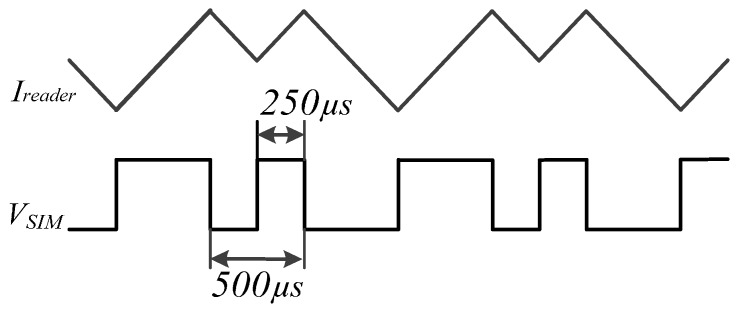
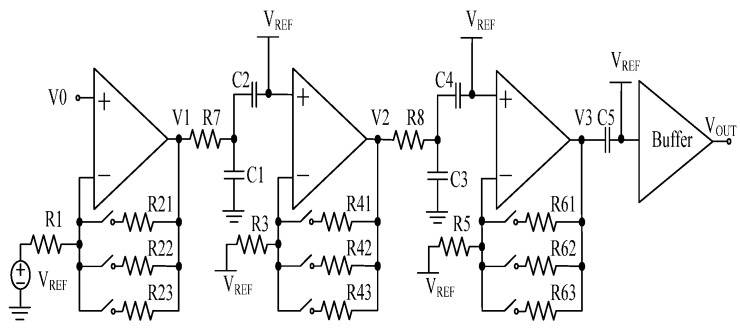
Power consumption and communication distance have become crucial challenges for SIM card RFID (radio frequency identification) applications. The combination of long distance 2.45 GHz radio frequency (RF) technology and low power 2 kHz near distance communication is a workable scheme. In this paper, an ultra-low frequency 2 kHz near field communication (NFC) method suitable for SIM cards is proposed and verified in silicon. The low frequency transmission model based on electromagnetic induction is discussed. Different transmission modes are introduced and compared, which show that the baseband transmit mode has a better performance. The low-pass filter circuit and programmable gain amplifiers are applied for noise reduction and signal amplitude amplification. Digital-to-analog converters and comparators are used to judge the card approach and departure. A novel differential Manchester decoder is proposed to deal with the internal clock drift in range-controlled communication applications. The chip has been fully implemented in 0.18 µm complementary metal-oxide-semiconductor (CMOS) technology, with a 330 µA work current and a 45 µA idle current. The low frequency chip can be integrated into a radio frequency SIM card for near field RFID applications.
功耗和通信距离已成为SIM卡射频识别(RFID)应用的关键挑战。长距离2.45 GHz射频(RF)技术与低功耗2 kHz近距离通信相结合是一种可行的方案。本文提出了一种适用于SIM卡的超低频2 kHz近场通信(NFC)方法,并在硅片中进行了验证。讨论了基于电磁感应的低频传输模型。介绍并比较了不同的传输模式,结果表明基带发射模式具有更好的性能。低通滤波器电路和可编程增益放大器用于降噪和信号幅度放大。数模转换器和比较器用于判断卡的靠近和离开。提出了一种新颖的差分曼彻斯特解码器,以处理距离控制通信应用中的内部时钟漂移。该芯片已采用0.18 µm互补金属氧化物半导体(CMOS)技术完全实现,工作电流为330 µA,空闲电流为45 µA。该低频芯片可集成到用于近场RFID应用的射频SIM卡中。