Repetto Ombretta, De Re Valli, De Paoli Antonino, Belluco Claudio, Alessandrini Lara, Canzonieri Vincenzo, Cannizzaro Renato
Facility of Bio-Proteomics, Immunopathology and Cancer Biomarkers, IRCCS CRO National Cancer Institute, Aviano, Italy.
Radiation Oncology, IRCCS CRO National Cancer Institute, Aviano, Italy.
Oncotarget. 2017 Apr 25;8(17):28328-28341. doi: 10.18632/oncotarget.16053.
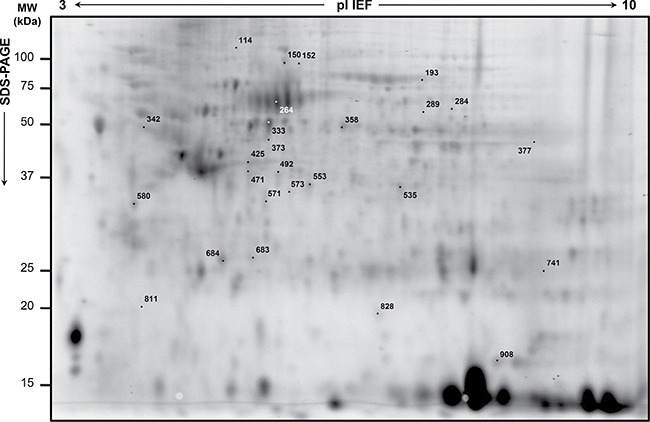
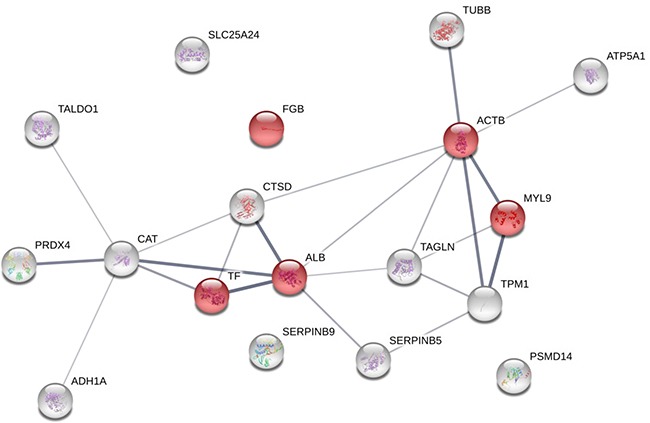
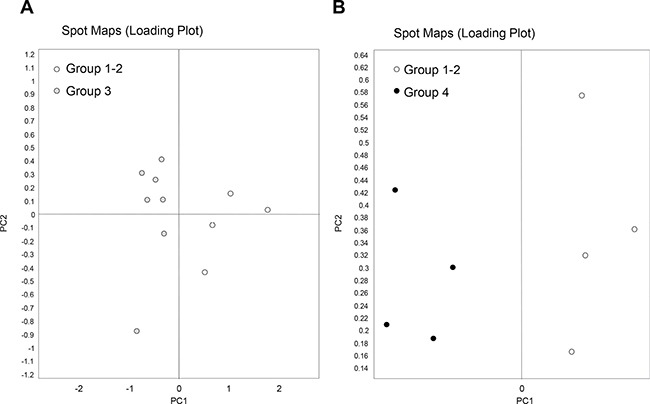
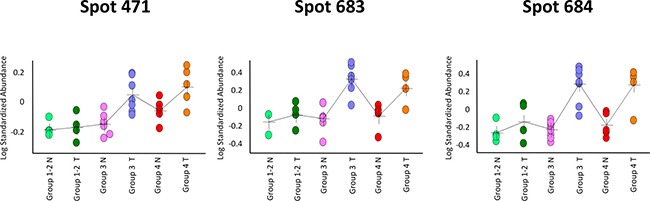
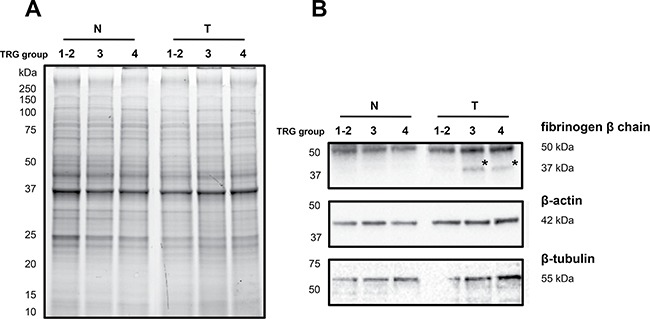
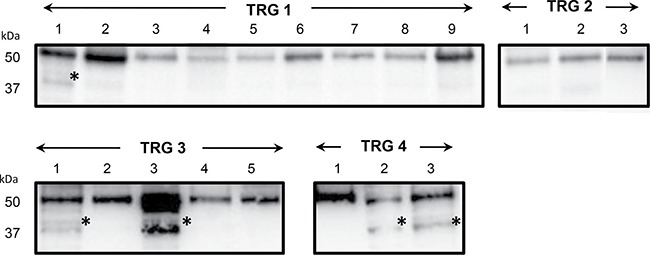
Preoperative neoadjuvant chemoradiotherapy (nCRT) is the gold standard in locally advanced rectal cancer, only 10-30% of patients achieving benefits. Currently, there is a need of a reliable selection of markers for the identification of poor or non-responders prior to therapy. In this work, we compared protein profiles before therapy of patients differing in their responses to nCRT to find novel predictive markers of response to therapy. Patients were grouped into 3 groups according to their tumor regression grading (TRG) after surgery: 'TRG 1-2', good responders, 'TRG 3' and 'TRG 4', poor responders. Paired surgical specimens of rectal cancer and healthy (histologically confirmed) rectal tissues from 15 patients were analysed before nCRT by two dimensional difference in gel electrophoresis followed by mass spectrometry. Thirty spots were found as differentially expressed (p < 0.05). Among them, 3 spots (spots 471, 683 and 684) showed an increased amount of protein in poor responders compared with good responders, and they were more tumor associated compared with healthy tissues. Proteins of these spots were identified as fibrinogen ß chain fragment D, actin isoforms, B9 and B5 serpins, cathepsin D isoforms and peroxiredoxin-4. In an independent validation set of 20 rectal carcinomas we validated the increased fibrinogen ß chain abundance before nCRT in poor responders by immunoblotting. In conclusion, we propose a risk-stratification tool in predicting the response to nCRT treatment in rectal cancer based on the quantity of these proteins.
术前新辅助放化疗(nCRT)是局部晚期直肠癌的金标准,但只有10%-30%的患者能从中获益。目前,需要一种可靠的标志物筛选方法,以便在治疗前识别出疗效不佳或无反应的患者。在本研究中,我们比较了对nCRT反应不同的患者治疗前的蛋白质谱,以寻找新的治疗反应预测标志物。根据术后肿瘤消退分级(TRG),将患者分为3组:“TRG 1-2”为反应良好组,“TRG 3”和“TRG 4”为反应不佳组。对15例患者的配对直肠癌手术标本和健康(经组织学证实)直肠组织在nCRT前进行二维差异凝胶电泳分析,随后进行质谱分析。发现30个斑点存在差异表达(p<0.05)。其中,3个斑点(斑点471、683和684)在反应不佳组中蛋白质含量高于反应良好组,且与健康组织相比,它们与肿瘤的相关性更强。这些斑点的蛋白质被鉴定为纤维蛋白原β链片段D、肌动蛋白异构体、B9和B5丝氨酸蛋白酶抑制剂、组织蛋白酶D异构体和过氧化物酶体增殖物激活受体4。在一个包含20例直肠癌的独立验证组中,我们通过免疫印迹法验证了反应不佳组在nCRT前纤维蛋白原β链丰度增加。总之,我们基于这些蛋白质的含量,提出了一种预测直肠癌对nCRT治疗反应的风险分层工具。