Han Ying, Liu Mei, Wang Ziyi, Huang Manni, Xu Ningzhi, Wu Lingying
Department of Gynecologic Oncology, National Cancer Center/Cancer Hospital, Chinese Academy of Medical Sciences & Peking Union Medical College, Beijing, PR China.
Laboratory of Cell and Molecular Biology & State Key Laboratory of Molecular Oncology, National Cancer Center/Cancer Hospital, Chinese Academy of Medical Sciences & Peking Union Medical College, Beijing, PR China.
Transl Oncol. 2017 Jun;10(3):378-384. doi: 10.1016/j.tranon.2017.03.005. Epub 2017 Apr 19.
To investigate the serum microRNAs as biomarkers in predicting chemoradiotherapy resistance in advanced-stage cervical squamous cell carcinoma (ACSCC) patients.
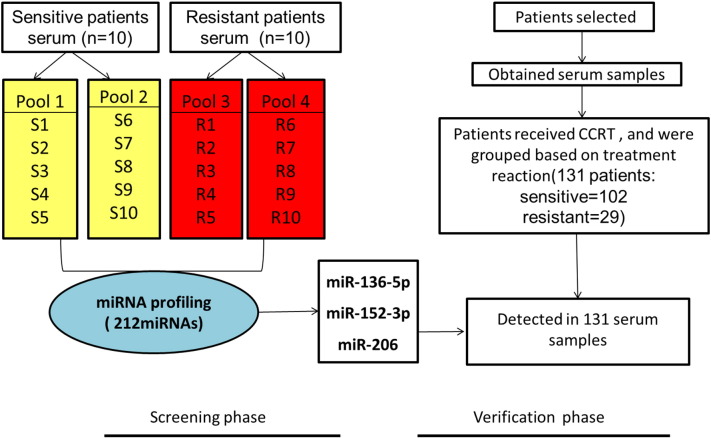
Serum samples were collected from International Federation of Gynecology and Obstetrics (FIGO) stage IIB to IIIB cervical squamous cell carcinoma patients treated with platinum based Concomitant Chemoradiotherapy (CCRT) in our hospital during September 2013 to November 2015. Twenty well-matched samples (10 resistant and 10 sensitive) were chosen to screen the miRNA expression profile using serum samples pooled with microarrays. miRNAs expressed significantly different between two groups were further verified in 131 patients (29 resistant and 102 sensitive) serum samples with TaqMan Real-time PCR. The AUC was used to evaluate the accuracy of the biomarkers for prediction.
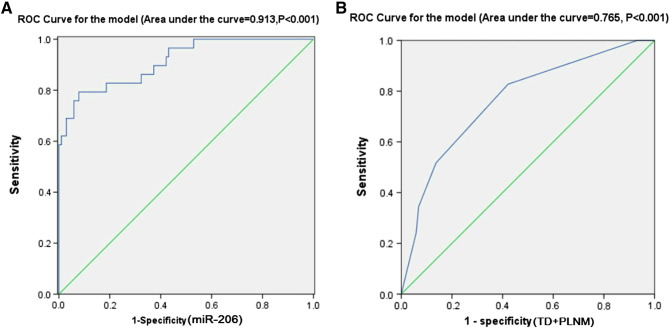
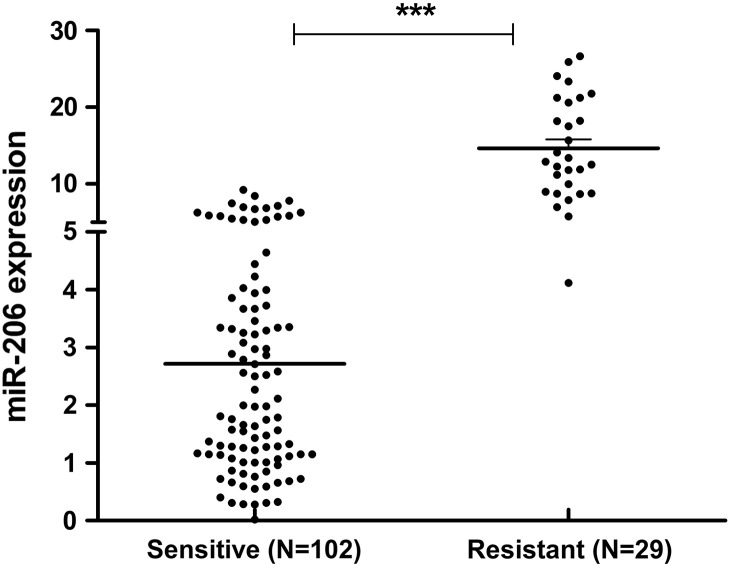
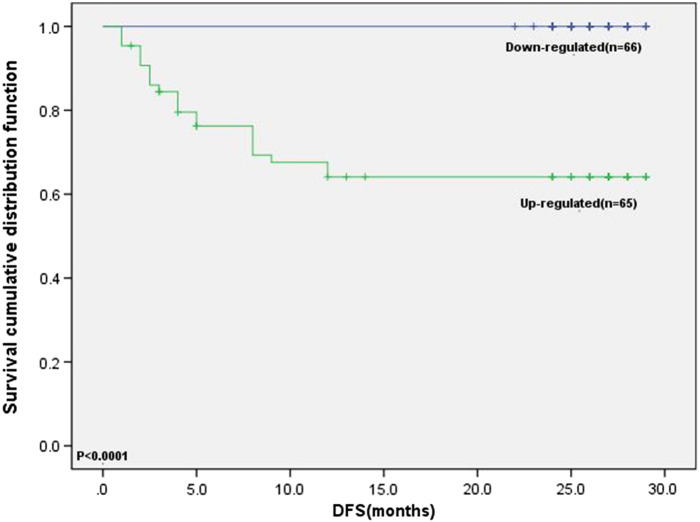
MiR-136-5, miR-152-3p and miR-206 were expressed significantly different between sensitive and resistant groups. Results of 131 patients verification showed that the levels of miR-206 in sensitive samples and resistant samples were 2.715±0.2115 and 14.64±1.184, respectively, which was significantly different (P<.0001), while miR-136-5p and miR-152-3p could not be tested without pre-amplification reactions. Univariate analysis revealed that miR-206 expression was significantly associated with patients' DFS. Multivariate analysis demonstrated that miR-206 expression, tumor differentiation and pelvic lymph nodes metastasis were the independent prognostic factors associated with DFS in this cohort (P=.008, 0.000, 0.000, respectively). The probability of the prognostic accuracy of miR-206 expression in predicting chemoradiotherapy sensitivity of ACSCC patients was 91.3% (79.3% sensitivity and 92.2% specificity).
Serum miR-206 is a powerful tool in predicting chemoradiotherapy sensitivity in ACSCC patients.
探讨血清微小RNA作为生物标志物预测晚期宫颈鳞状细胞癌(ACSCC)患者放化疗耐药性的价值。
收集2013年9月至2015年11月在我院接受铂类同步放化疗(CCRT)的国际妇产科联盟(FIGO)IIB至IIIB期宫颈鳞状细胞癌患者的血清样本。选取20例匹配良好的样本(10例耐药和10例敏感),使用微阵列芯片对混合血清样本进行微小RNA表达谱筛选。对两组间表达有显著差异的微小RNA,在131例患者(29例耐药和102例敏感)的血清样本中采用TaqMan实时荧光定量PCR进一步验证。采用受试者工作特征曲线下面积(AUC)评估生物标志物预测的准确性。
MiR-136-5、miR-152-3p和miR-206在敏感组和耐药组中的表达存在显著差异。131例患者的验证结果显示,敏感样本和耐药样本中miR-206的水平分别为2.715±0.2115和14.64±1.184,差异有统计学意义(P<0.0001),而miR-136-5p和miR-152-3p未经预扩增反应无法检测。单因素分析显示,miR-206表达与患者无病生存期(DFS)显著相关。多因素分析表明,miR-206表达、肿瘤分化程度和盆腔淋巴结转移是该队列中与DFS相关的独立预后因素(P分别为0.008、0.000、0.000)。miR-206表达预测ACSCC患者放化疗敏感性的预后准确性概率为91.3%(敏感性为79.3%,特异性为92.2%)。
血清miR-206是预测ACSCC患者放化疗敏感性的有力工具。