Yamaguchi Miki, Hirai Sachie, Sumi Toshiyuki, Tanaka Yusuke, Tada Makoto, Nishii Yukari, Hasegawa Tadashi, Uchida Hiroaki, Yamada Gen, Watanabe Atsushi, Takahashi Hiroki, Sakuma Yuji
Department of Molecular Medicine, Research Institute for Frontier Medicine, Sapporo Medical University School of Medicine, Sapporo, Japan.
Department of Molecular Medicine, Research Institute for Frontier Medicine, Sapporo Medical University School of Medicine, Sapporo, Japan; Department of Respiratory Medicine and Allergology, Sapporo Medical University School of Medicine, Sapporo, Japan.
Biochem Biophys Res Commun. 2017 Jun 3;487(3):613-618. doi: 10.1016/j.bbrc.2017.04.102. Epub 2017 Apr 20.
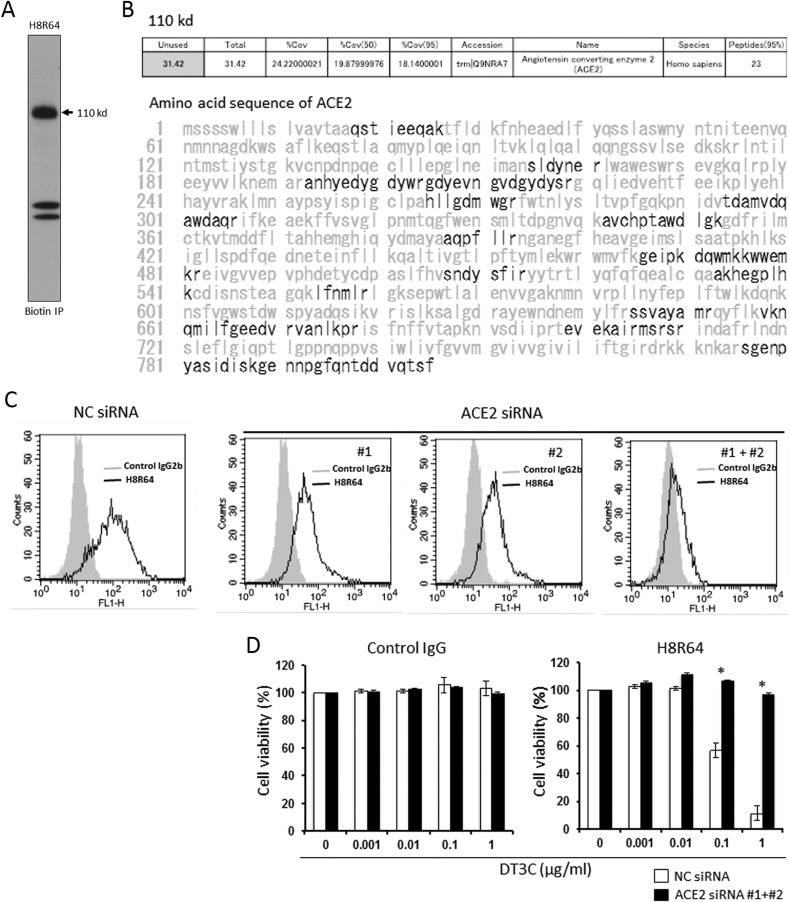
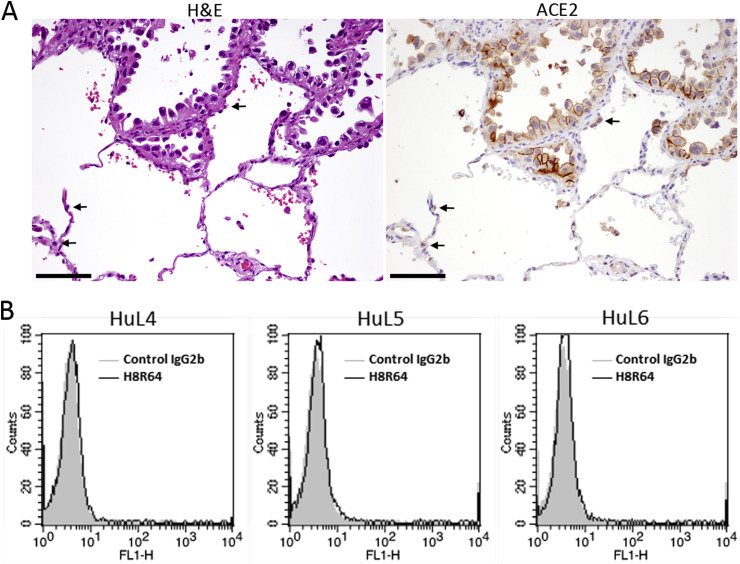
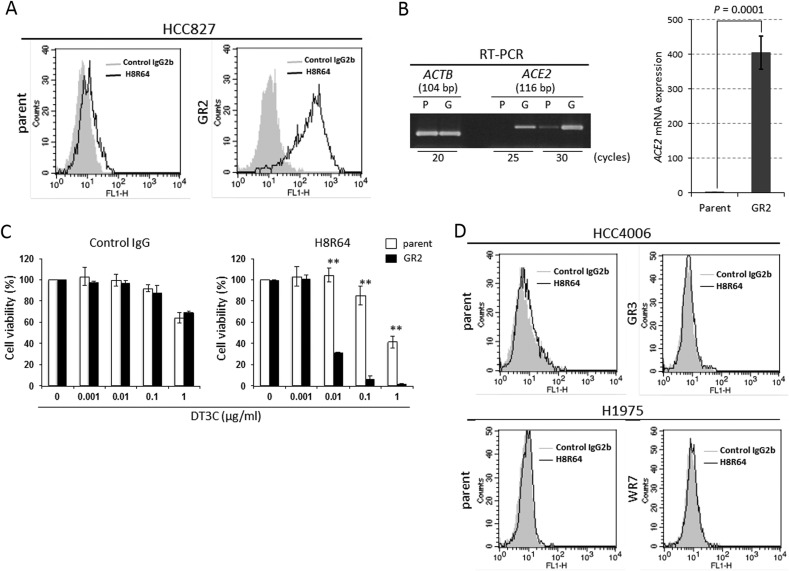
EGFR-mutant lung adenocarcinomas contain a subpopulation of cells that have undergone epithelial-to-mesenchymal transition and can grow independently of EGFR. To kill these cancer cells, we need a novel therapeutic approach other than EGFR inhibitors. If a molecule is specifically expressed on the cell surface of such EGFR-independent EGFR-mutant cancer cells, it can be a therapeutic target. We found that a mesenchymal EGFR-independent subline derived from HCC827 cells, an EGFR-mutant lung adenocarcinoma cell line, expressed angiotensin-converting enzyme 2 (ACE2) to a greater extent than its parental cells. ACE2 was also expressed at least partially in most of the primary EGFR-mutant lung adenocarcinomas examined, and the ACE2 expression level in the cancer cells was much higher than that in normal lung epithelial cells. In addition, we developed an anti-ACE2 mouse monoclonal antibody (mAb), termed H8R64, that was internalized by ACE2-expressing cells. If an antibody-drug conjugate consisting of a humanized mAb based on H8R64 and a potent anticancer drug were produced, it could be effective for the treatment of EGFR-mutant lung adenocarcinomas.
表皮生长因子受体(EGFR)突变的肺腺癌包含一群经历了上皮-间质转化且能独立于EGFR生长的细胞。为了杀死这些癌细胞,我们需要一种不同于EGFR抑制剂的新型治疗方法。如果一种分子在这种不依赖EGFR的EGFR突变癌细胞的细胞表面特异性表达,那么它可以成为一个治疗靶点。我们发现,从EGFR突变的肺腺癌细胞系HCC827衍生出的一个不依赖EGFR的间充质亚系,其血管紧张素转换酶2(ACE2)的表达程度高于其亲本细胞。在大多数检测的原发性EGFR突变肺腺癌中,ACE2也至少部分表达,并且癌细胞中的ACE2表达水平远高于正常肺上皮细胞。此外,我们开发了一种抗ACE2小鼠单克隆抗体(mAb),称为H8R64,它能被表达ACE2的细胞内化。如果生产一种由基于H8R64的人源化单克隆抗体和一种强效抗癌药物组成的抗体-药物偶联物,它可能对EGFR突变肺腺癌的治疗有效。