Crawford Sarah E, Hartung Thomas, Hollert Henner, Mathes Björn, van Ravenzwaay Bennard, Steger-Hartmann Thomas, Studer Christoph, Krug Harald F
Institute for Environmental Research, RWTH Aachen University, Worringerweg 1, 52074 Aachen, Germany.
John Hopkins University, Bloomberg School of Public Health, 615 N. Wolfe Street, Baltimore, MD 21205 USA.
Environ Sci Eur. 2017;29(1):16. doi: 10.1186/s12302-017-0115-z. Epub 2017 Apr 4.
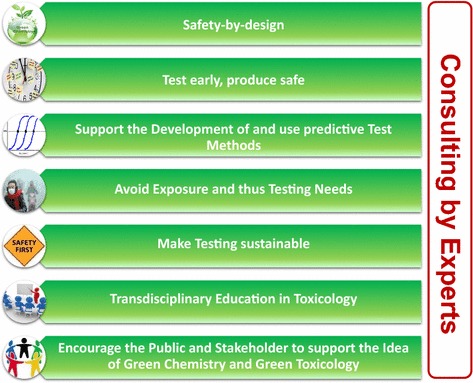
Green Toxicology refers to the application of predictive toxicology in the sustainable development and production of new less harmful materials and chemicals, subsequently reducing waste and exposure. Built upon the foundation of "Green Chemistry" and "Green Engineering", "Green Toxicology" aims to shape future manufacturing processes and safe synthesis of chemicals in terms of environmental and human health impacts. Being an integral part of Green Chemistry, the principles of Green Toxicology amplify the role of health-related aspects for the benefit of consumers and the environment, in addition to being economical for manufacturing companies. Due to the costly development and preparation of new materials and chemicals for market entry, it is no longer practical to ignore the safety and environmental status of new products during product development stages. However, this is only possible if toxicologists and chemists work together early on in the development of materials and chemicals to utilize safe design strategies and innovative in vitro and in silico tools. This paper discusses some of the most relevant aspects, advances and limitations of the emergence of Green Toxicology from the perspective of different industry and research groups. The integration of new testing methods and strategies in product development, testing and regulation stages are presented with examples of the application of in silico, omics and in vitro methods. Other tools for Green Toxicology, including the reduction of animal testing, alternative test methods, and read-across approaches are also discussed.
绿色毒理学是指预测毒理学在新型低危害材料和化学品的可持续开发与生产中的应用,从而减少废物和接触。基于“绿色化学”和“绿色工程”的基础,“绿色毒理学”旨在从环境和人类健康影响的角度塑造未来的制造工艺和化学品的安全合成。作为绿色化学的一个组成部分,绿色毒理学的原则不仅对制造公司具有经济性,还增强了与健康相关方面的作用,以造福消费者和环境。由于开发和准备用于进入市场的新材料和化学品成本高昂,在产品开发阶段忽视新产品的安全和环境状况已不再可行。然而,只有毒理学家和化学家在材料和化学品开发的早期就共同努力,利用安全设计策略以及创新的体外和计算机模拟工具,才有可能做到这一点。本文从不同行业和研究团体的角度讨论了绿色毒理学出现的一些最相关的方面、进展和局限性。文中通过计算机模拟、组学和体外方法应用的实例,介绍了在产品开发、测试和监管阶段新测试方法和策略的整合。还讨论了绿色毒理学的其他工具,包括减少动物试验、替代测试方法和类推法。