Allam-Ndoul Bénédicte, Guénard Frédéric, Barbier Olivier, Vohl Marie-Claude
Institute of Nutrition and Functional Foods (INAF), Pavillon des Services, 2440 Hochelaga Blvd, Laval University, Québec City, QC G1V 0A6, Canada.
Laboratory of Molecular Pharmacology, CHU de Québec Research Center, Québec City, QC G1V 0A6, Canada.
Nutrients. 2017 Apr 25;9(5):424. doi: 10.3390/nu9050424.
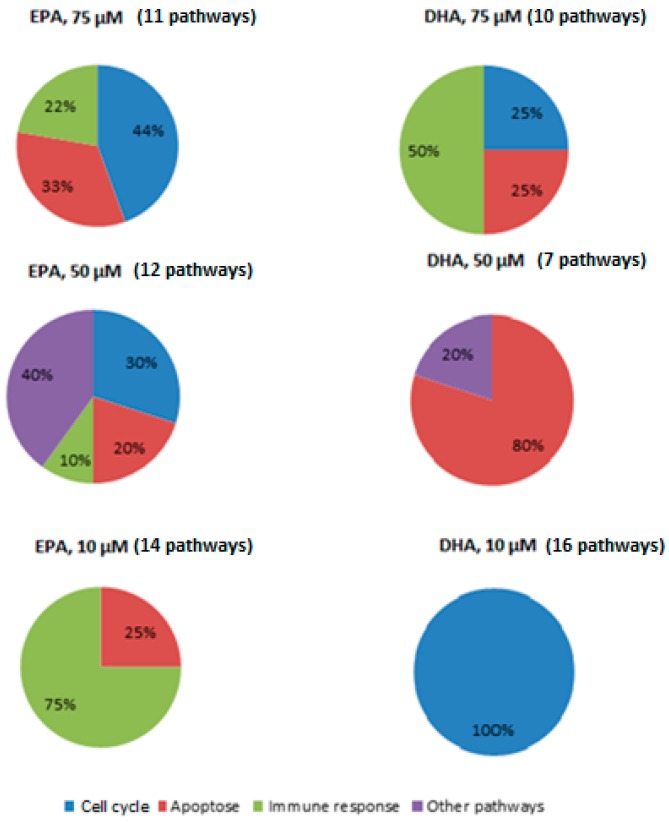
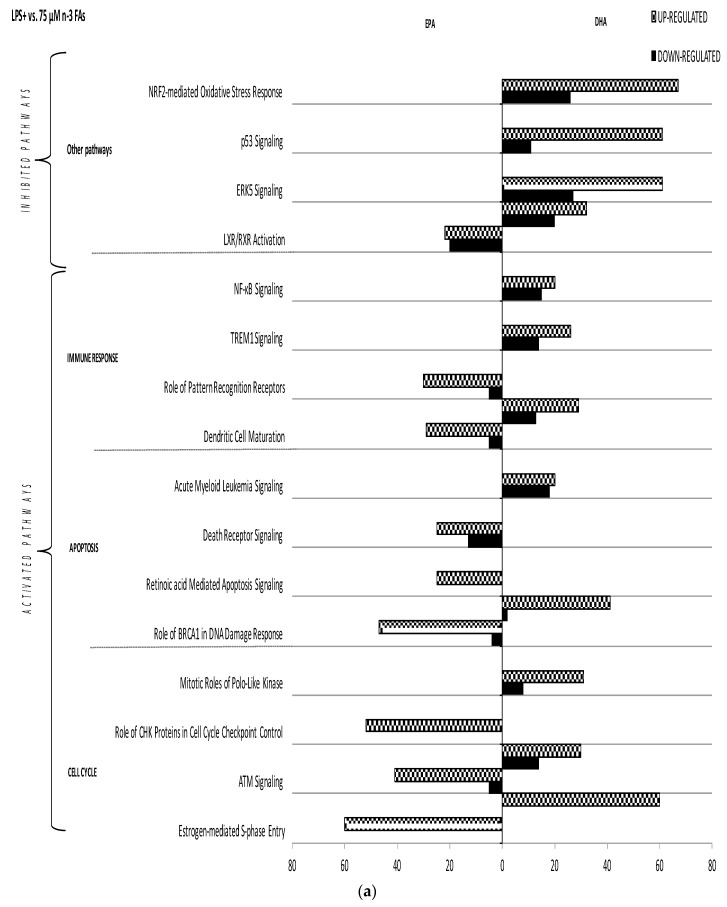
An appropriate intake of omega-3 (-3) fatty acids (FAs) such as eicosapentaenoic and docosahexaenoic acid (EPA/DHA) from marine sources is known to have anti-inflammatory effects. However, molecular mechanisms underlying their beneficial effects on health are not fully understood. The aim of the present study was to characterize gene expression profiles of THP-1 macrophages, incubated in either EPA or DHA and stimulated with lipopolysaccharide (LPS), a pro-inflammatory agent. THP-1 macrophages were incubated into 10, 50 and 75 µM of EPA or DHA for 24 h, and 100 nM of LPS was added to the culture media for 18 h. Total mRNA was extracted and gene expression examined by microarray analysis using Illumina Human HT-12 expression beadchips (Illumina). Pathway analysis revealed that EPA and DHA regulate genes involved in cell cycle regulation, apoptosis, immune response and inflammation, oxidative stress and cancer pathways in a differential and dose-dependent manner. EPA and DHA appear to exert differential effects on gene expression in THP-1 macrophages. Specific effects of -3 FAs on gene expression levels are also dose-dependent.
已知从海洋来源摄入适量的ω-3(-3)脂肪酸(FAs),如二十碳五烯酸和二十二碳六烯酸(EPA/DHA),具有抗炎作用。然而,其对健康有益作用的分子机制尚未完全了解。本研究的目的是表征THP-1巨噬细胞的基因表达谱,该细胞在EPA或DHA中孵育并用促炎剂脂多糖(LPS)刺激。将THP-1巨噬细胞在10、50和75μM的EPA或DHA中孵育24小时,并向培养基中加入100 nM的LPS 18小时。提取总mRNA,并使用Illumina Human HT-12表达微珠芯片(Illumina)通过微阵列分析检查基因表达。通路分析表明,EPA和DHA以不同的剂量依赖性方式调节参与细胞周期调控、细胞凋亡、免疫反应和炎症、氧化应激和癌症通路的基因。EPA和DHA似乎对THP-1巨噬细胞中的基因表达产生不同的影响。-3 FAs对基因表达水平的特定影响也是剂量依赖性的。