Nakamura Sayaka, Sato Hiroaki, Tanaka Reiko, Kusuya Yoko, Takahashi Hiroki, Yaguchi Takashi
Research Institute for Sustainable Chemistry, National Institute of Advanced Industrial Science and Technology (AIST), Higashi 1-1-1, Tsukuba, Ibaraki, 305-8565, Japan.
Medical Mycology Research Center, Chiba University, 1-8-1 Inohana, Chuo-ku, Chiba, 260-8673, Japan.
BMC Microbiol. 2017 Apr 26;17(1):100. doi: 10.1186/s12866-017-1009-3.
Accurate identification of Aspergillus species is a very important subject. Mass spectral fingerprinting using matrix-assisted laser desorption ionization time-of-flight mass spectrometry (MALDI-TOF MS) is generally employed for the rapid identification of fungal isolates. However, the results are based on simple mass spectral pattern-matching, with no peak assignment and no taxonomic input. We propose here a ribosomal subunit protein (RSP) typing technique using MALDI-TOF MS for the identification and discrimination of Aspergillus species. The results are concluded to be phylogenetic in that they reflect the molecular evolution of housekeeping RSPs.
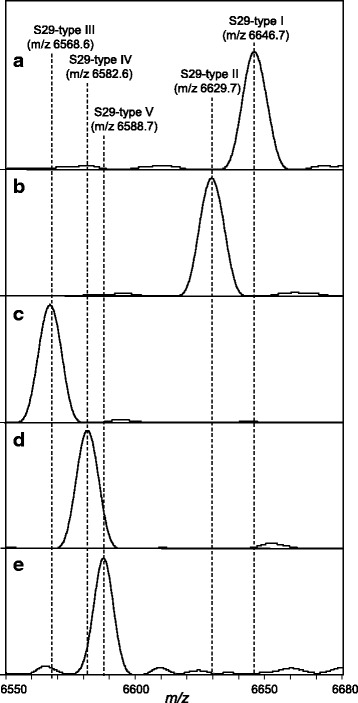
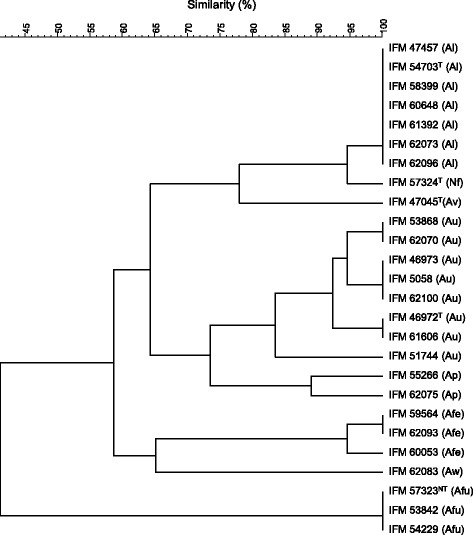
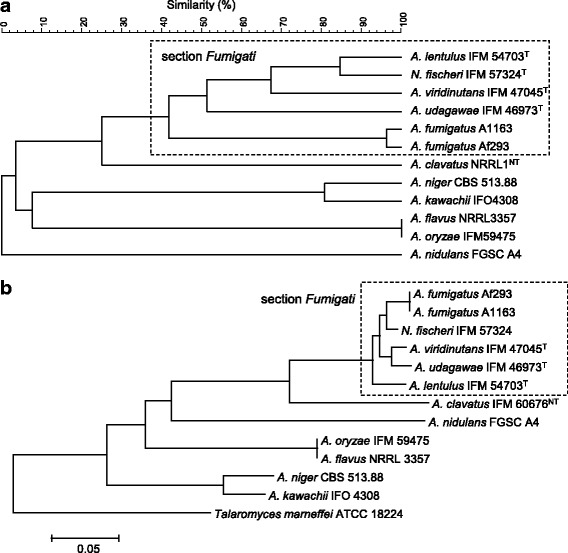
The amino acid sequences of RSPs of genome-sequenced strains of Aspergillus species were first verified and compared to compile a reliable biomarker list for the identification of Aspergillus species. In this process, we revealed that many amino acid sequences of RSPs (about 10-60%, depending on strain) registered in the public protein databases needed to be corrected or newly added. The verified RSPs were allocated to RSP types based on their mass. Peak assignments of RSPs of each sample strain as observed by MALDI-TOF MS were then performed to set RSP type profiles, which were then further processed by means of cluster analysis. The resulting dendrogram based on RSP types showed a relatively good concordance with the tree based on β-tubulin gene sequences. RSP typing was able to further discriminate the strains belonging to Aspergillus section Fumigati.
The RSP typing method could be applied to identify Aspergillus species, even for species within section Fumigati. The discrimination power of RSP typing appears to be comparable to conventional β-tubulin gene analysis. This method would therefore be suitable for species identification and discrimination at the strain to species level. Because RSP typing can characterize the strains within section Fumigati, this method has potential as a powerful and reliable tool in the field of clinical microbiology.
准确鉴定曲霉菌种是一个非常重要的课题。使用基质辅助激光解吸电离飞行时间质谱(MALDI-TOF MS)进行质谱指纹分析通常用于快速鉴定真菌分离株。然而,结果基于简单的质谱模式匹配,没有峰归属且没有分类学输入。我们在此提出一种使用MALDI-TOF MS的核糖体亚基蛋白(RSP)分型技术,用于曲霉菌种的鉴定和区分。结果被认为是系统发育的,因为它们反映了管家RSP的分子进化。
首先对曲霉菌种基因组测序菌株的RSP氨基酸序列进行验证和比较,以编制一份可靠的生物标志物列表用于曲霉菌种的鉴定。在此过程中,我们发现公共蛋白质数据库中登记的许多RSP氨基酸序列(约10%-60%,取决于菌株)需要校正或新添加。将验证后的RSP根据其质量分配到RSP类型。然后对通过MALDI-TOF MS观察到的每个样本菌株的RSP进行峰归属,以设置RSP类型谱,然后通过聚类分析进一步处理。基于RSP类型得到的树状图与基于β-微管蛋白基因序列的树状图显示出相对较好的一致性。RSP分型能够进一步区分烟曲霉组中的菌株。
RSP分型方法可用于鉴定曲霉菌种,即使是烟曲霉组内的物种。RSP分型的区分能力似乎与传统的β-微管蛋白基因分析相当。因此,该方法适用于菌株到物种水平的物种鉴定和区分。由于RSP分型可以表征烟曲霉组内的菌株,该方法有潜力成为临床微生物学领域一种强大而可靠的工具。