Grellety Emmanuel, Babakazo Pélagie, Bangana Amina, Mwamba Gustave, Lezama Ines, Zagre Noël Marie, Ategbo Eric-Alain
Independent Consultant, Paris, France.
Kinshasa School of Public Health, University of Kinshasa, Kinshasa, Democratic Republic of the Congo.
BMC Med. 2017 Apr 26;15(1):87. doi: 10.1186/s12916-017-0848-y.
Cash transfer programs (CTPs) aim to strengthen financial security for vulnerable households. This potentially enables improvements in diet, hygiene, health service access and investment in food production or income generation. The effect of CTPs on the outcome of children already severely malnourished is not well delineated. The objective of this study was to test whether CTPs will improve the outcome of children treated for severe acute malnutrition (SAM) in the Democratic Republic of the Congo over 6 months.
We conducted a cluster-randomised controlled trial in children with uncomplicated SAM who received treatment according to the national protocol and counselling with or without a cash supplement of US$40 monthly for 6 months. Analyses were by intention to treat.
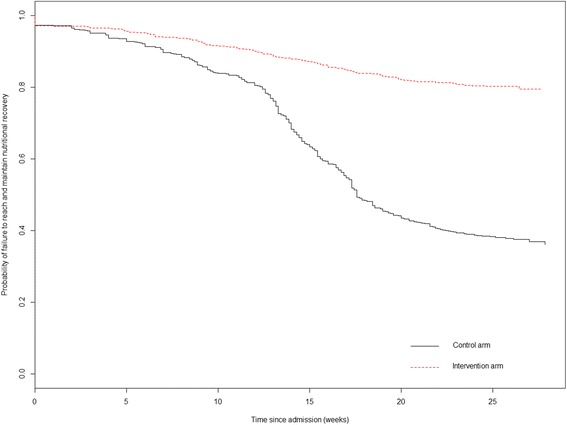
The hazard ratio of reaching full recovery from SAM was 35% higher in the intervention group than the control group (adjusted hazard ratio, 1.35, 95% confidence interval (CI) = 1.10 to 1.69, P = 0.007). The adjusted hazard ratios in the intervention group for relapse to moderate acute malnutrition (MAM) and SAM were 0.21 (95% CI = 0.11 to 0.41, P = 0.001) and 0.30 (95% CI = 0.16 to 0.58, P = 0.001) respectively. Non-response and defaulting were lower when the households received cash. All the nutritional outcomes in the intervention group were significantly better than those in the control group. After 6 months, 80% of cash-intervened children had re-gained their mid-upper arm circumference measurements and weight-for-height/length Z-scores and showed evidence of catch-up. Less than 40% of the control group had a fully successful outcome, with many deteriorating after discharge. There was a significant increase in diet diversity and food consumption scores for both groups from baseline; the increase was significantly greater in the intervention group than the control group.
CTPs can increase recovery from SAM and decrease default, non-response and relapse rates during and following treatment. Household developmental support is critical in food insecure areas to maximise the efficiency of SAM treatment programs.
ClinicalTrials.gov, NCT02460848 . Registered on 27 May 2015.
现金转移项目(CTPs)旨在加强弱势家庭的经济安全。这有可能改善饮食、卫生、医疗服务获取情况以及对粮食生产或创收的投资。现金转移项目对已经严重营养不良儿童的影响尚未明确界定。本研究的目的是检验现金转移项目是否会在6个月内改善刚果民主共和国接受重度急性营养不良(SAM)治疗儿童的治疗效果。
我们对患有单纯性重度急性营养不良的儿童进行了一项整群随机对照试验,这些儿童按照国家方案接受治疗,并接受为期6个月的咨询,咨询过程中有的家庭每月获得40美元现金补贴,有的则没有。分析采用意向性分析。
干预组从重度急性营养不良完全康复的风险比对照组高35%(调整后风险比为1.35,95%置信区间(CI)=1.10至1.69,P = 0.007)。干预组中复发至中度急性营养不良(MAM)和重度急性营养不良的调整后风险比分别为0.21(95% CI = 0.11至0.41,P = 0.001)和0.30(95% CI = 0.16至0.58,P = 0.001)。当家庭获得现金时,无应答和违约情况较少。干预组的所有营养结局均显著优于对照组。6个月后,80%接受现金干预的儿童恢复了上臂中部周长测量值以及身高/身长体重Z评分,并显示出追赶生长的迹象。对照组中不到40%的儿童取得了完全成功的结局,许多儿童出院后病情恶化。两组的饮食多样性和食物消费得分从基线开始均显著增加;干预组的增加幅度显著大于对照组。
现金转移项目可以提高重度急性营养不良的康复率,并降低治疗期间及治疗后的违约、无应答和复发率。在粮食不安全地区,家庭发展支持对于最大限度提高重度急性营养不良治疗项目的效率至关重要。
ClinicalTrials.gov,NCT02460848。于2015年5月27日注册。