Amri Fatma, Ghouili Ikram, Tonon Marie-Christine, Amri Mohamed, Masmoudi-Kouki Olfa
University of Tunis El Manar, Faculty of Sciences of Tunis, UR/11ES09 Laboratory of Functional Neurophysiology and Pathology, Tunis, Tunisia.
INSERM U1239, Laboratory of Neuronal and Neuroendocrine Communication and Differentiation, Institute for Research and Innovation in Biomedicine (IRIB), University of Rouen Normandie, Mont-Saint-Aignan, France.
Front Endocrinol (Lausanne). 2017 Apr 10;8:67. doi: 10.3389/fendo.2017.00067. eCollection 2017.
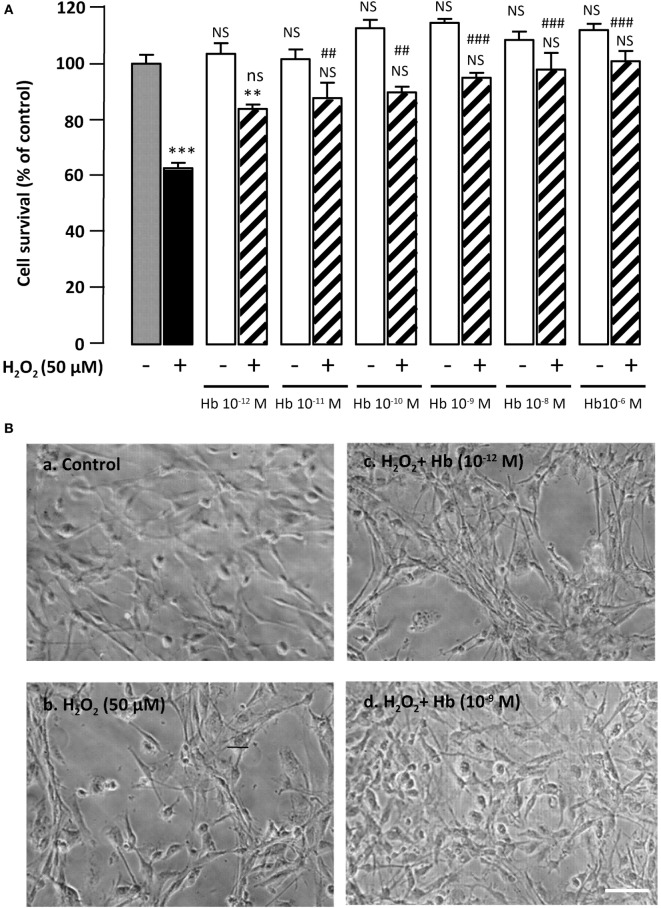
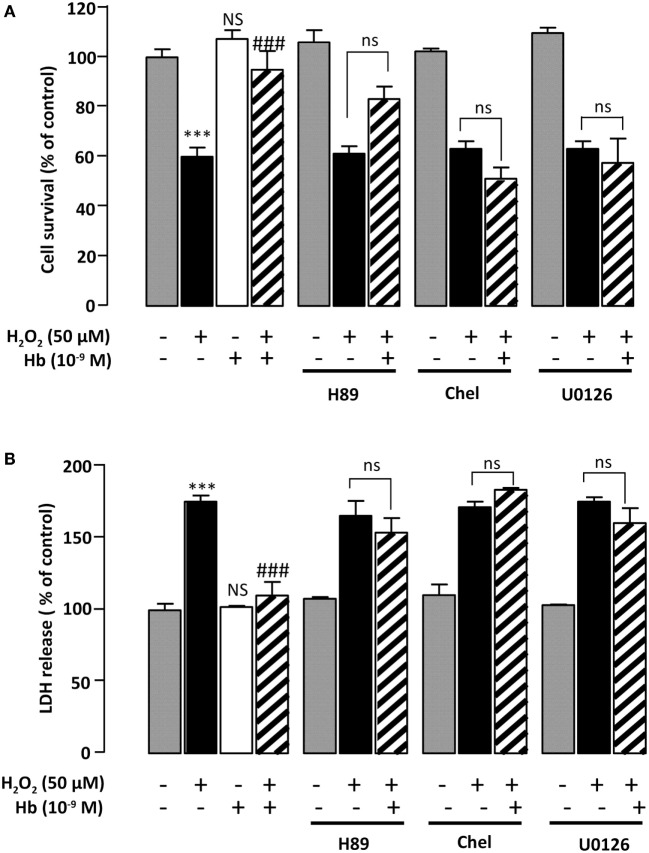
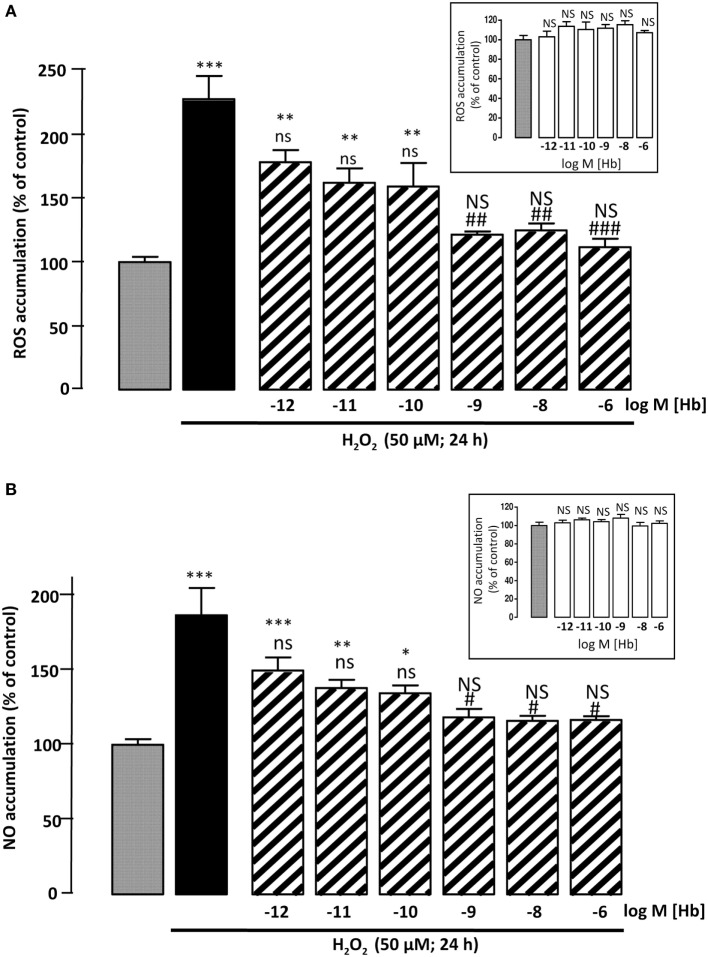
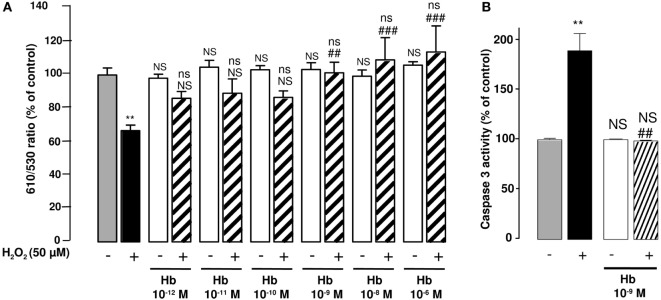
Oxidative stress plays a major role in triggering astroglial cell death in diverse neuropathological conditions such as ischemia and neurodegenerative diseases. Numerous studies indicate that hemoglobin (Hb) is expressed in both resting and reactive glia cells, but nothing is known regarding a possible role of Hb on astroglial cell survival. Thus, the purpose of the present study was to investigate the potential glioprotective effect of Hb on hydrogen peroxide (HO)-induced oxidative stress and apoptosis in cultured rat astrocytes. Our study demonstrates that administration of graded concentrations of Hb (10 to 10 M) to HO-treated astrocytes reduces cell death in a concentration-dependent manner. HO treatment induces the accumulation of reactive oxygen species (ROS) and nitric oxide (NO), a drop of the mitochondrial membrane potential, and a stimulation of caspase-3/7 activity. Exposure of HO-treated cells to Hb was accompanied by marked attenuations of ROS and NO surproductions, mitochondrial membrane potential reduction, and caspase-3/7 activity increase. The protective action of Hb was blocked by the protein kinase A (PKA) inhibitor H89, the protein kinase C (PKC) inhibitor chelerythrine, and the mitogen-activated protein (MAP)-kinase kinase (MEK) inhibitor U0126. Taken together, these data demonstrate for the first time that Hb is a glioprotective factor that protects astrocytes from apoptosis induced by oxidative stress and suggest that Hb may confer neuroprotection in neurodegenerative diseases. The anti-apoptotic activity of Hb on astrocytes is mediated through the PKA, PKC, and MAPK transduction pathways and can be accounted for by inhibition of oxidative stress-induced mitochondrial dysfunctions and caspase activation.
氧化应激在多种神经病理状况(如局部缺血和神经退行性疾病)中触发星形胶质细胞死亡的过程中起主要作用。大量研究表明,血红蛋白(Hb)在静息和反应性神经胶质细胞中均有表达,但关于Hb对星形胶质细胞存活的可能作用却一无所知。因此,本研究的目的是探讨Hb对过氧化氢(HO)诱导的培养大鼠星形胶质细胞氧化应激和凋亡的潜在神经胶质保护作用。我们的研究表明,向HO处理的星形胶质细胞给予不同浓度梯度的Hb(10至10 M)可呈浓度依赖性地减少细胞死亡。HO处理可诱导活性氧(ROS)和一氧化氮(NO)的积累、线粒体膜电位的下降以及caspase-3/7活性的增强。将HO处理的细胞暴露于Hb后,ROS和NO的过量产生、线粒体膜电位的降低以及caspase-3/7活性的增强均明显减弱。Hb的保护作用被蛋白激酶A(PKA)抑制剂H89、蛋白激酶C(PKC)抑制剂白屈菜红碱和丝裂原活化蛋白(MAP)激酶激酶(MEK)抑制剂U0126所阻断。综上所述,这些数据首次证明Hb是一种神经胶质保护因子,可保护星形胶质细胞免受氧化应激诱导的凋亡,并表明Hb可能在神经退行性疾病中发挥神经保护作用。Hb对星形胶质细胞的抗凋亡活性是通过PKA、PKC和MAPK转导途径介导的,并且可以通过抑制氧化应激诱导的线粒体功能障碍和caspase激活来解释。