Department of Public Health, Çanakkale Onsekiz Mart University School of Medicine, Çanakkale, Turkey.
Department of Public Health, İstanbul Medeniyet University School of Medicine, İstanbul, Turkey.
Balkan Med J. 2017 Aug 4;34(4):323-334. doi: 10.4274/balkanmedj.2016.0960. Epub 2017 Apr 6.
The causes of death have changed with regard to the epidemiological and demographic events in society. There is no evidence of prior research into the epidemiological transition in Turkey. This transition in Turkey should be observed starting with the Ottoman Empire period (19th to early 20th century). However, information about the Ottoman Empire is quite limited.
To discuss the epidemiological and demographic transitions in Turkey, using demographic, educational and urbanization data in our present study.
A descriptive archive study.
Mortality statistics dating from 1931 and published by the Turkish Statistical Institute were analysed, and the causes of death were coded and classified according to ICD-10. Other data were obtained from the published reports and studies regarding the issue.
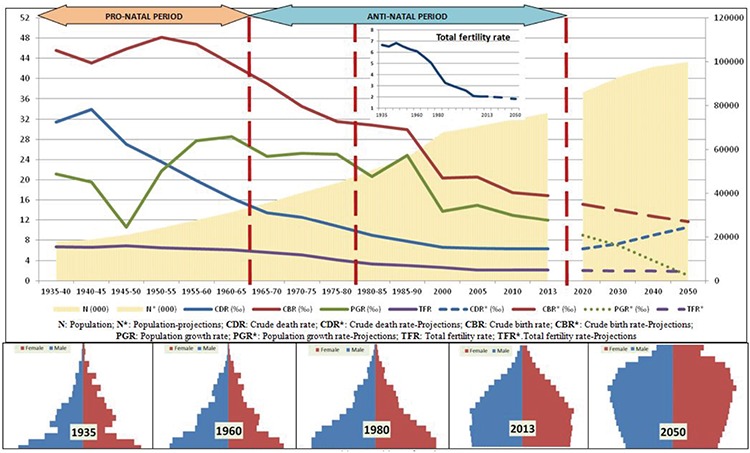
In the 1930s, Turkey's life expectancy was low (aged 40 years), fertility and mortality rates were high (respectively 45% and 31%), and the main causes of death were infectious diseases. Nowadays, life expectancy is close to 80 years, the total fertility rate has dropped to 2.1 per woman, and the main causes of death are chronic diseases and cancer. The population rate in the urban areas has increased steadily from 24.2% in 1927 to 77.3% in 2012. level of education has also increased during this period. In 1935, less than 10% of women were literate, and in 2013 90% were literate. Qualitative and quantitative increase have been observed in the presentation and access of healthcare services compared to the early years of the Republic.
Turkey has been undergoing a modernization period in the last 200 years, and it is believed that the epidemiological and demographic transitions result from this period. This process has led to urbanization and an increase in the level of education, as well as a decrease in premature deaths, lower fertility rates, and an increase in the elderly population and chronic diseases. It is therefore our conclusion that Turkey needs policies regarding the elderly population and the management of chronic diseases.
随着社会的流行病学和人口统计学事件的变化,死亡原因也发生了变化。目前没有关于土耳其流行病学转变的研究证据。这种转变应该从奥斯曼帝国时期(19 世纪至 20 世纪初)开始观察。然而,关于奥斯曼帝国的信息相当有限。
利用本研究中的人口统计学、教育和城市化数据,讨论土耳其的流行病学和人口统计学转变。
描述性档案研究。
分析了土耳其统计局发布的 1931 年及以前的死亡率统计数据,并根据 ICD-10 对死亡原因进行了编码和分类。其他数据来自关于该问题的已发表报告和研究。
在 20 世纪 30 年代,土耳其的预期寿命较低(40 岁),生育率和死亡率较高(分别为 45%和 31%),主要死亡原因是传染病。如今,预期寿命接近 80 岁,总生育率已降至每位女性 2.1 人,主要死亡原因是慢性疾病和癌症。城市人口比例从 1927 年的 24.2%稳步上升到 2012 年的 77.3%。在此期间,教育水平也有所提高。1935 年,不到 10%的女性识字,而 2013 年则有 90%的女性识字。与共和国早期相比,医疗保健服务的提供和获取在质量和数量上都有所增加。
在过去的 200 年里,土耳其一直在经历现代化时期,据信流行病学和人口统计学的转变是由这一时期引起的。这一过程导致了城市化和教育水平的提高,以及早逝人数的减少、生育率的下降、老年人口和慢性疾病的增加。因此,我们的结论是,土耳其需要制定有关老年人口和慢性病管理的政策。