Eun Sung-Jong, Whangbo Taeg-Keun, Park Dong Kyun, Kim Khae-Hawn
Department of Computer Science, Gachon University, Seongnam, Korea.
Health IT Research Center, Gachon University Gil Medical Center, Gachon University, Incheon, Korea.
Int Neurourol J. 2017 Apr;21(Suppl 1):S76-83. doi: 10.5213/inj.1734886.443. Epub 2017 Apr 21.
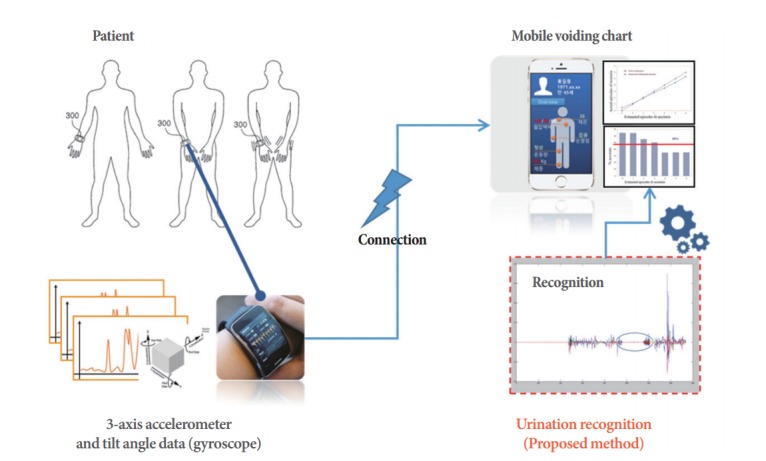
This study collected and analyzed activity data sensed through smart bands worn by patients in order to resolve the clinical issues posed by using voiding charts. By developing a smart band-based algorithm for recognizing urination activity in patients, this study aimed to explore the feasibility of urination monitoring systems.
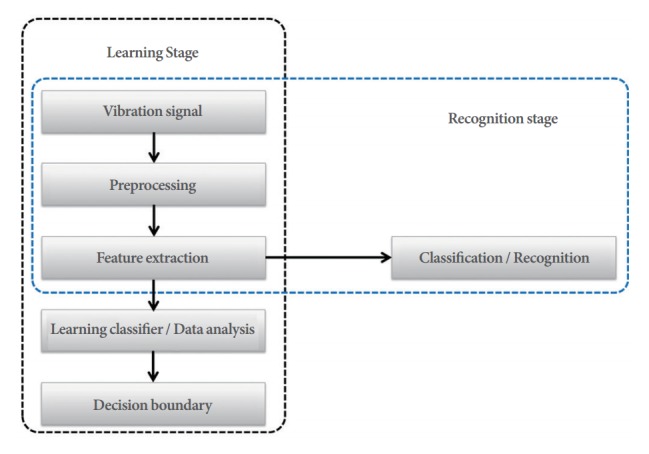
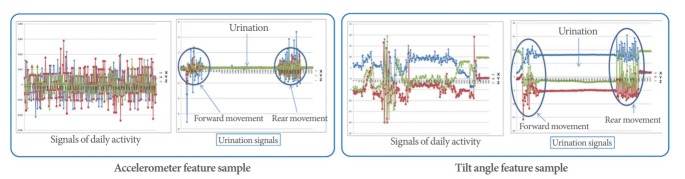
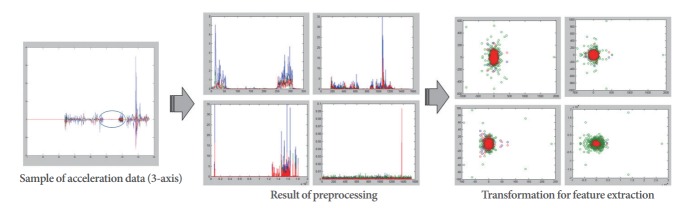
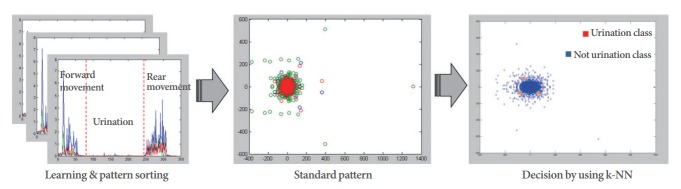
This study aimed to develop an algorithm that recognizes urination based on a patient's posture and changes in posture. Motion data was obtained from a smart band on the arm. An algorithm that recognizes the 3 stages of urination (forward movement, urination, backward movement) was developed based on data collected from a 3-axis accelerometer and from tilt angle data. Real-time data were acquired from the smart band, and for data corresponding to a certain duration, the absolute value of the signals was calculated and then compared with the set threshold value to determine the occurrence of vibration signals. In feature extraction, the most essential information describing each pattern was identified after analyzing the characteristics of the data. The results of the feature extraction process were sorted using a classifier to detect urination.
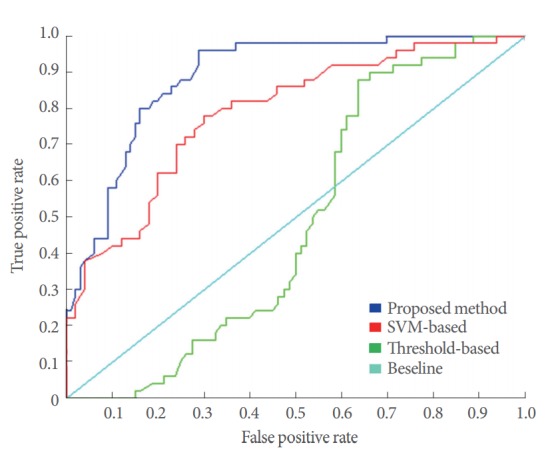
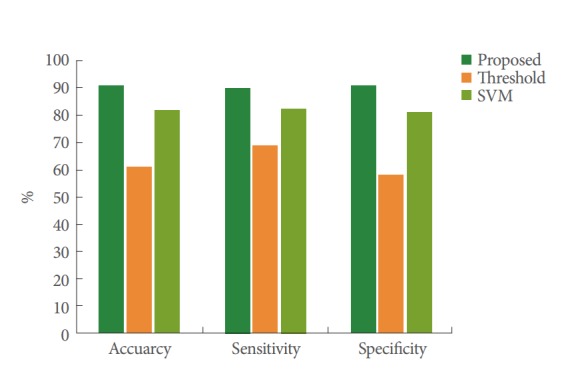
An experiment was carried out to assess the performance of the recognition technology proposed in this study. The final accuracy of the algorithm was calculated based on clinical guidelines for urologists. The experiment showed a high average accuracy of 90.4%, proving the robustness of the proposed algorithm.
The proposed urination recognition technology draws on acceleration data and tilt angle data collected via a smart band; these data were then analyzed using a classifier after comparative analyses with standardized feature patterns.
本研究收集并分析了患者佩戴智能手环所感知到的活动数据,以解决使用排尿图表所带来的临床问题。通过开发一种基于智能手环的算法来识别患者的排尿活动,本研究旨在探索排尿监测系统的可行性。
本研究旨在开发一种基于患者姿势及姿势变化来识别排尿的算法。运动数据从手臂上的智能手环获取。基于从三轴加速度计收集的数据和倾斜角度数据,开发了一种识别排尿三个阶段(向前移动、排尿、向后移动)的算法。从智能手环获取实时数据,对于对应一定时长的数据,计算信号的绝对值,然后与设定的阈值进行比较,以确定振动信号的发生情况。在特征提取过程中,在分析数据特征后,识别出描述每种模式的最关键信息。使用分类器对特征提取过程的结果进行排序,以检测排尿情况。
进行了一项实验来评估本研究提出的识别技术的性能。该算法的最终准确率是根据泌尿外科医生的临床指南计算得出的。实验显示平均准确率高达90.4%,证明了所提算法的稳健性。
所提出的排尿识别技术利用通过智能手环收集的加速度数据和倾斜角度数据;在与标准化特征模式进行对比分析后,再使用分类器对这些数据进行分析。