Rundle Stuart, Bradbury Alice, Drew Yvette, Curtin Nicola J
Northern Institute for Cancer Research, Newcastle University, Newcastle upon Tyne NE2 4HH, UK.
Northern Gynaecological Oncology Centre, Queen Elizabeth Hospital, Gateshead NE9 6SX, UK.
Cancers (Basel). 2017 Apr 27;9(5):41. doi: 10.3390/cancers9050041.
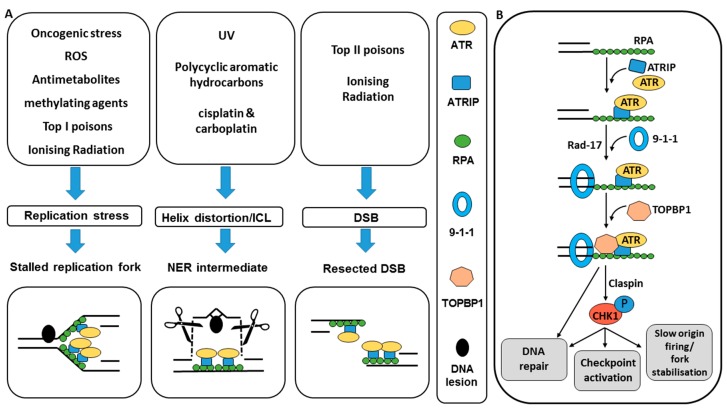
Targeting the DNA damage response (DDR) is a new therapeutic approach in cancer that shows great promise for tumour selectivity. Key components of the DDR are the ataxia telangiectasia mutated and Rad3 related (ATR) and checkpoint kinase 1 (CHK1) kinases. This review article describes the role of ATR and its major downstream target, CHK1, in the DDR and why cancer cells are particularly reliant on the ATR-CHK1 pathway, providing the rationale for targeting these kinases, and validation of this hypothesis by genetic manipulation. The recent development of specific inhibitors and preclinical data using these inhibitors not only as chemosensitisers and radiosensitisers but also as single agents to exploit specific pathologies of tumour cells is described. These potent and specific inhibitors have now entered clinical trial and early results are presented.
靶向DNA损伤反应(DDR)是癌症治疗的一种新方法,在肿瘤选择性方面显示出巨大潜力。DDR的关键组成部分是共济失调毛细血管扩张症突变基因(ATM)和Rad3相关蛋白(ATR)以及检查点激酶1(CHK1)激酶。这篇综述文章描述了ATR及其主要下游靶点CHK1在DDR中的作用,以及癌细胞为何特别依赖ATR-CHK1通路,为靶向这些激酶提供了理论依据,并通过基因操作验证了这一假设。还介绍了特异性抑制剂的最新进展以及使用这些抑制剂的临床前数据,这些抑制剂不仅可作为化学增敏剂和放射增敏剂,还可作为单一药物来利用肿瘤细胞的特定病理特征。这些强效且特异性的抑制剂现已进入临床试验并展示了早期结果。