Gezgin Gülçin, Luk Sietse J, Cao Jinfeng, Dogrusöz Mehmet, van der Steen Dirk M, Hagedoorn Renate S, Krijgsman Daniëlle, van der Velden Pieter A, Field Matthew G, Luyten Gregorius P M, Szuhai Karoly, Harbour J William, Jordanova Ekaterina S, Heemskerk Mirjam H M, Jager Martine J
Department of Ophthalmology, Leiden University Medical Center, Leiden, the Netherlands.
Department of Haematology, Leiden University Medical Center, Leiden, the Netherlands.
JAMA Ophthalmol. 2017 Jun 1;135(6):541-549. doi: 10.1001/jamaophthalmol.2017.0729.
Uveal melanoma (UM) is an intraocular primary malignant neoplasm that often gives rise to metastatic disease for which there are no effective therapies. A substantial proportion of UMs express the cancer-testis antigen PRAME (preferentially expressed antigen in melanoma), which can potentially be targeted by adoptive T-cell therapy.
To determine whether there may be a rationale for PRAME-directed T-cell therapy for metastatic UM.
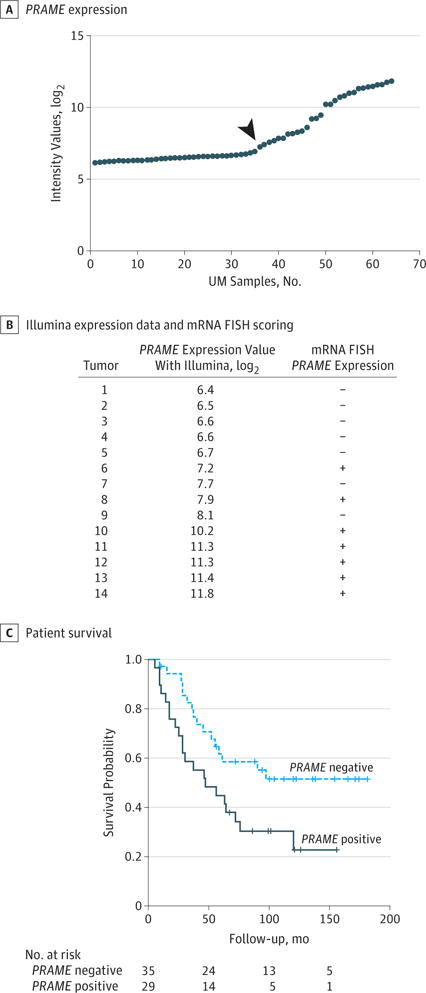
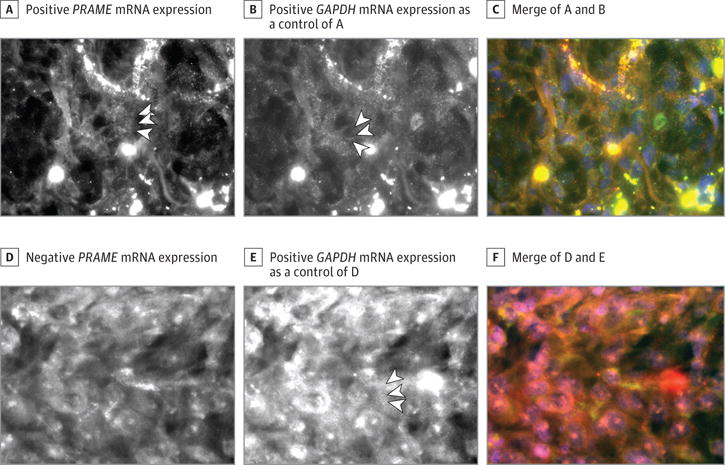
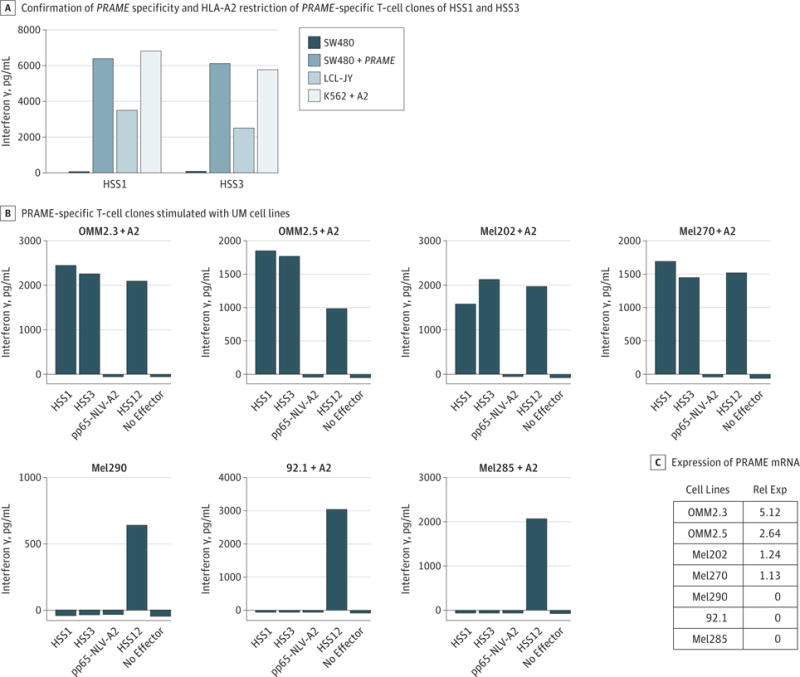
DESIGN, SETTING, AND PARTICIPANTS: An experimental study using a retrospective cohort of 64 patients with UM (median follow-up, 62 months) was conducted from January 8, 2015, to November 20, 2016, at the Leiden University Medical Center. Clinical, histopathologic, and genetic parameters were compared between 64 PRAME-positive and PRAME-negative UMs. HLA class I restricted, PRAME-specific T cells were stimulated with UM cell lines to measure their antigen-specific reactivity against these cell lines, which were analyzed for PRAME expression by real-time quantitative polymerase chain reaction. Uveal melanoma metastases from 16 unrelated patients were assessed for PRAME expression by messenger RNA fluorescence in situ hybridization and for HLA class I expression by immunofluorescence staining.
Interferon γ production for antigen-specific reactivity and detection of PRAME and HLA class I expression in primary and metastatic UM.
Of the 64 patients in the study (31 women and 33 men; mean [SD] age at the time of enucleation, 60.6 [15.6] years), PRAME expression was negative in 35 primary UMs and positive in 29 primary UMs. Positive PRAME expression was associated with a high largest basal diameter (15.0 vs 12.0 mm; P = .005), ciliary body involvement (59% vs 26%; P = .008), and amplification of chromosome 8q (66% vs 23%; P = .002). PRAME-specific T cells reacted against 4 of 7 UM cell lines, demonstrating that T-cell reactivity correlated with PRAME expression. Metastatic UM samples were positive for PRAME messenger RNA in 11 of 16 patients and for HLA class I in 10 of 16 patients, with 8 of 16 patients demonstrating coexpression of both PRAME and HLA class I.
PRAME is expressed in many primary and metastatic UMs, and about half of the metastatic UMs coexpress PRAME and HLA class I. The finding that PRAME-specific T cells in this study reacted against PRAME-positive UM cell lines suggests a potential role for PRAME-directed immunotherapy for selected patients with metastatic UM.
葡萄膜黑色素瘤(UM)是一种眼内原发性恶性肿瘤,常引发转移性疾病,而目前尚无有效的治疗方法。相当一部分UM表达癌 - 睾丸抗原PRAME(黑色素瘤中优先表达的抗原),这有可能通过过继性T细胞疗法进行靶向治疗。
确定PRAME导向的T细胞疗法治疗转移性UM是否具有合理性。
设计、地点和参与者:2015年1月8日至2016年11月20日在莱顿大学医学中心进行了一项实验研究,使用了64例UM患者的回顾性队列(中位随访时间为62个月)。比较了64例PRAME阳性和PRAME阴性UM的临床、组织病理学和基因参数。用UM细胞系刺激HLA I类限制性、PRAME特异性T细胞,以测量它们对这些细胞系的抗原特异性反应性,通过实时定量聚合酶链反应分析这些细胞系的PRAME表达。通过信使RNA荧光原位杂交评估16例无关患者的葡萄膜黑色素瘤转移灶的PRAME表达,并通过免疫荧光染色评估HLA I类表达。
抗原特异性反应性的γ干扰素产生以及原发性和转移性UM中PRAME和HLA I类表达的检测。
在该研究的64例患者中(31例女性和33例男性;摘除眼球时的平均[标准差]年龄为60.6[15.6]岁),35例原发性UM中PRAME表达为阴性,29例原发性UM中PRAME表达为阳性。PRAME阳性表达与较大的最大基底直径(15.0对12.0mm;P = 0.005)、睫状体受累(59%对26%;P = 0.008)以及8号染色体q臂扩增(66%对23%;P = 0.002)相关。PRAME特异性T细胞对7种UM细胞系中的4种有反应,表明T细胞反应性与PRAME表达相关。16例患者的转移性UM样本中,11例PRAME信使RNA呈阳性,16例中有10例HLA I类呈阳性,16例中有8例同时表达PRAME和HLA I类。
PRAME在许多原发性和转移性UM中表达,约一半的转移性UM同时表达PRAME和HLA I类。本研究中PRAME特异性T细胞对PRAME阳性UM细胞系有反应这一发现表明,PRAME导向的免疫疗法对选定的转移性UM患者可能具有潜在作用。