Rafeeq Misbahuddin M, Murad Hussam Aly Sayed
Department of Pharmacology, Faculty of Medicine, King Abdulaziz University, Rabigh Campus, Jeddah, 21589, Saudi Arabia.
Department of Pharmacology, Faculty of Medicine, Ain Shams University, Cairo, 11562, Egypt.
J Transl Med. 2017 Apr 27;15(1):84. doi: 10.1186/s12967-017-1193-9.
Study of currently approved drugs and exploration of future clinical development pipeline therapeutics for cystic fibrosis, and possible limitations in their use.
Extensive literature search using individual and a combination of key words related to cystic fibrosis therapeutics.
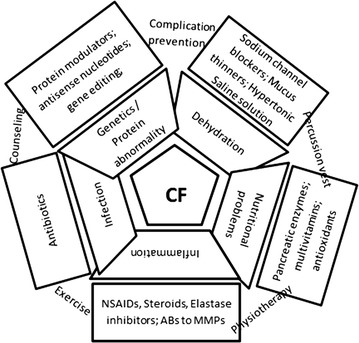
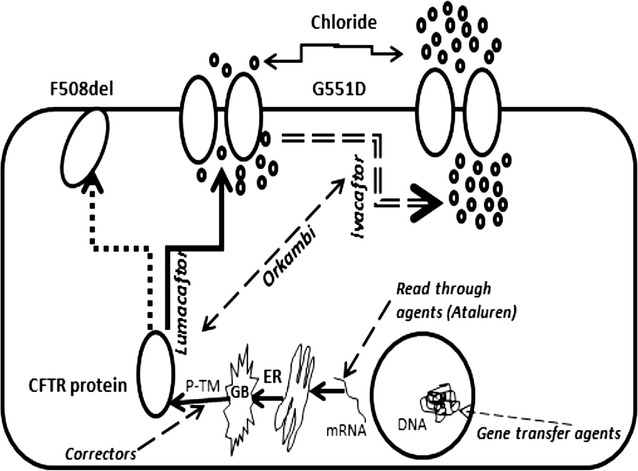
Cystic fibrosis is an autosomal recessive disorder due to mutations in CFTR gene leading to abnormality of chloride channels in mucus and sweat producing cells. Respiratory system and GIT are primarily involved but eventually multiple organs are affected leading to life threatening complications. Management requires drug therapy, extensive physiotherapy and nutritional support. Previously, the focus was on symptomatic improvement and complication prevention but recently the protein rectifiers are being studied which are claimed to correct underlying structural and functional abnormalities. Some improvement is observed by the corrector drugs. Other promising approaches are gene therapy, targeting of cellular interactomes, and newer drugs for symptomatic improvement.
The treatment has a long way to go as most of the existing therapeutics is for older children. Other limiting factors include mutation class, genetic profile, drug interactions, adverse effects, and cost. Novel approaches like gene transfer/gene editing, disease modeling and search for alternative targets are warranted.
研究目前已获批的治疗囊性纤维化的药物,探索未来临床研发管线中的治疗方法及其使用中可能存在的局限性。
使用与囊性纤维化治疗相关的单个关键词及关键词组合进行广泛的文献检索。
囊性纤维化是一种常染色体隐性疾病,由CFTR基因突变引起,导致产生黏液和汗液的细胞中氯离子通道异常。呼吸系统和胃肠道是主要受累部位,但最终多个器官都会受到影响,引发危及生命的并发症。治疗需要药物治疗、广泛的物理治疗和营养支持。以前,重点在于症状改善和并发症预防,但最近正在研究蛋白质校正剂,据称这些校正剂可纠正潜在的结构和功能异常。校正药物已观察到一些改善效果。其他有前景的方法包括基因治疗、靶向细胞互作组以及用于症状改善的新型药物。
由于现有的大多数治疗方法是针对大龄儿童的,因此治疗仍有很长的路要走。其他限制因素包括突变类型、基因谱、药物相互作用、不良反应和成本。基因转移/基因编辑、疾病建模以及寻找替代靶点等新方法是必要的。