Nonhoff Justus, Ricke-Hoch Melanie, Mueller Mirco, Stapel Britta, Pfeffer Tobias, Kasten Martina, Scherr Michaela, von Kaisenberg Constantin, Bauersachs Johann, Haghikia Arash, Hilfiker-Kleiner Denise
Department of Cardiology and Angiology, Hannover Medical School, Carl-Neuberg Str. 1, 30625 Hannover, Germany.
Department of Hematology, Hemostasis, Oncology and Stem Cell Transplantation, Hannover Medical School, Carl-Neuberg Str. 1, 30625 Hannover, Germany.
Cardiovasc Res. 2017 May 1;113(6):598-608. doi: 10.1093/cvr/cvw245.
Peripartum cardiomyopathy (PPCM) is a systolic left ventricular dysfunction developing in the peripartum phase in previously healthy women. Relaxin-2 is a pregnancy hormone with potential beneficial effects in heart failure patients. We evaluated Relaxin-2 as a potential diagnostic marker and/or a therapeutic agent in PPCM.
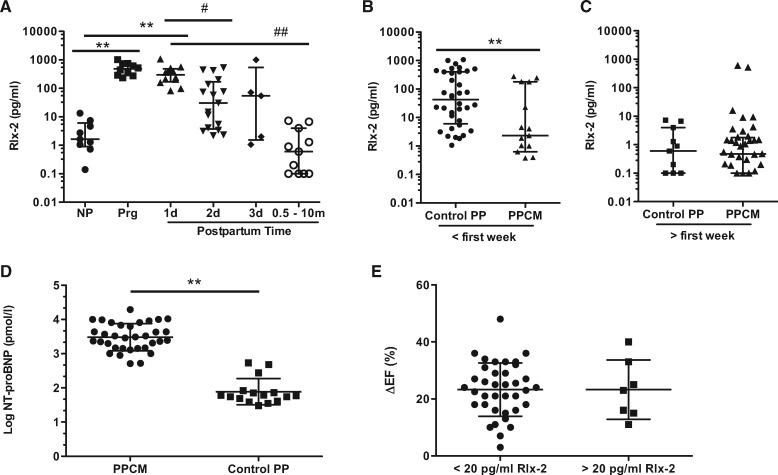
In healthy peripartum women, serum Relaxin-2 levels (measured by ELISA in the second half of pregnancy) were elevated showing a decreasing trend in the first postpartum week and returned to non-pregnant levels thereafter. In PPCM patients diagnosed in the first postpartum week, serum Relaxin-2 levels were lower compared to healthy postpartum stage-matched controls. In PPCM patients diagnosed later (0.5-10 months postpartum) Relaxin-2 levels were in the range of non-pregnant controls and not different from healthy postpartum stage-matched controls. In mice, serum Relaxin-1 (functional equivalent of human Relaxin-2) was increased late in pregnancy and rapidly cleared in the first postpartum week. In mice with PPCM due to a cardiomyocyte-specific knockout of STAT3 (CKO) neither low nor high dose of recombinant Relaxin-2 (serelaxin, sRlx-LD: 30 µg/kg/day; sRlx-HD: 300 µg/kg/day) affected cardiac fibrosis, inflammation and heart failure but sRlx-HD increased capillary/cardiomyocyte ratio. sRlx-HD significantly increased heart/body weight ratio and cardiomyocyte cross-sectional area in postpartum CKO and wild-type mice without changing the foetal gene expression program (ANP or β-MHC). sRlx-HD augmented plasma Prolactin levels in both genotypes, which induced cardiac activation of STAT5. In vitro analyses showed that Prolactin induces cardiomyocyte hypertrophy via activation of STAT5.
Although Relaxin-2 levels seemed lower in PPCM patients diagnosed early postpartum, we observed a high pregnancy-related variance of serum Relaxin-2 levels peripartum making it unsuitable as a biomarker for this condition. Supplementation with sRlx may contribute to angiogenesis and compensatory hypertrophy in the diseased heart, but the effects are not sufficient to prevent heart failure in an experimental PPCM model.
围产期心肌病(PPCM)是一种发生在既往健康女性围产期的左心室收缩功能障碍。松弛素-2是一种妊娠激素,对心力衰竭患者可能具有有益作用。我们评估了松弛素-2作为PPCM潜在诊断标志物和/或治疗药物的可能性。
在健康围产期女性中,血清松弛素-2水平(在妊娠后半期通过酶联免疫吸附测定法测量)升高,在产后第一周呈下降趋势,此后恢复到非妊娠水平。在产后第一周诊断出的PPCM患者中,血清松弛素-2水平低于健康产后阶段匹配的对照组。在产后较晚时间(产后0.5 - 10个月)诊断出的PPCM患者中,松弛素-2水平处于非妊娠对照组范围内,与健康产后阶段匹配的对照组无差异。在小鼠中,血清松弛素-1(人类松弛素-2的功能等效物)在妊娠后期升高,并在产后第一周迅速清除。在因心肌细胞特异性敲除信号转导和转录激活因子3(CKO)而患PPCM的小鼠中,低剂量和高剂量的重组松弛素-2(serelaxin,sRlx-LD:30μg/kg/天;sRlx-HD:300μg/kg/天)均未影响心脏纤维化、炎症和心力衰竭,但sRlx-HD增加了毛细血管/心肌细胞比例。sRlx-HD显著增加了产后CKO和野生型小鼠的心脏/体重比和心肌细胞横截面积,而未改变胎儿基因表达程序(心钠素或β-肌球蛋白重链)。sRlx-HD增加了两种基因型小鼠的血浆催乳素水平,从而诱导了信号转导和转录激活因子5的心脏激活。体外分析表明,催乳素通过激活信号转导和转录激活因子5诱导心肌细胞肥大。
尽管产后早期诊断的PPCM患者中松弛素-2水平似乎较低,但我们观察到围产期血清松弛素-2水平与妊娠相关的差异很大,使其不适用于作为这种疾病的生物标志物。补充sRlx可能有助于患病心脏的血管生成和代偿性肥大,但在实验性PPCM模型中,这些作用不足以预防心力衰竭。