Li Chang-Hui, Yu Teng-Bo, Qiu Hong-Wei, Zhao Xia, Zhou Chuan-Li, Qi Chao
Department of Orthopedics, Affiliated Hospital of Qingdao University, Qingdao, Shandong 266003, P.R. China.
Department of Orthopedics, People's Hospital of Rizhao, Rizhao, Shandong 276826, P.R. China.
Oncol Lett. 2017 Apr;13(4):2191-2197. doi: 10.3892/ol.2017.5709. Epub 2017 Feb 9.
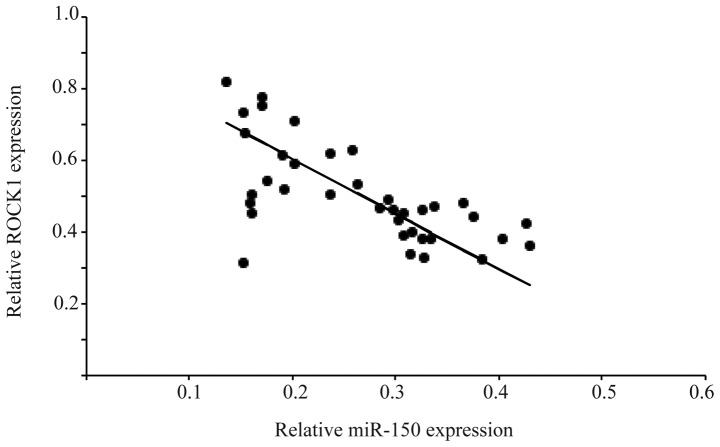
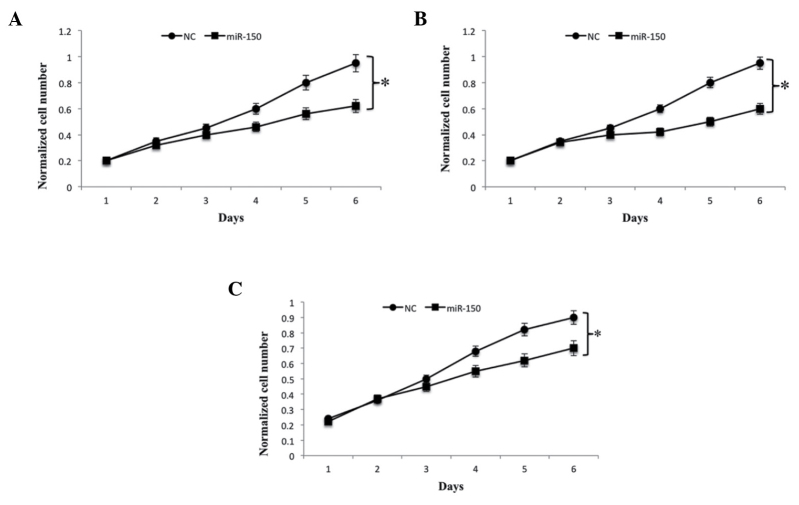
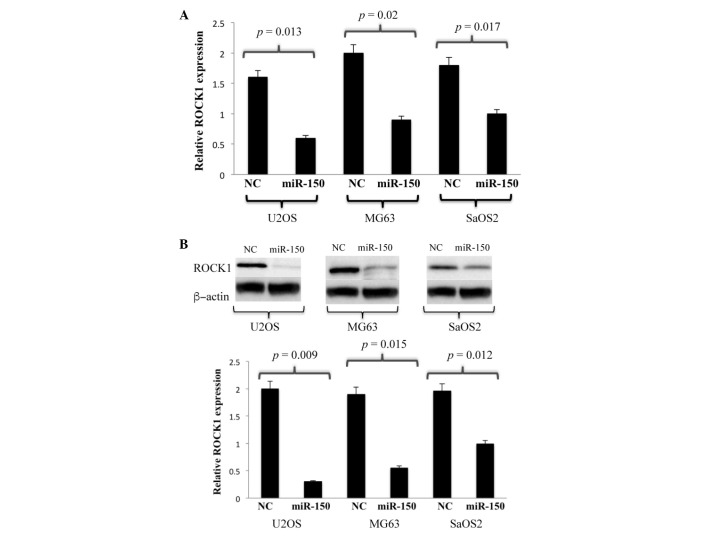
Osteosarcoma (OS) is the most common form of bone malignancy in children and adolescents. A class of molecules known as microRNAs (miRNAs) have been routinely associated in the development and progression of OS. The present study was centered on the less well-known miRNA, miRNA (miR)-150, and its role in OS was investigated. The levels of miR-150 were examined in 40 tissue specimens from patients with OS and adjacent normal tissues using reverse transcription-quantitative polymerase chain reaction (RT-qPCR) analysis. In addition the expression levels of miR-150 were examined in three OS cell lines and a normal osteoblast cell line. Cell proliferation, migration and invasion assays were performed to establish the correlation between miR-150 and metastasis. The potential targets of miR-150 were theoretically predicted and one high-scoring target, Rho-associated kinase 1 (ROCK1), was established to be a direct target using RT-qPCR and western blot analyses and Pearson's correlation analysis. The results indicated that miR-150 was downregulated in tissues from patients with OS and cell lines. Secondly, it was shown that the overexpression of miR-150 was inversely correlated with OS cell proliferation, migration and invasion. It was also shown that miR-150 negatively regulated the gene expression of ROCK1 in the OS cell lines. Finally, the interaction between miR-150 and ROCK1 was established and it was shown that miR-150 directly targeted ROCK1. In conclusion, miR-150 was found to be a tumor suppressor, and the suppression of miR-150 resulted in elevation in the levels of ROCK1. This interaction between miR-150 and ROCK1 may be key in the progression of OS. Furthermore, miR-150 or ROCK1 may be potential therapeutic targets for the treatment of OS.
骨肉瘤(OS)是儿童和青少年中最常见的骨恶性肿瘤形式。一类被称为微小RNA(miRNA)的分子经常与骨肉瘤的发生和发展相关。本研究聚焦于鲜为人知的miRNA,即miR-150,并对其在骨肉瘤中的作用进行了研究。使用逆转录-定量聚合酶链反应(RT-qPCR)分析检测了40例骨肉瘤患者组织标本及相邻正常组织中miR-150的水平。此外,还检测了三种骨肉瘤细胞系和一种正常成骨细胞系中miR-150的表达水平。进行细胞增殖、迁移和侵袭实验以确定miR-150与转移之间的相关性。从理论上预测了miR-150的潜在靶标,并通过RT-qPCR、蛋白质印迹分析和Pearson相关性分析确定了一个高分靶标,即Rho相关激酶1(ROCK1)为直接靶标。结果表明,miR-150在骨肉瘤患者的组织和细胞系中表达下调。其次,研究表明miR-150的过表达与骨肉瘤细胞的增殖、迁移和侵袭呈负相关。还表明miR-150在骨肉瘤细胞系中负调控ROCK1的基因表达。最后,确定了miR-150与ROCK1之间的相互作用,表明miR-150直接靶向ROCK1。总之,发现miR-