Zhang Yaowen, Dong Shangwen, Xu Ruiping, Yang Yanping, Zheng Zhiyong, Wang Xiaojing, Ren Runchuan, Sun Ronggang, Li Ming, Yang Haijun, Huang Yuting, Zhou Fuyou, Zheng Anping
Department of Radiation Oncology, Anyang Cancer Hospital, Anyang, Henan 455000, P.R. China.
Department of Cardiothoracic Surgery, Tianjin Medical University General Hospital, Tianjin 300052, P.R. China.
Oncol Lett. 2017 Apr;13(4):2549-2556. doi: 10.3892/ol.2017.5780. Epub 2017 Feb 24.
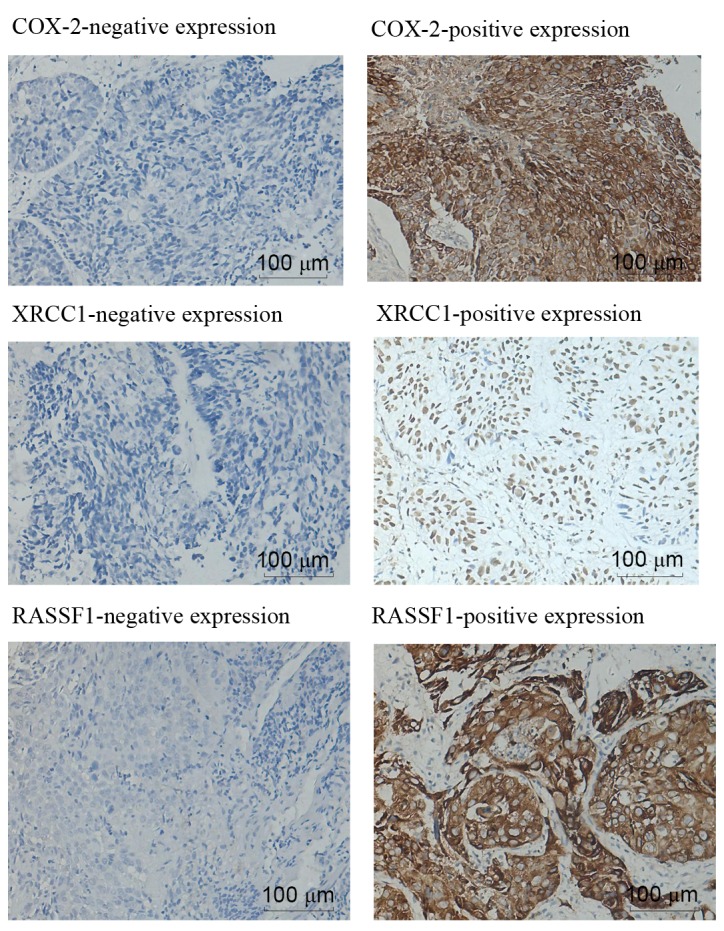
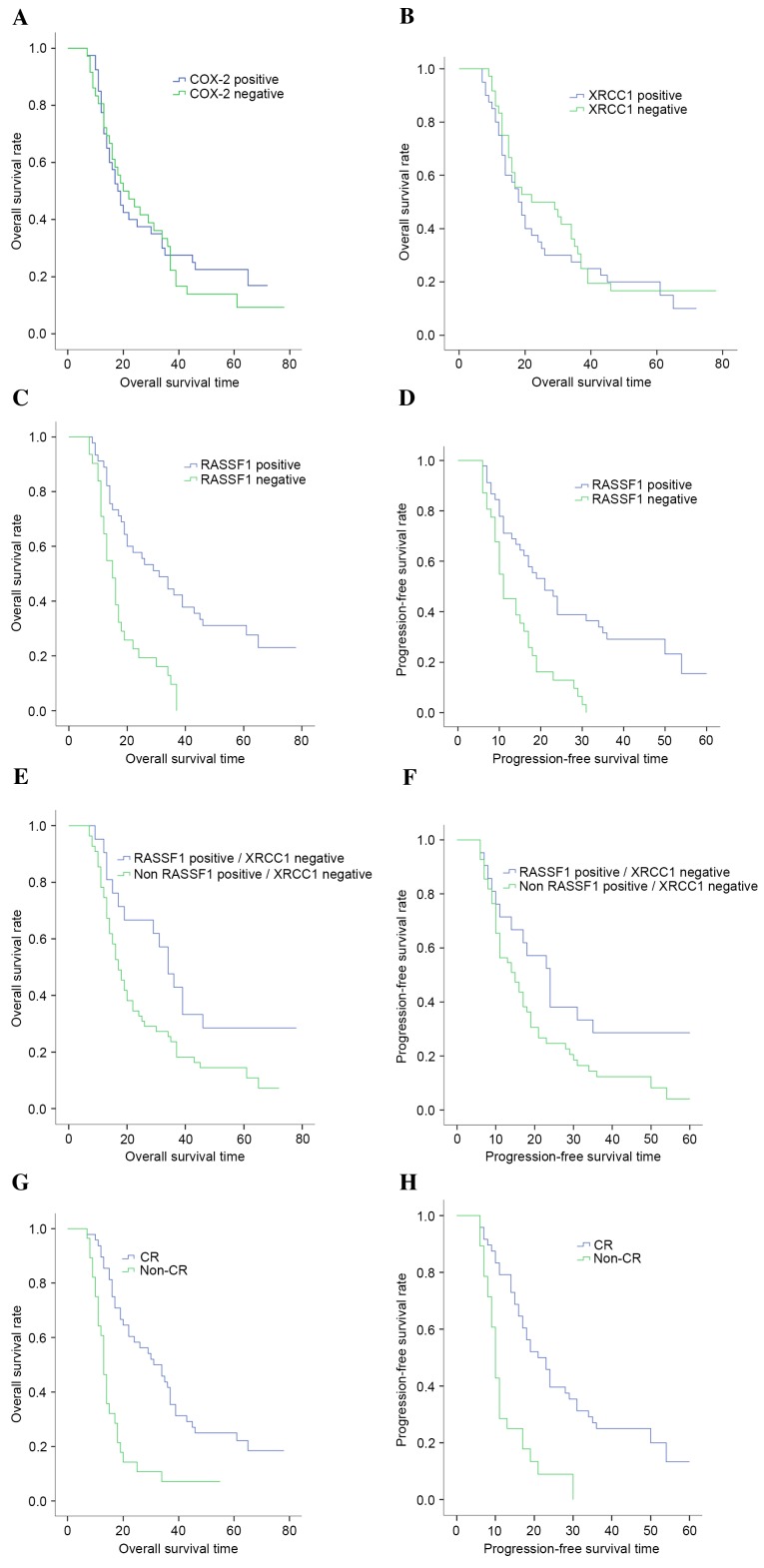
Identification of biomarkers for predicting radiosensitivity would be useful for administering individualized radiotherapy (RT) to patients with esophageal cancer. The aim of the present study was to evaluate the association between cyclooxygenase-2 (COX-2), X-ray repair cross complementing group 1 (XRCC1), ras association domain family 1 (RASSF1) protein expression, clinicopathological characteristics, radiosensitivity and survival rate in 76 patients with esophageal squamous cell carcinoma (ESCC) who were treated with RT. Positive expression of COX-2, XRCC1 and RASSF1 was identified by immunohistochemistry in 81.6, 52.6 and 59.2% of ESCC cases, respectively. Negative COX-2 expression was associated with tumor (T) stage, node (N) stage, clinical stage and complete response (P<0.05), but not with gender, age, tumor location, differentiation degree, lesion length, progression-free survival (PFS) or overall survival (OS; P>0.05). XRCC1 expression was not associated with the clinicopathological features of ESCC, response to RT, PFS or OS. Positive RASSF1 expression was associated with the clinical stage, response to RT, PFS and OS (P<0.05), but not with gender, age, tumor location, T stage, N stage, differentiation degree or the lesion length (P>0.05). In the subgroup analysis, RASSF1 positive/XRCC1 negative expression was correlated with a longer median OS and PFS (P<0.05). Multivariate analyses revealed that the tumor response and RASSF1 expression were significant prognostic factors. Therefore, positive RASSF1 expression is associated with ESCC RT sensitivity, and may be a useful independent prognostic factor for ESCC.
鉴定预测放射敏感性的生物标志物将有助于对食管癌患者进行个体化放射治疗(RT)。本研究的目的是评估76例接受RT治疗的食管鳞状细胞癌(ESCC)患者中环氧合酶-2(COX-2)、X射线修复交叉互补基因1(XRCC1)、Ras相关结构域家族1(RASSF1)蛋白表达、临床病理特征、放射敏感性和生存率之间的关联。通过免疫组织化学鉴定,COX-2、XRCC1和RASSF1的阳性表达分别在81.6%、52.6%和59.2%的ESCC病例中出现。COX-2阴性表达与肿瘤(T)分期、淋巴结(N)分期、临床分期和完全缓解相关(P<0.05),但与性别、年龄、肿瘤位置、分化程度、病变长度、无进展生存期(PFS)或总生存期(OS;P>0.05)无关。XRCC1表达与ESCC的临床病理特征、对RT的反应、PFS或OS无关。RASSF1阳性表达与临床分期、对RT的反应、PFS和OS相关(P<0.05),但与性别、年龄、肿瘤位置、T分期、N分期、分化程度或病变长度无关(P>0.05)。在亚组分析中,RASSF1阳性/XRCC1阴性表达与较长的中位OS和PFS相关(P<0.05)。多变量分析显示,肿瘤反应和RASSF1表达是显著的预后因素。因此,RASSF1阳性表达与ESCC RT敏感性相关,可能是ESCC有用的独立预后因素。