Ball Christopher B, Solem Amanda C, Meganck Rita M, Laederach Alain, Ramos Silvia B V
Biochemistry and Biophysics Department, University of North Carolina, Chapel Hill, North Carolina 27599, USA.
Biology Department, University of North Carolina, Chapel Hill, North Carolina 27599, USA.
RNA. 2017 Aug;23(8):1209-1223. doi: 10.1261/rna.060467.116. Epub 2017 Apr 28.
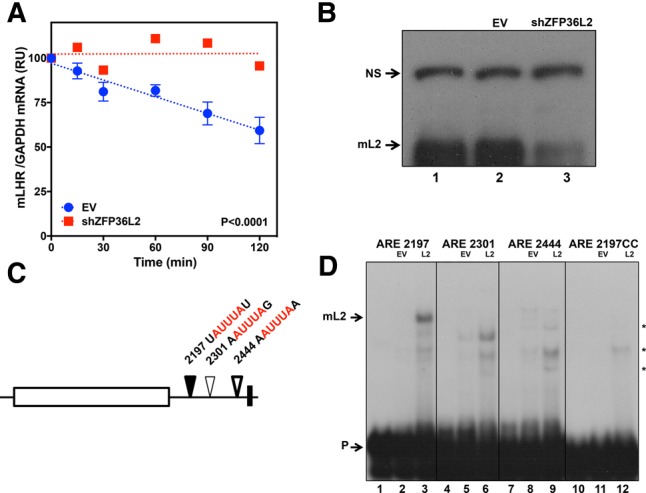
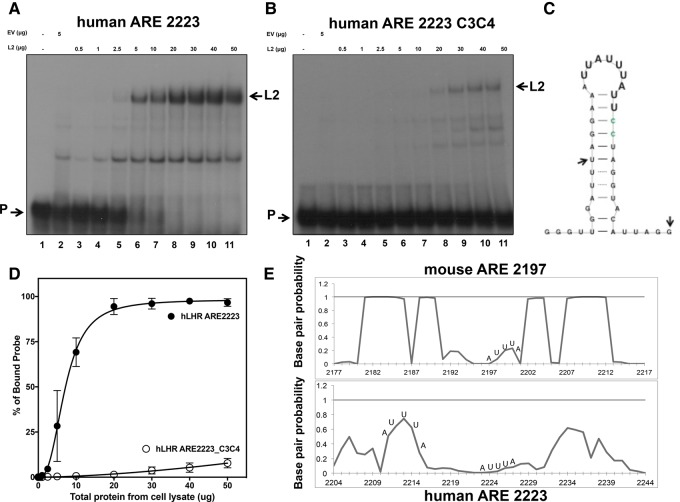
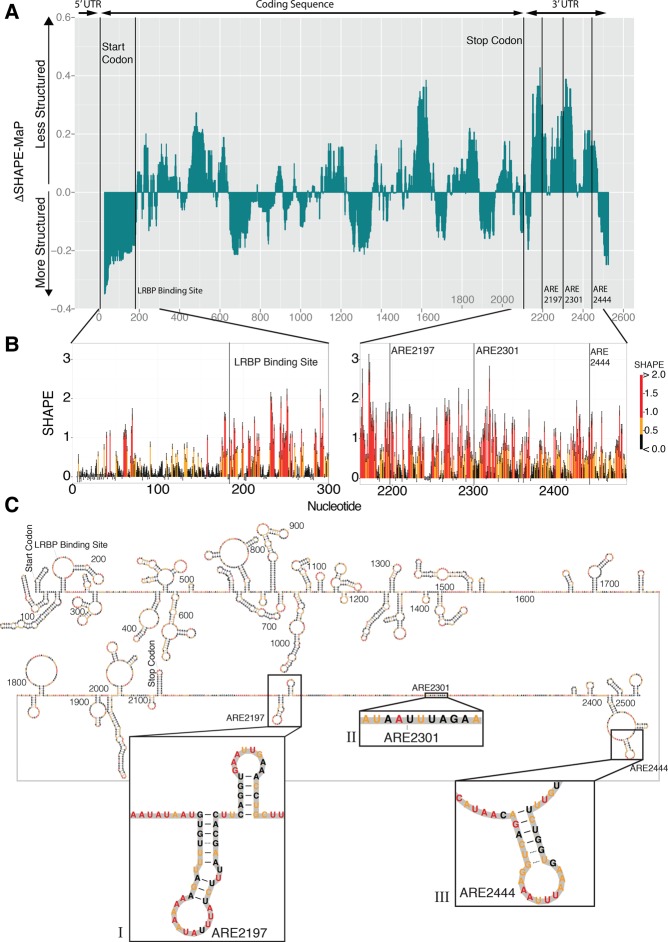
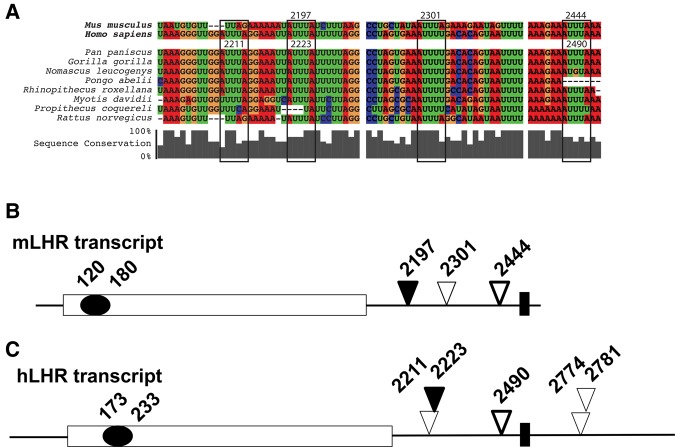
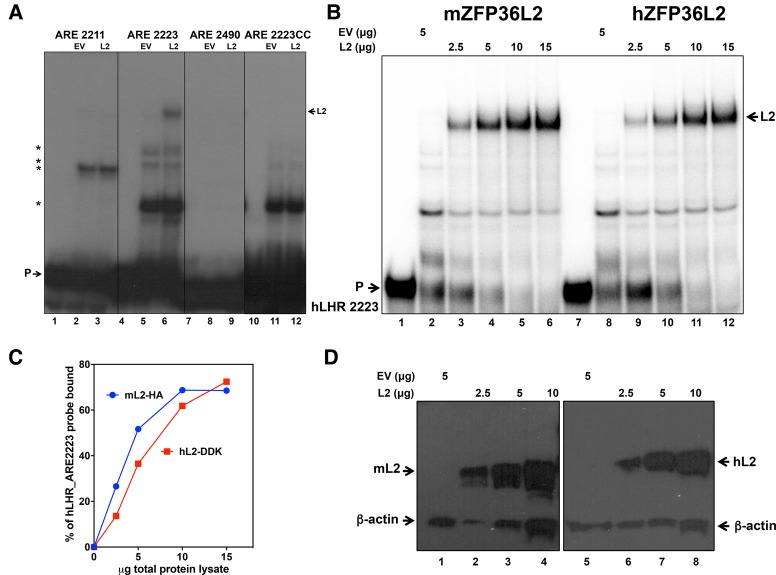
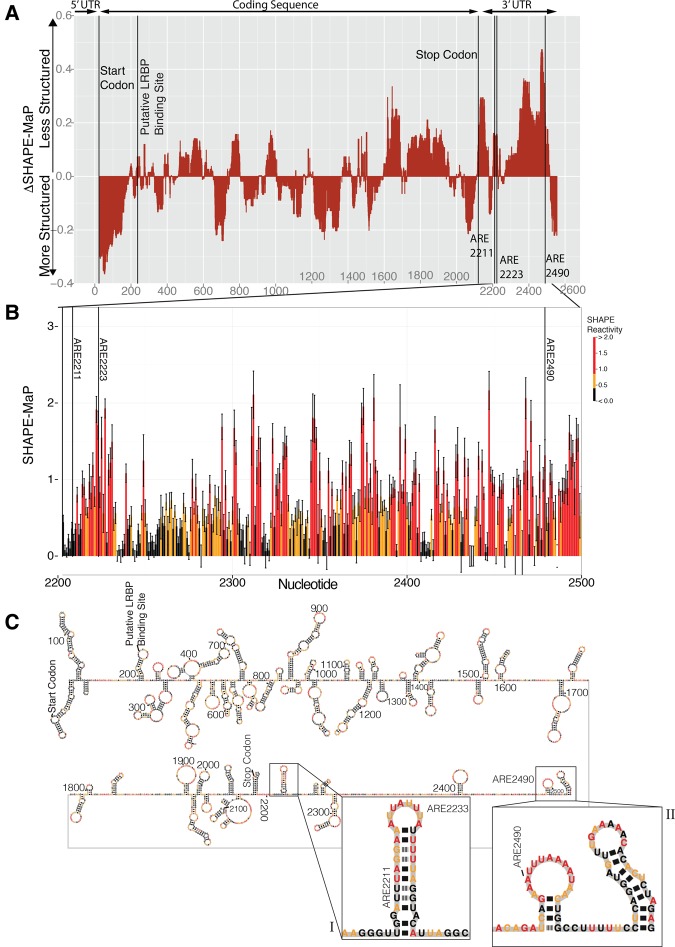
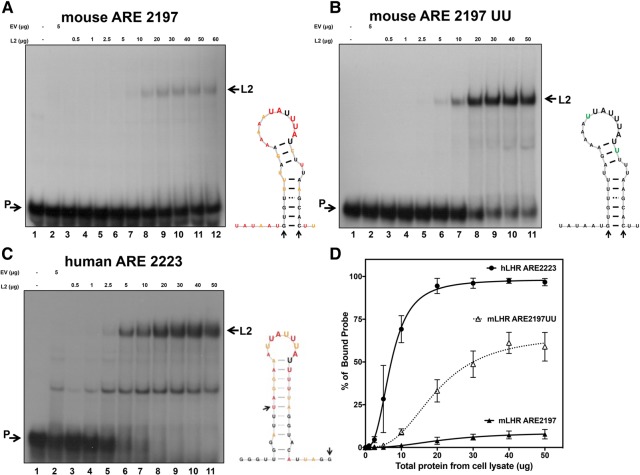
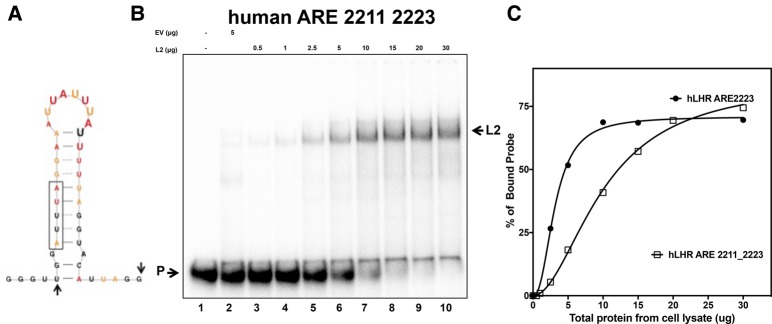
ZFP36L2 (L2) destabilizes AU-rich element (ARE)-containing transcripts and has been implicated in female fertility. We have shown that only one of three putative AREs within the 3' UTR of murine luteinizing hormone receptor mRNA, ARE2197 (UAUUUAU), is capable of interacting with L2. To assess whether structural elements of ARE2197 could explain this unique binding ability, we performed whole-transcript SHAPE-MaP (selective 2' hydroxyl acylation by primer extension-mutational profiling) of the full-length mLHR mRNA. The data revealed that the functional ARE2197 is located in a hairpin loop structure and most nucleotides are highly reactive. In contrast, each of the nonbinding AREs, 2301 and 2444, contains only a pentamer AUUUA; and in ARE2301 much of the ARE sequence is poorly accessible. Because the functional mARE was also found to be conserved in humans at the sequence level (ARE 2223), we decided to investigate whether binding and structure are also preserved. Similar to mouse, only one ARE in hLHR mRNA is capable of binding to L2; and it is also located in a hairpin structure, based on our SHAPE-MaP data. To investigate the role of secondary structure in the binding, we mutated specific nucleotides in both functional AREs. Mutations in the flexible stem region proximal to the loop that enforce strong base-pairing, drastically reduced L2 binding affinity; this confirms that the structural context is critical for L2 recognition of hARE2223. Collectively, our results suggest that a combination of minimal ARE sequence, placement of the ARE in a hairpin loop, and stem flexibility mediate high-affinity L2 binding to hLHR mRNA.
锌指蛋白36样蛋白2(ZFP36L2,简称L2)可使富含AU元件(ARE)的转录本不稳定,并与雌性生育力有关。我们已经表明,小鼠促黄体生成素受体mRNA的3'非翻译区(UTR)内三个假定的ARE中,只有一个ARE2197(UAUUUAU)能够与L2相互作用。为了评估ARE2197的结构元件是否可以解释这种独特的结合能力,我们对全长促黄体生成素受体(mLHR)mRNA进行了全转录本选择性2'-羟基酰化引物延伸突变分析(SHAPE-MaP)。数据显示,功能性ARE2197位于一个发夹环结构中,大多数核苷酸具有高反应性。相比之下,两个非结合性ARE,即2301和2444,每个仅包含一个五聚体AUUUA;并且在ARE2301中,大部分ARE序列难以接近。由于功能性小鼠ARE在人类中在序列水平上也保守(ARE 2223),我们决定研究其结合和结构是否也得以保留。与小鼠相似,人促黄体生成素受体(hLHR)mRNA中只有一个ARE能够与L2结合;根据我们的SHAPE-MaP数据,它也位于一个发夹结构中。为了研究二级结构在结合中的作用,我们对两个功能性ARE中的特定核苷酸进行了突变。在靠近环的柔性茎区域引入强制强碱基配对的突变会大幅降低L2结合亲和力;这证实了结构背景对于L2识别hARE2223至关重要。总体而言,我们的结果表明,最小ARE序列、ARE在发夹环中的位置以及茎的灵活性共同介导了L2与hLHR mRNA的高亲和力结合。