Tindemans Irma, Peeters Marlies J W, Hendriks Rudi W
Department of Pulmonary Medicine, Erasmus MC, Rotterdam, Netherlands.
Front Immunol. 2017 Apr 18;8:419. doi: 10.3389/fimmu.2017.00419. eCollection 2017.
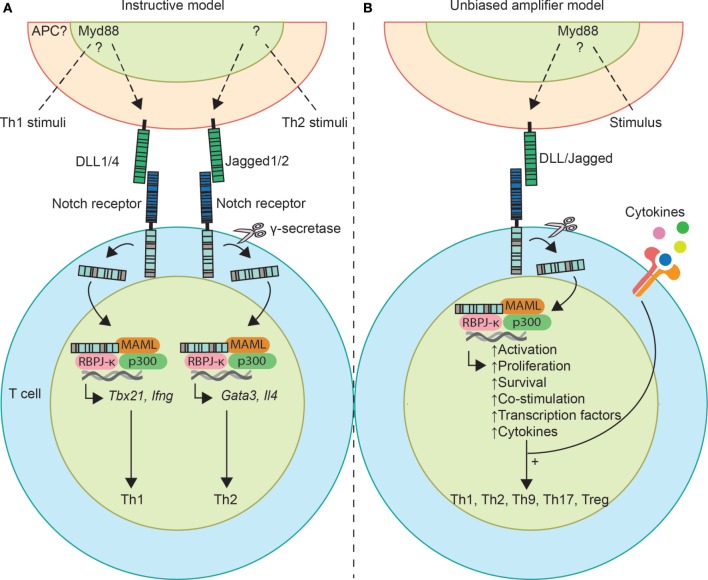
For protection against pathogens, it is essential that naïve CD4 T cells differentiate into specific effector T helper (Th) cell subsets following activation by antigen presented by dendritic cells (DCs). Next to T cell receptor and cytokine signals, membrane-bound Notch ligands have an important role in orchestrating Th cell differentiation. Several studies provided evidence that DC activation is accompanied by surface expression of Notch ligands. Intriguingly, DCs that express the delta-like or Jagged Notch ligands gain the capacity to instruct Th1 or Th2 cell polarization, respectively. However, in contrast to this model it has also been hypothesized that Notch signaling acts as a general amplifier of Th cell responses rather than an instructive director of specific T cell fates. In this alternative model, Notch enhances proliferation, cytokine production, and anti-apoptotic signals or promotes co-stimulatory signals in T cells. An instructive role for Notch ligand expressing DCs in the induction of Th cell differentiation is further challenged by evidence for the involvement of Notch signaling in differentiation of Th9, Th17, regulatory T cells, and follicular Th cells. In this review, we will discuss the two opposing models, referred to as the "instructive" and the "unbiased amplifier" model. We highlight both the function of different Notch receptors on CD4 T cells and the impact of Notch ligands on antigen-presenting cells.
为了抵御病原体,至关重要的是,初始CD4 T细胞在被树突状细胞(DC)呈递的抗原激活后,分化为特定的效应性辅助性T(Th)细胞亚群。除了T细胞受体和细胞因子信号外,膜结合的Notch配体在协调Th细胞分化中起重要作用。多项研究表明,DC激活伴随着Notch配体的表面表达。有趣的是,表达Delta样或锯齿状Notch配体的DC分别获得了指导Th1或Th2细胞极化的能力。然而,与该模型相反,也有人推测Notch信号作为Th细胞反应的一般放大器,而不是特定T细胞命运的指导性因子。在这个替代模型中,Notch增强T细胞的增殖、细胞因子产生和抗凋亡信号,或促进共刺激信号。Notch信号参与Th9、Th17、调节性T细胞和滤泡性Th细胞的分化这一证据,进一步挑战了表达Notch配体的DC在诱导Th细胞分化中的指导性作用。在这篇综述中,我们将讨论这两种相反的模型,即“指导性”模型和“无偏向放大器”模型。我们将重点介绍不同Notch受体在CD4 T细胞上的功能以及Notch配体对抗抗原呈递细胞的影响。