Demitrack Elise S, Samuelson Linda C
Department of Molecular and Integrative Physiology, University of Michigan, Ann Arbor, Michigan.
Department of Internal Medicine, University of Michigan, Ann Arbor, Michigan.
Cell Mol Gastroenterol Hepatol. 2017 Feb 14;3(3):323-330. doi: 10.1016/j.jcmgh.2017.01.012. eCollection 2017 May.
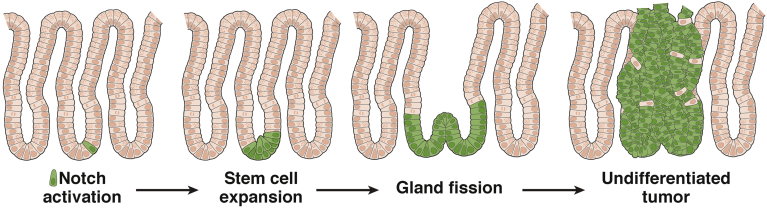
The gastric epithelium is sustained by a population of stem cells that replenish the various mature epithelial lineages throughout adulthood. Regulation of stem and progenitor cell proliferation occurs via basic developmental signaling pathways, including the Notch pathway, which recently was described to promote gastric stem cell proliferation in both mice and human beings. Current cancer theory proposes that adult stem cells that maintain gastrointestinal tissues accumulate mutations that promote cancerous growth, and that basic signaling pathways, such as Notch, which stimulate stem cell proliferation, can promote tumorigenesis. Accordingly, constitutive Notch activation leads to unchecked cellular proliferation and gastric tumors in genetic mouse models. Furthermore, there is emerging evidence suggesting that the Notch pathway may be activated in some human gastric cancers, supporting a potential role for Notch in gastric tumorigenesis. In this review, we first summarize the current understanding of gastric stem cells defined by genetic mouse studies, followed by discussion of the literature regarding Notch pathway regulation of gastric stem cell function in the mouse and human beings. Notch action to maintain gastric epithelial cell homeostasis and the cellular consequences of dysregulated signaling to promote tumorigenesis are discussed, including studies associating Notch activation with human gastric cancer. Finally, we compare and contrast Notch function in the stomach with other gastrointestinal tissues, including the intestine, to highlight the sensitivity of the stomach to Notch-induced tumors.
胃上皮由一群干细胞维持,这些干细胞在成年期补充各种成熟的上皮谱系。干细胞和祖细胞增殖的调节通过基本的发育信号通路进行,包括Notch通路,最近有研究表明该通路在小鼠和人类中均能促进胃干细胞增殖。当前的癌症理论认为,维持胃肠道组织的成体干细胞积累促进癌性生长的突变,而刺激干细胞增殖的基本信号通路,如Notch,可促进肿瘤发生。因此,在基因小鼠模型中,Notch的组成性激活会导致细胞不受控制地增殖和胃肿瘤。此外,越来越多的证据表明Notch通路可能在某些人类胃癌中被激活,这支持了Notch在胃肿瘤发生中的潜在作用。在本综述中,我们首先总结了通过基因小鼠研究对胃干细胞的当前认识,随后讨论了关于Notch通路对小鼠和人类胃干细胞功能调节的文献。我们讨论了Notch维持胃上皮细胞稳态的作用以及信号失调促进肿瘤发生的细胞后果,包括将Notch激活与人类胃癌相关联的研究。最后,我们比较并对比了Notch在胃与其他胃肠道组织(包括肠道)中的功能,以突出胃对Notch诱导肿瘤的敏感性。