Wurfel B E, Drevets W C, Bliss S A, McMillin J R, Suzuki H, Ford B N, Morris H M, Teague T K, Dantzer R, Savitz J B
Laureate Institute for Brain Research, Laureate Institute for Brain Research, Tulsa, OK, USA.
Department of Psychiatry, University of Oklahoma School of Community Medicine, Tulsa, OK, USA.
Transl Psychiatry. 2017 May 2;7(5):e1115. doi: 10.1038/tp.2017.88.
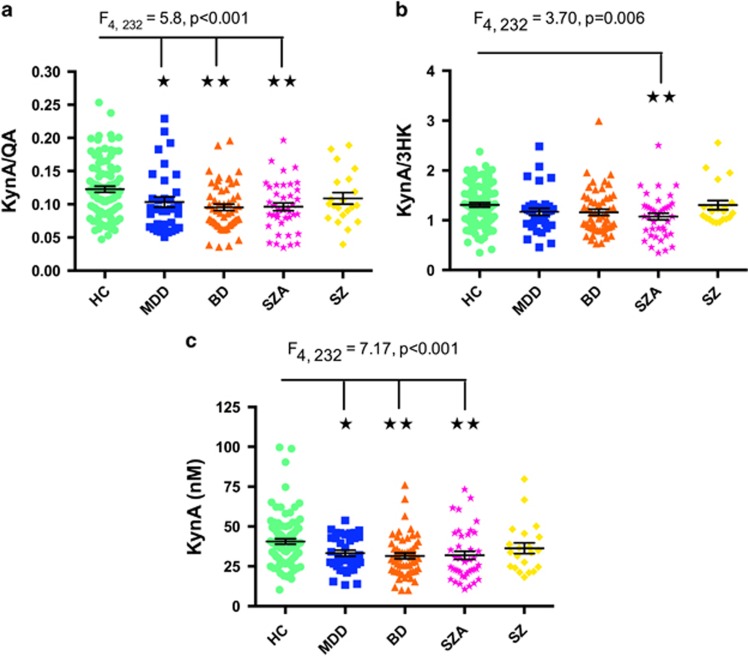
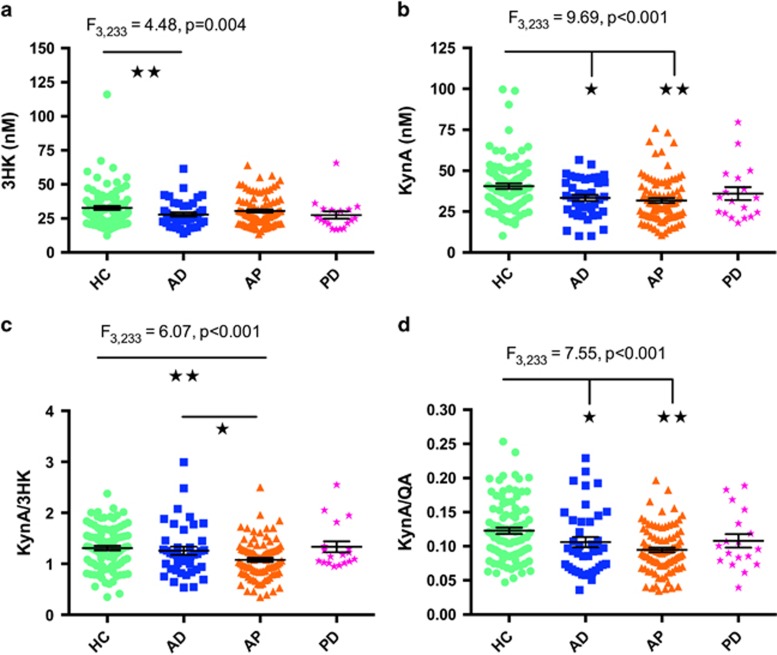
A subgroup of individuals with mood and psychotic disorders shows evidence of inflammation that leads to activation of the kynurenine pathway and the increased production of neuroactive kynurenine metabolites. Depression is hypothesized to be causally associated with an imbalance in the kynurenine pathway, with an increased metabolism down the 3-hydroxykynurenine (3HK) branch of the pathway leading to increased levels of the neurotoxic metabolite, quinolinic acid (QA), which is a putative N-methyl-d-aspartate (NMDA) receptor agonist. In contrast, schizophrenia and psychosis are hypothesized to arise from increased metabolism of the NMDA receptor antagonist, kynurenic acid (KynA), leading to hypofunction of GABAergic interneurons, the disinhibition of pyramidal neurons and striatal hyperdopaminergia. Here we present results that challenge the model of excess KynA production in affective psychosis. After rigorous control of potential confounders and multiple testing we find significant reductions in serum KynA and/or KynA/QA in acutely ill inpatients with major depressive disorder (N=35), bipolar disorder (N=53) and schizoaffective disorder (N=40) versus healthy controls (N=92). No significant difference was found between acutely ill inpatients with schizophrenia (n=21) and healthy controls. Further, a post hoc comparison of patients divided into the categories of non-psychotic affective disorder, affective psychosis and psychotic disorder (non-affective) showed that the greatest decrease in KynA was in the affective psychosis group relative to the other diagnostic groups. Our results are consistent with reports of elevations in proinflammatory cytokines in psychosis, and preclinical work showing that inflammation upregulates the enzyme, kynurenine mono-oxygenase (KMO), which converts kynurenine into 3-hydroxykynurenine and quinolinic acid.
患有情绪和精神障碍的一部分个体表现出炎症迹象,这种炎症会导致犬尿氨酸途径的激活以及神经活性犬尿氨酸代谢产物的生成增加。据推测,抑郁症与犬尿氨酸途径的失衡存在因果关系,该途径中沿3-羟基犬尿氨酸(3HK)分支的代谢增加会导致神经毒性代谢产物喹啉酸(QA)水平升高,QA是一种假定的N-甲基-D-天冬氨酸(NMDA)受体激动剂。相比之下,据推测精神分裂症和精神病是由NMDA受体拮抗剂犬尿喹啉酸(KynA)的代谢增加引起的,这会导致GABA能中间神经元功能减退、锥体神经元去抑制和纹状体多巴胺能亢进。在此,我们展示的结果对情感性精神病中KynA产生过多的模型提出了挑战。在对潜在混杂因素和多重检验进行严格控制后,我们发现与健康对照者(N = 92)相比,重度抑郁症(N = 35)、双相情感障碍(N = 53)和分裂情感性障碍(N = 40)的急性病住院患者血清KynA和/或KynA/QA显著降低。精神分裂症急性病住院患者(n = 21)与健康对照者之间未发现显著差异。此外,对分为非精神病性情感障碍、情感性精神病和精神病性障碍(非情感性)类别的患者进行的事后比较显示,相对于其他诊断组,情感性精神病组中KynA的下降幅度最大。我们的结果与精神病中促炎细胞因子升高的报道以及临床前研究结果一致,临床前研究表明炎症会上调将犬尿氨酸转化为3-羟基犬尿氨酸和喹啉酸的犬尿氨酸单加氧酶(KMO)。