Arriola Carmen S, Vasconez Nancy, Thompson Mark G, Olsen Sonja J, Moen Ann C, Bresee Joseph, Ropero Alba María
Epidemic Intelligence Service Program, Centers for Disease Control and Prevention, Atlanta, GA, USA; Influenza Division, Centers for Disease Control and Prevention, Atlanta, GA, USA.
Pan American Health Organization, Managua, Nicaragua.
Vaccine. 2017 May 25;35(23):3056-3063. doi: 10.1016/j.vaccine.2017.04.045. Epub 2017 Apr 29.
Studies have shown that influenza vaccination during pregnancy reduces the risk of influenza disease in pregnant women and their offspring. Some have proposed that maternal vaccination may also have beneficial effects on birth outcomes. In 2014, we conducted an observational study to test this hypothesis using data from two large hospitals in Managua, Nicaragua.
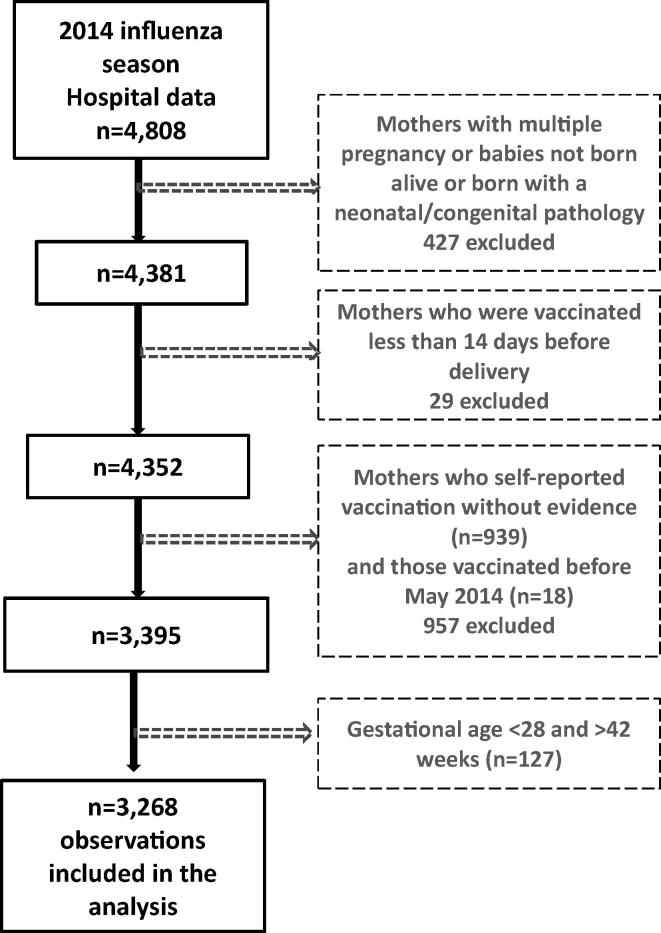
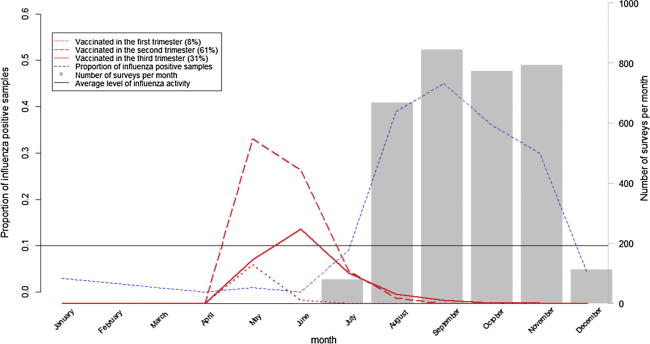
We conducted a retrospective cohort study to evaluate associations between influenza vaccination and birth outcomes. We carried out interviews and reviewed medical records post-partum to collect data on demographics, influenza vaccination during pregnancy, birth outcomes and other risk factors associated with adverse neonatal outcomes. We used influenza surveillance data to adjust for timing of influenza circulation. We assessed self-reports of influenza vaccination status by further reviewing medical records of those who self-reported but did not have readily available evidence of vaccination status. We performed multiple logistic regression (MLR) and propensity score matching (PSM).
A total of 3268 women were included in the final analysis. Of these, 55% had received influenza vaccination in 2014. Overall, we did not observe statistically significant associations between influenza vaccination and birth outcomes after adjusting for risk factors, with either MLR or PSM. With PSM, after adjusting for risk factors, we observed protective associations between influenza vaccination in the second and third trimester and preterm birth (aOR: 0.87; 95% confidence interval (CI): 0.75-0.99 and aOR: 0.66; 95% CI: 0.45-0.96, respectively) and between influenza vaccination in the second trimester and low birth weight (aOR: 0.80; 95% CI: 0.64-0.97).
We found evidence to support an association between influenza vaccination and birth outcomes by trimester of receipt with data from an urban population in Nicaragua. The study had significant selection and recall biases. Prospective studies are needed to minimize these biases.
研究表明,孕期接种流感疫苗可降低孕妇及其后代患流感疾病的风险。一些人提出,母体接种疫苗可能对分娩结局也有有益影响。2014年,我们利用尼加拉瓜马那瓜两家大型医院的数据进行了一项观察性研究,以检验这一假设。
我们进行了一项回顾性队列研究,以评估流感疫苗接种与分娩结局之间的关联。我们进行了访谈,并在产后查阅了医疗记录,以收集有关人口统计学、孕期流感疫苗接种、分娩结局以及与不良新生儿结局相关的其他风险因素的数据。我们使用流感监测数据来调整流感流行的时间。对于那些自我报告但没有现成疫苗接种状态证据的人,我们通过进一步查阅其医疗记录来评估流感疫苗接种状态的自我报告。我们进行了多因素逻辑回归(MLR)和倾向得分匹配(PSM)。
最终分析共纳入3268名女性。其中,55%在2014年接种了流感疫苗。总体而言,在调整风险因素后,无论是采用MLR还是PSM,我们均未观察到流感疫苗接种与分娩结局之间存在统计学显著关联。采用PSM时,在调整风险因素后,我们观察到孕中期和孕晚期接种流感疫苗与早产之间存在保护性关联(调整后比值比[aOR]:分别为0.87;95%置信区间[CI]:0.75 - 0.99和aOR:0.66;95%CI:0.45 - 0.96),以及孕中期接种流感疫苗与低出生体重之间存在保护性关联(aOR:0.80;95%CI:0.64 - 0.97)。
我们发现有证据支持在尼加拉瓜城市人群中,根据接种流感疫苗的孕周,流感疫苗接种与分娩结局之间存在关联。该研究存在显著的选择偏倚和回忆偏倚。需要进行前瞻性研究以尽量减少这些偏倚。