Laboratory of Food and Environmental Microbiology, Université catholique de Louvain, Louvain-la-Neuve, Belgium.
CEBEDEAU, Research and Expertise Center for Water, Allée de la découverte, 11 (B53), Quartier Polytech 1, B-4000, Liège, Belgium.
Sci Rep. 2017 May 3;7(1):1430. doi: 10.1038/s41598-017-01481-1.
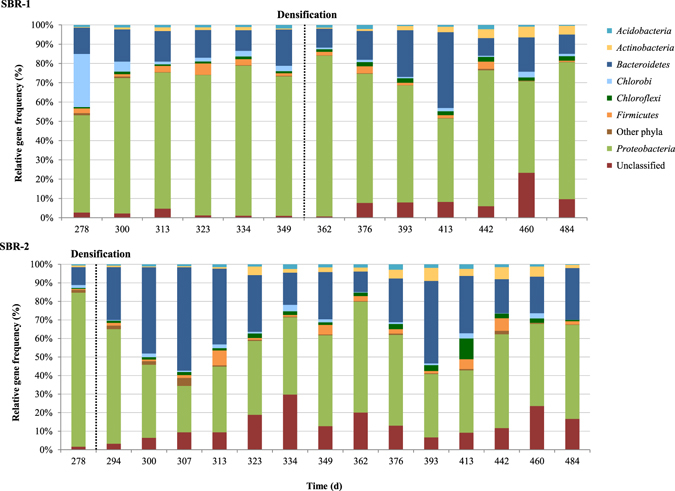
Filamentous bulking caused by Thiothrix species is responsible for sludge washout and loss of performance in dairy wastewater treatment plants. A long-term study was conducted over 1.5 years to test three different mitigation strategies in a full-scale plant composed of two parallel sequential batch reactors (SBR1 and 2). Strategies based on polyaluminium chloride addition and volatile fatty acids reduction were ineffective to permanently solve the problem. On the contrary, modification of the reactor cycle based on the implementation of a periodic starvation proved efficient to solve the biomass wash-out and drastically reduce the sludge volume index in both reactors. Bacterial diversity analysis using 16S amplicon sequencing and quantitative PCR indicated a reduction of Thiothrix abundance from 51.9 to 1.0% in SBR1 and from 71.8 to 0.6% in SBR2. Simultaneously, the abundance of the glycogen-accumulating bacterium Candidatus Competibacter increased in both reactors. Microscopy analysis confirmed the transition between a bulking sludge towards a granular-like sludge. This study confirms the applicability of a periodic starvation to (1) solve recurring Thiothrix bulking, (2) convert loose aggregates into dense and compact granular-like structures and (3) considerably reduce energy demand for aeration.
丝状菌膨胀是由硫丝菌属引起的,会导致乳制品废水处理厂的污泥流失和性能下降。本研究进行了为期 1.5 年的长期研究,以在由两个平行序批式反应器(SBR1 和 2)组成的全尺寸工厂中测试三种不同的缓解策略。基于聚合氯化铝添加和挥发性脂肪酸减少的策略无效,无法永久解决问题。相反,基于周期性饥饿实施的反应器周期修改被证明可以有效地解决生物量流失问题,并在两个反应器中大大降低污泥体积指数。使用 16S 扩增子测序和定量 PCR 的细菌多样性分析表明,SBR1 中的硫丝菌丰度从 51.9%降低到 1.0%,SBR2 中的硫丝菌丰度从 71.8%降低到 0.6%。同时,两个反应器中糖原积累菌“ Competibacter 菌”的丰度增加。显微镜分析证实了从膨胀污泥到颗粒状污泥的转变。本研究证实了周期性饥饿策略的适用性,可用于(1)解决反复出现的硫丝菌膨胀问题,(2)将松散的聚集体转化为致密和紧凑的颗粒状结构,以及(3)大大降低曝气的能源需求。