Warszawski Josiane, Avettand-Fenoel Véronique, Rouzioux Christine, Scott-Algara Daniel, Montange Thomas, Didier Céline, Le Chenadec Jérôme, Viard Jean-Paul, Dollfus Catherine, Blanche Stéphane, Buseyne Florence
Centre de recherche en Epidemiologie er Santé des Populations (CESP) Institut National de la Santé et de la Recherche Médicale (INSERM) U1018, Le Kremlin-Bicêtre, France.
Université Paris-Sud, Le Kremlin-Bicêtre, France.
Open Forum Infect Dis. 2016 Dec 7;4(1):ofw239. doi: 10.1093/ofid/ofw239. eCollection 2017 Winter.
Gag-specific T lymphocytes play a key role in the control of human immunodeficiency virus (HIV) replication. Their restoration will be important for future reservoir targeting strategies. In this study, we aimed to identify immune correlates of Gag-specific CD8 T-cell proliferation in youths with perinatally acquired HIV-1 infection.
The ANRS-EP38-IMMIP study included youths of 15 to 24 years of age. Fifty-three were taking combination anti-retroviral therapy and aviremic at the time of the study and had undergone valid 5-6-carboxyfluorescein diacetate succimidyl ester-based flow cytometry T-cell proliferation assays. Plasma analytes were quantified by enzyme-linked immunosorbent assay or multiplex assays. Peripheral blood cells were phenotyped by flow cytometry. Logistic regression was used to study the association between Gag-specific T-cell proliferation and immune markers.
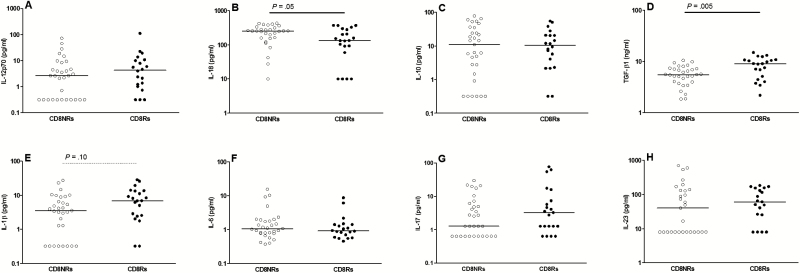
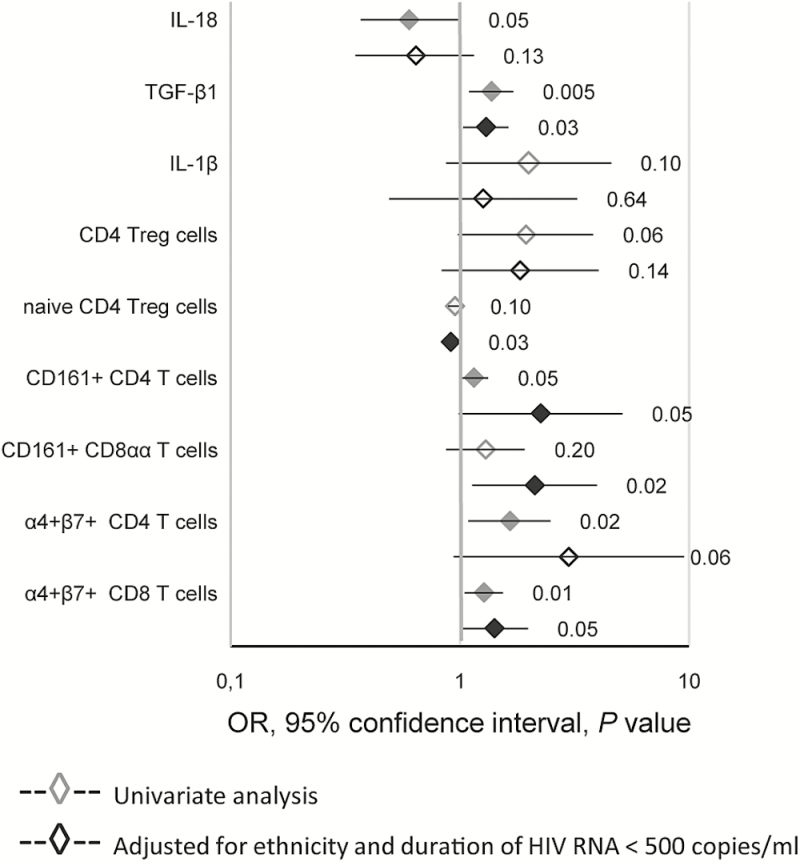
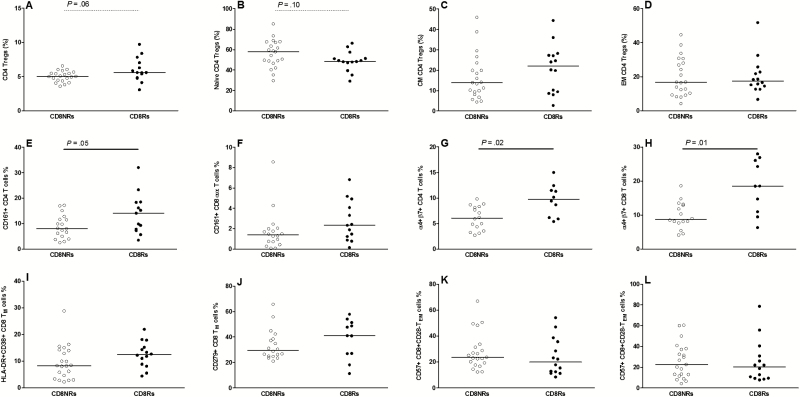
Patients with Gag-specific CD8 T-cell proliferation had higher levels of plasma transforming growth factor (TGF)-β1, a lower proportion of naive cells among regulatory T cells (Tregs), and higher percentages of CD4 and CD8 T cells expressing the αβ integrin or CD161 molecule than those without a Gag-specific response. These associations were significant based on analyses including potential confounders.
Preserved Gag-specific CD8 T-cell proliferation was associated with higher TGF-β1 levels and increased percentages of T cells with a gut-homing phenotype at least 15 years after HIV infection during the perinatal period.
针对gag的T淋巴细胞在控制人类免疫缺陷病毒(HIV)复制中起关键作用。它们的恢复对于未来针对病毒储存库的策略至关重要。在本研究中,我们旨在确定围生期感染HIV-1的青年中gag特异性CD8 T细胞增殖的免疫相关因素。
ANRS-EP38-IMMIP研究纳入了15至24岁的青年。53名参与者在研究时正在接受抗逆转录病毒联合治疗且病毒血症阴性,并接受了基于5-6-羧基荧光素二乙酸琥珀酰亚胺酯的有效流式细胞术T细胞增殖测定。通过酶联免疫吸附测定或多重测定对血浆分析物进行定量。通过流式细胞术对外周血细胞进行表型分析。使用逻辑回归研究gag特异性T细胞增殖与免疫标志物之间的关联。
与没有gag特异性反应的患者相比,具有gag特异性CD8 T细胞增殖的患者血浆转化生长因子(TGF)-β1水平更高,调节性T细胞(Tregs)中幼稚细胞的比例更低,表达αβ整合素或CD161分子的CD4和CD8 T细胞百分比更高。基于包括潜在混杂因素的分析,这些关联具有统计学意义。
在围生期感染HIV至少15年后,保留的gag特异性CD8 T细胞增殖与更高的TGF-β1水平和具有肠道归巢表型的T细胞百分比增加相关。