de Wit Meike, Carvalho Beatriz, Delis-van Diemen Pien M, van Alphen Carolien, Beliën Jeroen A M, Meijer Gerrit A, Fijneman Remond J A
Department of Pathology, Netherlands Cancer Institute, Amsterdam, the Netherlands.
Department of Pathology, VU University Medical Center, Amsterdam, the Netherlands.
PLoS One. 2017 May 8;12(5):e0174768. doi: 10.1371/journal.pone.0174768. eCollection 2017.
One prominent event associated with colorectal adenoma-to-carcinoma progression is genomic instability. Approximately 85% of colorectal cancer cases exhibit chromosomal instability characterized by accumulation of chromosome copy number aberrations (CNAs). Adenomas with gain of chromosome 8q, 13q, and/or 20q are at high risk of progression to cancer. Tumor progression is also associated with expansion of the extracellular matrix (ECM) and the activation of non-malignant cells within the tumor stroma. The glycoproteins versican and lumican are overexpressed at the mRNA level in colon carcinomas compared to adenomas, and are associated with the formation of tumor stroma.
The aim of this study was to characterize versican and lumican protein expression in tumor progression and investigate their association with CNAs commonly associated with adenoma-to-carcinoma progression.
Tissue microarrays were constructed with colon adenomas and carcinomas that were characterized for MSI-status and DNA copy number gains of chromosomes 8q, 13q and 20q. Sections were immunohistochemically stained for lumican and versican. Protein expression levels were evaluated using digitized slides, and scores were finally dichotomized into a positive or negative score per sample.
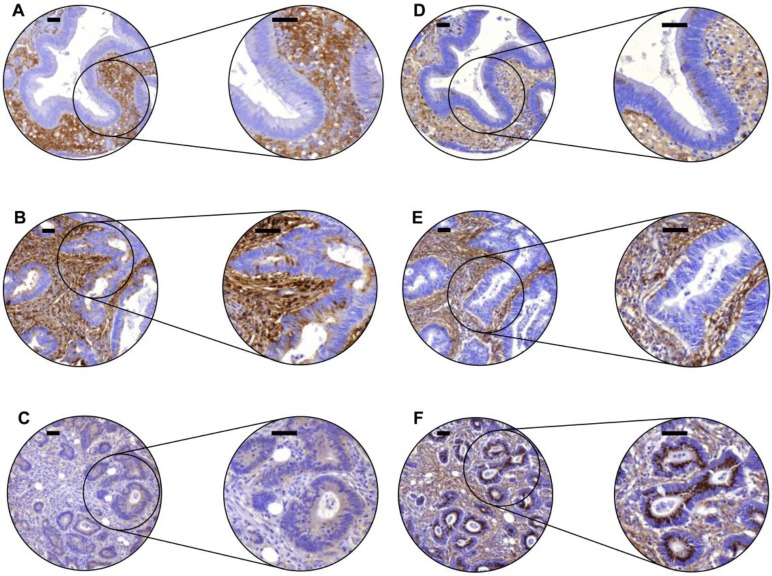
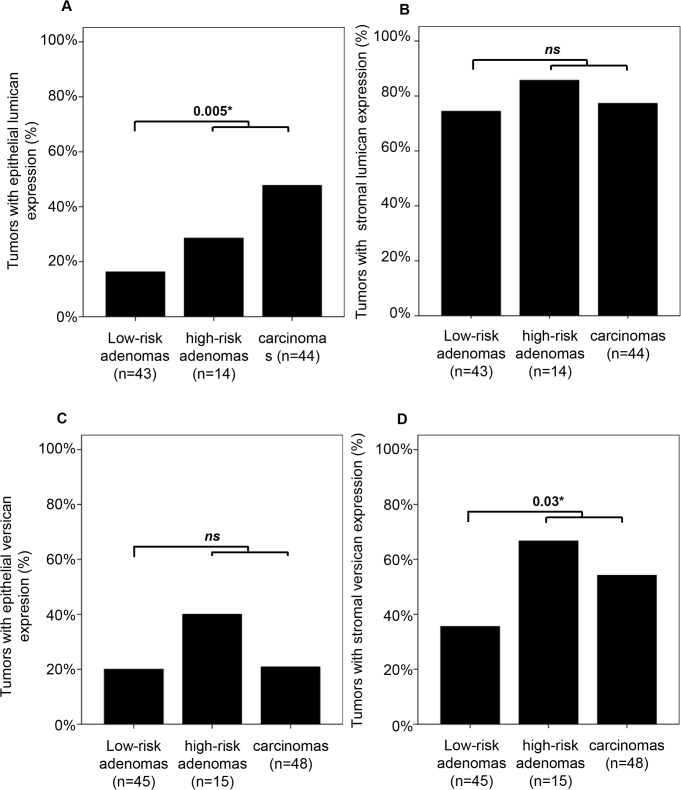
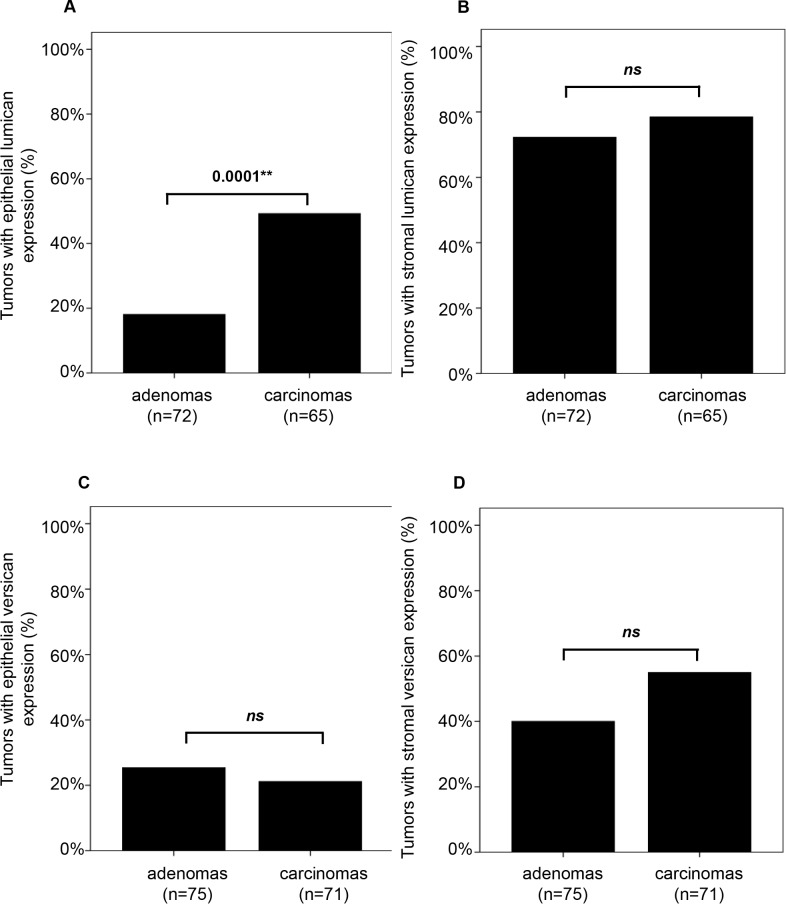
Lumican and versican expression were both observed in neoplastic cells and in the tumor stroma of colon adenomas and carcinomas. Lumican expression was more frequently present in epithelial cells of carcinomas than adenomas (49% versus 18%; P = 0.0001) and in high-risk adenomas and carcinomas combined compared to low-risk adenomas (43% versus 16%; P = 0.005). Versican staining in the tumor stroma was more often present in high-risk adenomas combined with carcinomas compared to low-risk adenomas (57% versus 36%; P = 0.03) and was associated with the presence of gain of 13q (71% versus 44%; P = 0.04).
Epithelial lumican and stromal versican protein expression are increased during colorectal adenoma-to-carcinoma progression.
与结直肠腺瘤向癌进展相关的一个突出事件是基因组不稳定。大约85%的结直肠癌病例表现出染色体不稳定,其特征是染色体拷贝数畸变(CNA)的积累。染色体8q、13q和/或20q获得的腺瘤进展为癌的风险很高。肿瘤进展还与细胞外基质(ECM)的扩张以及肿瘤基质中非恶性细胞的激活有关。与腺瘤相比,核心蛋白聚糖和光蛋白聚糖在结肠癌的mRNA水平上过度表达,并与肿瘤基质的形成有关。
本研究的目的是表征核心蛋白聚糖和光蛋白聚糖在肿瘤进展中的蛋白表达,并研究它们与通常与腺瘤向癌进展相关的CNA的关联。
构建组织微阵列,其中包含结肠腺瘤和癌,对其微卫星不稳定性(MSI)状态以及染色体8q、13q和20q的DNA拷贝数增加进行表征。切片进行光蛋白聚糖和核心蛋白聚糖的免疫组织化学染色。使用数字化切片评估蛋白表达水平,最后将每个样本的评分分为阳性或阴性。
在结肠腺瘤和癌的肿瘤细胞和肿瘤基质中均观察到光蛋白聚糖和核心蛋白聚糖的表达。与腺瘤相比,光蛋白聚糖表达更常见于癌的上皮细胞中(49%对18%;P = 0.0001),与低风险腺瘤相比,在高风险腺瘤和癌合并组中更常见(43%对16%;P = 0.005)。与低风险腺瘤相比,肿瘤基质中的核心蛋白聚糖染色在高风险腺瘤与癌合并组中更常见(57%对36%;P = 0.03),并且与13q获得的存在相关(71%对44%;P = 0.04)。
在结直肠腺瘤向癌进展过程中,上皮光蛋白聚糖和基质核心蛋白聚糖的蛋白表达增加。