University of Pittsburgh, Pittsburgh, Pennsylvania.
Center for Outcomes Research and Evaluation, Carolinas Health Care System, Charlotte, North Carolina.
Arthritis Care Res (Hoboken). 2018 Mar;70(3):333-342. doi: 10.1002/acr.23278. Epub 2018 Feb 6.
To characterize skeletal muscle fat (SMF), intermuscular adipose tissue (IMAT), and subcutaneous adipose tissue (SAT) in individuals with rheumatoid arthritis (RA), and assess the associations between these fat depots and physical function and physical activity.
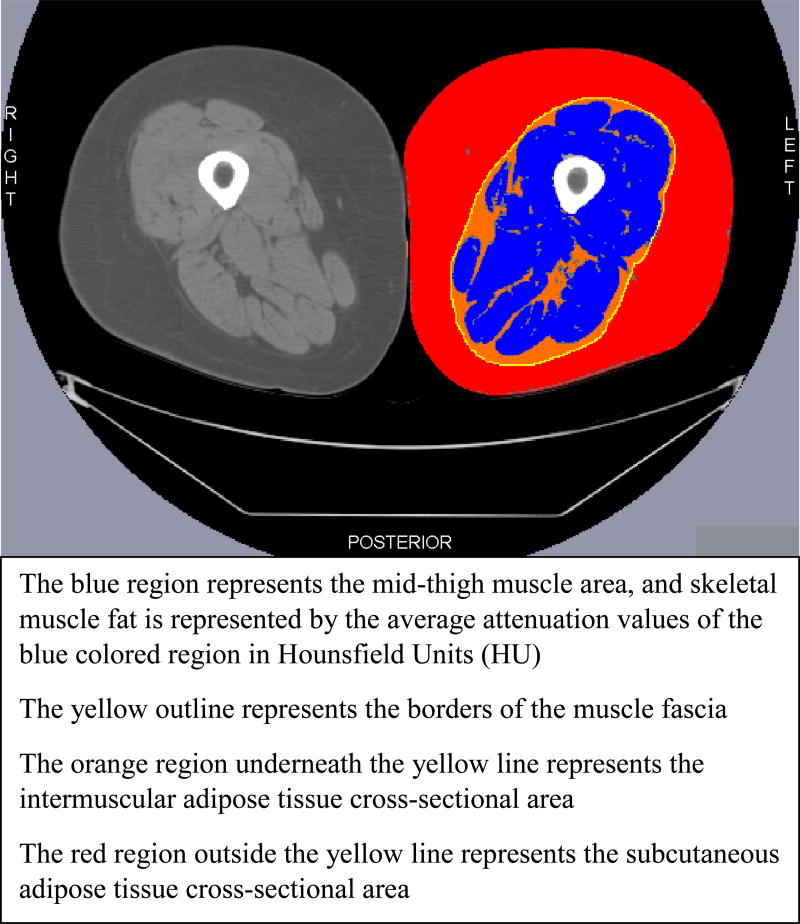
In a cross-sectional analysis from an RA cohort, SMF, IMAT, and SAT were measured using computed tomography imaging of the midthigh cross-sectional region. Physical function was measured using the Health Assessment Questionnaire (HAQ) and a battery of performance-based tests that included quadriceps muscle strength, gait speed, repeated chair-stands, stair ascent, and single-leg stance. Physical activity was assessed using an activity monitor. Associations between SMF, IMAT, and SAT and physical function and activity were assessed by multiple linear regression models adjusted for potential confounders such as age, sex, body mass index (BMI), muscle area, and muscle strength.
Sixty subjects with RA (82% female, mean ± SD age 59 ± 10 years, mean ± SD BMI 31.79 ± 7.16 kg/m ) were included. In the adjusted models, lower SMF was associated with greater gait speed, single-leg stance, quadriceps strength, and physical activity, and less disability (R Δ range 0.06-0.25; P < 0.05), whereas IMAT was not associated with physical function or physical activity and SAT was negatively associated with disability (HAQ) (R Δ = 0.13; P < 0.05) and weakly but positively associated with muscle strength (R Δ = 0.023; P < 0.05).
Fat infiltration within the muscle seems to independently contribute to low physical function and physical activity, contrary to IMAT or SAT accumulation. Longitudinal studies are necessary to confirm the impact of SMF on disability and health promotion in persons with RA.
描述类风湿关节炎(RA)患者的骨骼肌脂肪(SMF)、肌间脂肪组织(IMAT)和皮下脂肪组织(SAT)的特征,并评估这些脂肪组织与身体功能和身体活动之间的关系。
在 RA 队列的横断面分析中,使用大腿中部的 CT 成像测量 SMF、IMAT 和 SAT。身体功能通过健康评估问卷(HAQ)和一系列基于表现的测试进行测量,包括股四头肌力量、步态速度、重复坐站、爬楼梯和单腿站立。使用活动监测器评估身体活动。通过多元线性回归模型评估 SMF、IMAT 和 SAT 与身体功能和活动之间的关系,这些模型调整了年龄、性别、体重指数(BMI)、肌肉面积和肌肉力量等潜在混杂因素。
共纳入 60 名 RA 患者(82%为女性,平均年龄±标准差为 59±10 岁,平均 BMI±标准差为 31.79±7.16kg/m )。在调整后的模型中,较低的 SMF 与更快的步态速度、更长的单腿站立时间、更强的股四头肌力量和更高的身体活动水平以及更低的残疾程度相关(RΔ范围 0.06-0.25;P<0.05),而 IMAT 与身体功能或身体活动无关,SAT 与残疾(HAQ)呈负相关(RΔ=0.13;P<0.05),与肌肉力量呈弱但正相关(RΔ=0.023;P<0.05)。
与 IMAT 或 SAT 积累相反,肌肉内的脂肪浸润似乎独立地导致身体功能和身体活动水平降低。需要进行纵向研究来确认 SMF 对 RA 患者残疾和健康促进的影响。