Stančík Matej, Ságová Ivana, Kantorová Ema, Mokáň Marián
Clinic of Internal Medicine I., Jessenius Faculty of Medicine in Martin, Comenius University in Bratislava, Kollárova 2, Martin, 036 59, Slovak Republic.
Clinic of Neurology, Jessenius Faculty of Medicine in Martin, Comenius University in Bratislava, Kollárova 2, Martin, 036 59, Slovak Republic.
BMC Cardiovasc Disord. 2017 May 8;17(1):117. doi: 10.1186/s12872-017-0550-1.
The role of vaspin in the pathogenesis of stable coronary artery disease (SCAD) have been repeatedly addressed in clinical studies. However, from the point of view of clinical practice, the results of earlier studies are still inconclusive.
The data of 106 SCAD patients who received coronary angiography and 85 coronary artery disease-free controls were collected and analysed. The patients were divided into subgroups according to their pre-test probability (PTP) and according to the result of coronary angiography. Fasting vaspin concentrations were compared between subgroups of SCAD patients and between target group and controls. The effect of age and smoking on the result of coronary angiography was compared to the effect of vaspin using the binomial regression.
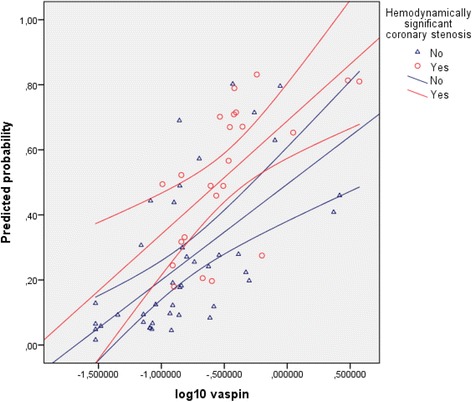
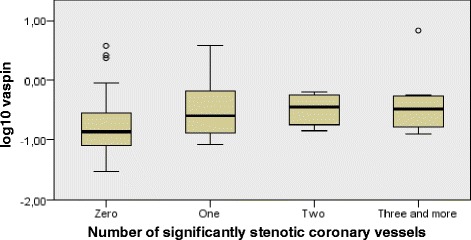
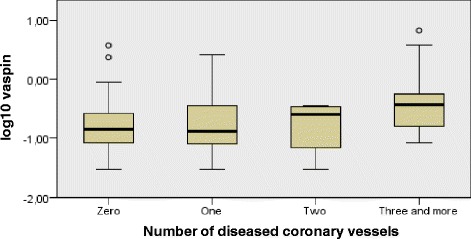
We did not find significant difference in vaspin level between target group and controls. Unless the pre-test probability was taken into account, we did not find vaspin difference in the target group, when dividing patients on the basis of presence/absence of significant coronary stenosis. In the subgroup of SCAD patients with PTP between 15% - 65%, those with significant coronary stenoses had higher mean vaspin concentration (0,579 ± 0,898 ng/ml) than patients without significant stenoses. (0,379 ± 0,732 ng/ml) (t = -2595; p = 0,012; d = 0,658; 1-β = 0,850). Age, smoking status and vaspin significantly contributed to the HSCS prediction in binomial regression model in patients with low PTP (OR: 1.1, 4.9, 8.7, respectively).
According to our results, vaspin cannot be used as an independent marker for the presence of CAD in general population. However, our results indicate that measuring vaspin in SCAD patients might be clinically useful in patients with PTP below 66%.
临床研究中已多次探讨内脏脂肪素在稳定型冠状动脉疾病(SCAD)发病机制中的作用。然而,从临床实践的角度来看,早期研究结果仍无定论。
收集并分析了106例接受冠状动脉造影的SCAD患者和85例无冠状动脉疾病的对照者的数据。根据患者的预检概率(PTP)和冠状动脉造影结果将患者分为亚组。比较SCAD患者亚组之间以及目标组与对照组之间的空腹内脏脂肪素浓度。使用二项式回归比较年龄和吸烟对冠状动脉造影结果的影响与内脏脂肪素的影响。
我们未发现目标组与对照组之间内脏脂肪素水平存在显著差异。除非考虑预检概率,否则在根据是否存在显著冠状动脉狭窄对患者进行分组时,我们未发现目标组内脏脂肪素存在差异。在PTP介于15% - 65%的SCAD患者亚组中,有显著冠状动脉狭窄的患者平均内脏脂肪素浓度(0.579±0.898 ng/ml)高于无显著狭窄的患者(0.379±0.732 ng/ml)(t = -2595;p = 0.012;d = 0.658;1-β = 0.850)。在低PTP患者的二项式回归模型中,年龄、吸烟状况和内脏脂肪素对高危冠状动脉狭窄(HSCS)预测有显著贡献(OR分别为1.1、4.9、8.7)。
根据我们的结果,内脏脂肪素不能用作一般人群中CAD存在的独立标志物。然而,我们的结果表明,在PTP低于66%的SCAD患者中测量内脏脂肪素可能具有临床意义。