Sakai Hiroyasu, Suto Wataru, Kai Yuki, Chiba Yoshihiko
Department of Analytical Pathophysiology, Hoshi University.
Department of Physiology and Molecular Sciences, Hoshi University.
J Smooth Muscle Res. 2017;53(0):37-47. doi: 10.1540/jsmr.53.37.
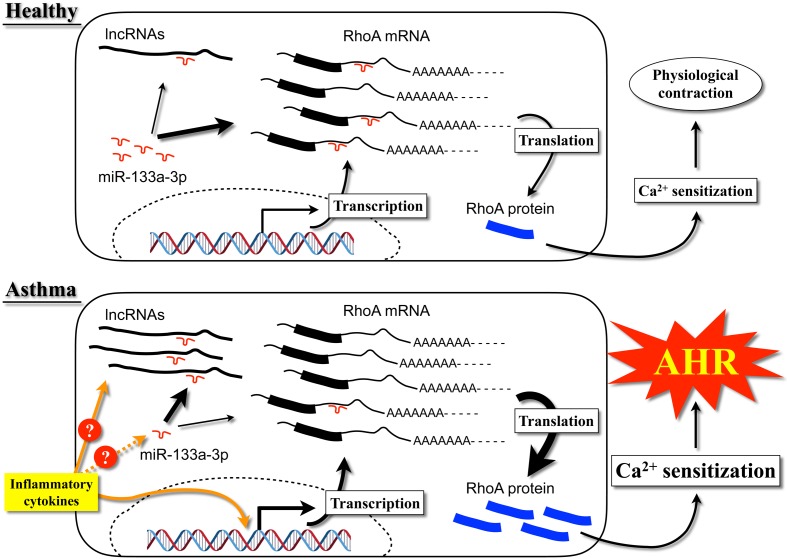
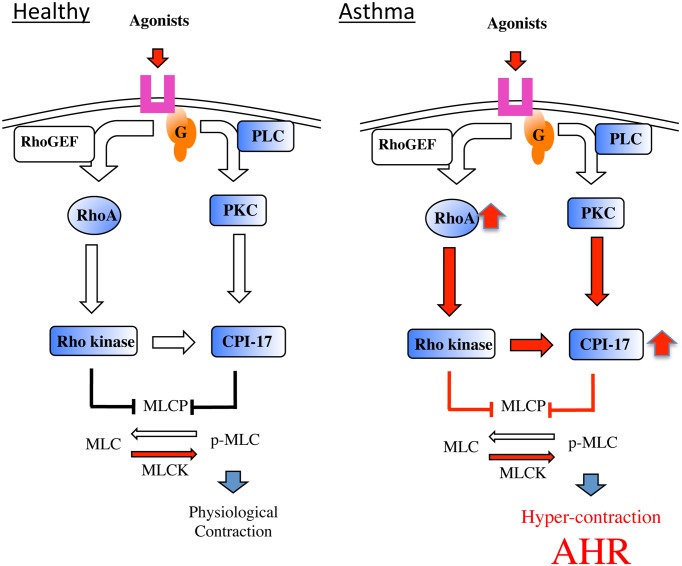
Airway hyperresponsiveness (AHR) and inflammation are key pathophysiological features of asthma. Enhanced contraction of bronchial smooth muscle (BSM) is one of the causes of the AHR. It is thus important for development of asthma therapy to understand the change in the contractile signaling of airway smooth muscle cells associated with the AHR. In addition to the Ca-mediated phosphorylation of myosin light chain (MLC), contractile agonists also enhance MLC phosphorylation level, Ca-independently, by inactivating MLC phosphatase (MLCP), called Ca sensitization of contraction, in smooth muscle cells including airways. To date, involvements of RhoA/ROCKs and PKC/Ppp1r14a (also called as CPI-17) pathways in the Ca sensitization have been identified. Our previous studies revealed that the agonist-induced Ca sensitization of contraction is markedly augmented in BSMs of animal models of allergen-induced AHR. In BSMs of these animal models, the expression of RhoA and CPI-17 proteins were significantly increased, indicating that both the Ca sensitizing pathways are augmented. Interestingly, incubation of BSM cells with asthma-associated cytokines, such as interleukin-13 (IL-13), IL-17, and tumor necrosis factor-α (TNF-α), caused up-regulations of RhoA and CPI-17 in BSM cells of naive animals and cultured human BSM cells. In addition to the transcription factors such as STAT6 and NF-κB activated by these inflammatory cytokines, an involvement of down-regulation of miR-133a, a microRNA that negatively regulates RhoA translation, has also been suggested in the IL-13- and IL-17-induced up-regulation of RhoA. Thus, the Ca sensitizing pathways and the cytokine-mediated signaling including microRNAs in BSMs might be potential targets for treatment of allergic asthma, especially the AHR.
气道高反应性(AHR)和炎症是哮喘的关键病理生理特征。支气管平滑肌(BSM)收缩增强是AHR的原因之一。因此,了解与AHR相关的气道平滑肌细胞收缩信号变化对于哮喘治疗的发展很重要。除了钙介导的肌球蛋白轻链(MLC)磷酸化外,收缩激动剂还通过使MLC磷酸酶(MLCP)失活,在包括气道在内的平滑肌细胞中独立于钙增强MLC磷酸化水平,称为收缩的钙敏化。迄今为止,已确定RhoA/ROCKs和PKC/Ppp1r14a(也称为CPI-17)途径参与钙敏化。我们之前的研究表明,在变应原诱导的AHR动物模型的BSM中,激动剂诱导的收缩钙敏化明显增强。在这些动物模型的BSM中,RhoA和CPI-17蛋白的表达显著增加,表明这两种钙敏化途径均增强。有趣的是,用哮喘相关细胞因子如白细胞介素-13(IL-13)、IL-17和肿瘤坏死因子-α(TNF-α)孵育BSM细胞,可导致未致敏动物的BSM细胞和培养的人BSM细胞中RhoA和CPI-17上调。除了这些炎症细胞因子激活的转录因子如STAT6和NF-κB外,在IL-13和IL-17诱导的RhoA上调中,还提示了负调节RhoA翻译的微小RNA miR-133a下调的参与。因此,BSM中的钙敏化途径和包括微小RNA在内的细胞因子介导的信号传导可能是过敏性哮喘尤其是AHR治疗的潜在靶点。